Showing posts with label data. Show all posts

Thursday, March 8, 2018

Here's Why it Might Be Time to Take Natural Gas Seriously

Last week we identified a prime chart pattern in natural gas that matched our technical analysis and cycle price prediction system. This type of setup is our favorite as it leads to quick juicy profits and the last setup we had like this in natural gas I think we pocketed 74% return in 12 days using the ETF UGAZ.

Charts speak for themselves so let me show you what myself and our subscribers are into right now. We are long UGAZ and today (Wed March 7th) we locked in 9.1% profit with UGAZ on half the position. Our stops are now at break even, and we are looking for the final blast off stage, which may or may not happen, but we are ready!


We share this analysis so that you have some real predictive data to work with through March. We are not always 100% accurate in our modeling systems predictions or accuracy, but you can spend a little time reading our research reports through most of this year to see how we’ve been calling these market moves since well before the start of 2018. Visit the Technical Traders here to see what we offer our subscribers and learn how we can assist you in finding great trading opportunities. In fact, pay attention to the market moves as they play out over the next few weeks to see how accurate our research really is. We’re confident you will quickly understand that we provide the best predictive analysis you can find and are proud to offer our clients this type of research.

Get ready for this move and don’t miss the future ones. We’ll keep our members aware of all of these moves going forward so they can take advantage of these opportunities to generate profits.

Hope to see you in our member’s area, as well, where we can share more data and research to help you profit from these moves – visit The Technical Traders Right Here to learn more.


Stock & ETF Trading Signals

Thursday, July 20, 2017

This Weeks Free Webinar: How To Align with the Institutions Driving the Market Vehicle

It's time to introduce the newest member of our team, Grant Larsen of Financial Investing Secrets. Grant brings years of experience from the technology world to the table and has developed an easy to understand, reliable system that the beginning trader or seasoned professional trader can put to work in the markets right away.

It all get's started this Saturday, July 22nd at 12:00pm pacific time, that's 3:00pm eastern standard time.

What You'll Learn in this Free Webinar

    Secret #1....How To Know Where and WHEN to Enter and Exit Using Real Time Market Data

    Secret #2....How To Re-Master Your Trading Confidence Using The Market Engine

    Secret #3....How To Align with the Institutions Driving the Market Vehicle

This is a FREE Class, Absolutely no costs and no obligation. But seats are limited....Get Yours Now

Register Here Now

See you Saturday!
The Stock Market Club


Thursday, December 10, 2015

How Big the Gig Economy Really Is

By John Mauldin

There is growing awareness of what is being called the “gig economy.” It’s not just Uber driving or Airbnb. There are literally scores of websites and apps where you can advertise your services, get temporary or part time work, and do so from anywhere you happen to be.

Some “gigs” actually pay pretty good money, but they are for people with specialized skills who prefer to live a somewhat different lifestyle than the typical 9 to 5’er does. My hedge fund friend Murat Köprülü has been busy researching and documenting this phenomenon and regularly regales me with what he finds.

He goes and spends evenings and weekends with young gig workers, trying to figure out what it is they really do and how they make ends meet in New York City. It turns out they need a lot less to support their lifestyle than you might imagine, and they prefer working intermittent gigs, being able to do what they want, and having no boss.

A close look at the data indicates that the gig economy is indeed big and growing. But there is a great deal of debate among economists about how big it really is.

It’s Much Bigger Than the Employment Data Suggests

Gig workers don’t seem to show up clearly in the BLS employment data. Typically, we would expect those working in the gig economy to appear in the self employed category, but that category is actually drifting downward in numbers—relatively speaking.

But Harvard economist Larry Katz and Princeton’s Alan Krueger, who are working on research to document the rise of the gig economy in America, says that our current measures ignore the bulk of the gig economy.

 From a story at fusion.net:
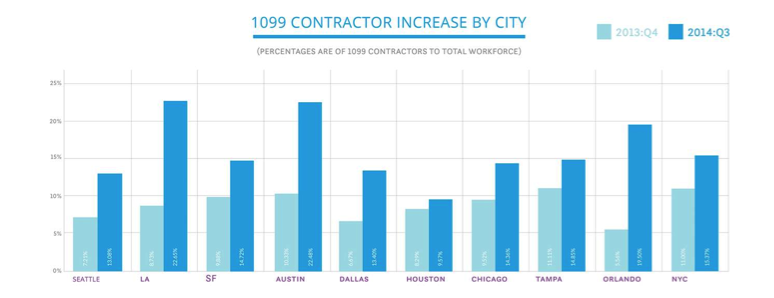
Katz said two pieces of evidence suggest current measures of self-employment and multiple-job holding are “missing a large part of the gig economy.” The first is that the share of the employed (and of the adult population) filing a 1099 form, the tax document “gig economy” workers must file, increased in the 2000s, even as standard measures of self-employment declined in the 2000s. Other groups have confirmed this: Zen Payroll, a site that tracks the sharing economy, found increases in the share of 1099 workers across many major U.S. metros.

Mauldin-Economics-Gig-Economy
Source: Zen Payroll via Small Business Labs

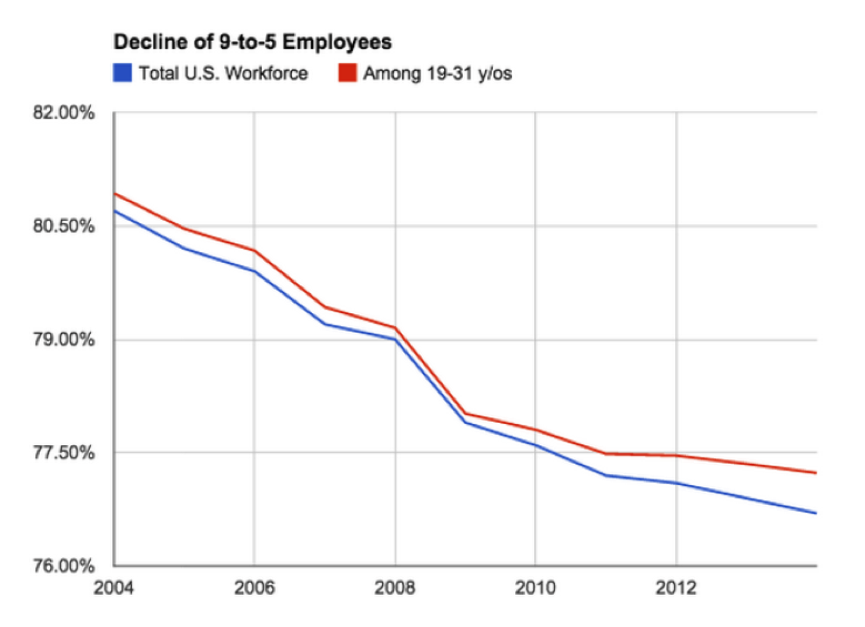
And data from research group EconomicModeling.com show the share of traditional, 9-to-5 workers in the labor force has declined…..

Mauldin-Economics-Gig-Economy
Source: Fusion, data via EconomicModeling.com

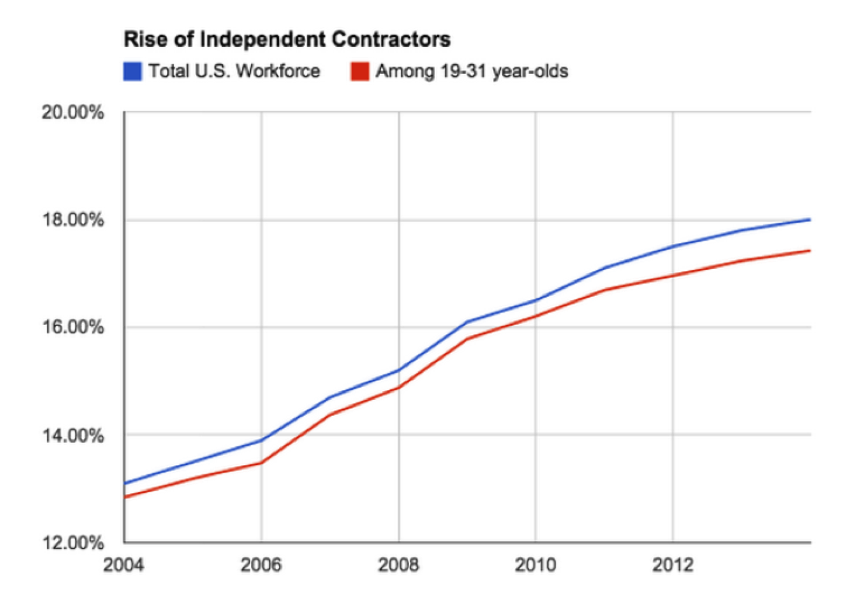
… while those who categorize themselves as “miscellaneous proprietors” is climbing.

Mauldin-Economics-Gig-Economy
Source: Fusion, data via EconomicModeling.com

A recent survey found 60 percent of such workers get at least 25 percent of their income from gig economy work.

The problem with the BLS estimates is that they overlook a sizable chunk of the true gig economy.
And this report absolutely squares with what my friend Murat’s research is showing: that gig economy is not shrinking. On the contrary, it’s on the rise, and a quite rapid rise.

Subscribe to Thoughts from the Frontline

Follow Mauldin as he uncovers the truth behind, and beyond, the financial headlines in his free publication, Thoughts from the Frontline. The publication explores developments overlooked by mainstream news to help you understand what’s happening in the economy and navigate the markets with confidence.

The article was excerpted from John F. Mauldin’s Thoughts from the Frontline. Follow John Mauldin on Twitter. The article How Big the Gig Economy Really Is was originally published at mauldineconomics.com.


Get our latest FREE eBook "Understanding Options"....Just Click Here!

Wednesday, January 21, 2015

The Single Most Important Economic Statistic that the White House Never Talks About

By Tony Sagami


For the first time in 35 years, American business deaths now outnumber business births. —Jim Clifton, CEO, Gallup Polls

I’ve been self employed since 1998, and let me tell you, the life of a business owner isn’t easy. It’s filled with long hours, a relentless amount of paperwork, and uncertainty of where your next paycheck will come from.

If you’ve ever owned a business, you know exactly what I’m talking about.

Difficult or not, self employment is extremely rewarding, and I wouldn’t have it any other way. Nor would the other 6 million business owners in the United States. Of those 6 million businesses, the vast majority are small “Mom and Pop” businesses. Here are more statistics on businesses in the U.S. :
  • 3.8 million have four or fewer employees. That’s me!
     
  • 1 million with 5-9 employees;
     
  • 600,000 with 10-19 employees;
     
  • 500,000 with 20-99 employees;
     
  • 90,000 with 100-499 employees;
     
  • 18,000 with 500 employees or more; and
     
  • 1,000 companies with 10,000 employees or more.
Those small businesses are the backbone of our economy and responsible for employing roughly half of all Americans. Moreover, while estimates vary, small business create roughly two thirds of all new jobs in our country.

Get our latest FREE eBook "Understanding Options"....Just Click Here!

For those reasons, the health (or lack thereof) of small business is the single most important long term indicator of America’s economic health. Warning: new data suggest that small businesses are in deep trouble.
For the first time in 35 years, the number of business deaths outnumbers the number of business births.


The US Census Bureau reported that the birth and death rates of American businesses crossed for the first time ever! 400,000 new businesses were born last year, but 470,000 died.

Yup, business deaths now outnumber business births.


Pay attention, because this part is important.

The problem isn’t so much that businesses are failing, but that American entrepreneurs are simply not starting as many new businesses as they used to. We like to think of America has the hotbed of capitalism, but the US actually is number 12 among developed nations for new business startups.

Number 12!

You know what countries are ahead of us? Hungary, Denmark, Finland, New Zealand, Sweden, Israel, and even financially troubled Italy are creating new businesses faster than us!


The reasons for the capitalist pessimism are many, but my guess is that the root of the problem comes down to three issues: (1) difficulty of accessing capital (loans); (2) excessive and burdensome government regulations; and (3) an overall malaise about our economic future.

Business owners are permanently smitten with an entrepreneurial bug, and the only thing that prevents them from seeking business success is the expectation that they’ll lose money.

Sadly, the lack of new business start ups is confirmation that American’s free enterprise system is broken.

"There is nobody in this country who got rich on their own. Nobody. You built a factory out there—good for you. But I want to be clear. You moved your goods to market on roads the rest of us paid for. You hired workers the rest of us paid to educate. You were safe in your factory because of police forces and fire forces that the rest of us paid for. You didn't have to worry that marauding bands would come and seize everything at your factory... Now look. You built a factory and it turned into something terrific or a great idea—God bless! Keep a hunk of it. But part of the underlying social contract is you take a hunk of that and pay forward for the next kid who comes along."

Elizabeth Warren

“When small and medium-sized businesses are dying faster than they’re being born, so is free enterprise. And when free enterprise dies, America dies with it,” warns Gallup CEO Jim Clifton.

I don’t believe for a second that America’s free-enterprise system is permanently broken. The pendulum will eventually swing the other way, but our economy will not enjoy boom times until the birth/death trends are reversed.

That won’t happen next week or next month. It will take serious, fundamental changes in tax, regulatory, and judicial rules, and I sadly fear that it will take several years for that to happen. Until then, our economy is going to struggle and will pull our high flying stock market down with it. Are you prepared?

If you’re not familiar with inverse ETFs, you’re ignoring one of your best defenses against tough times. An inverse ETF is an exchange traded fund that’s designed to perform as the inverse of whatever index or benchmark it’s designed to track.

By providing performance opposite to their benchmark, inverse ETFs prosper when stock prices are falling. An inverse S&P 500 ETF, for example, seeks a daily percentage movement opposite that of the S&P. If the S&P 500 rises by 1%, the inverse ETF is designed to fall by 1%; and if the S&P falls by 1%, the inverse ETF should rise by 1%.

There are inverse ETFs for most major indices and even sectors and commodities (like oil and gold), as well as specialty ETFs for things like the VIX Volatility Index.

I’m not suggesting that you rush out and buy a bunch of inverse ETFs tomorrow morning. As always, timing is critical, so I recommend that you wait for my buy signals in my Rational Bear service.

But make no mistake, the birth/death ratio is signaling serious trouble ahead. Any investor who doesn’t prepare for it is going to get run over and flattened like a pancake.

Tony Sagami
Tony Sagami

30 year market expert Tony Sagami leads the Yield Shark and Rational Bear advisories at Mauldin Economics. To learn more about Yield Shark and how it helps you maximize dividend income, click here.

To learn more about Rational Bear and how you can use it to benefit from falling stocks and sectors, click here.


New Video: 6 Simple Criteria that Guarantee Trading Success.....Just Click Here!


Friday, October 24, 2014

Third Quarter Review from Hoisington Management

By John Mauldin


I featured the thinking of Dr. Lacy Hunt on the velocity of money and its relationship to developed-world overindebtedness and the potential for deflation in this week’s Thoughts from the Frontline, and I thought you’d like to peruse Lacy’s entire recent piece on the subject.

Lacy takes the US, Europe, and Japan one by one, examining the velocity of money (V) in each economy and bolstering the principle, first proposed by Irving Fisher in 1933, that V is critically influenced by the productivity of debt. Then, turning to the equation of exchange (M*V=Nominal GDP, where M is money supply), he demonstrates that we shouldn’t be the least bit surprised by sluggish global growth and had better be on the lookout for global deflation.

Hoisington Investment Management Company (www.Hoisingtonmgt.com) is a registered investment advisor specializing in fixed-income portfolios for large institutional clients. Located in Austin, Texas, the firm has over $5 billion under management and is the sub-adviser of the Wasatch-Hoisington US Treasury Fund (WHOSX).

I am writing this note in a car going to Athens, Texas, where I’ll join Kyle Bass and friends at his Barefoot Ranch for a huge macro fest. October is one of my favorite times of the year to be in Texas, and the ranch is a beautiful venue. I am sure I will have some challenging conversations.

Last night in Chicago I was picked up by Austyn Crites, who drove me downtown in rush-hour traffic, which gave us a lot of time to talk about his current passion, high balloons. I have been fascinated with them for some time, but there hasn’t been a lot of reliable information.

Basically, Google and Facebook are both planning to launch very large helium balloons full of radios and cameras and float them up to 60,000+ feet. The concept is working in several remote locations now. It’s a way to get full wireless internet coverage. With about 40,000 balloons you can blanket the earth. Literally. Full connectivity. Everywhere. Austyn wants to design a new type of balloon and be the manufacturer. It’s tricky as you need a VERY thin balloon envelope (that does not leak) the size of small house in order to get enough payload that high.

But he thinks the final cost of the balloons will fall dramatically and that you might be able eventually to pull off the operation for a billion or so a year (since balloons eventually come down and need to be replaced).
But if you are Google and you get the search revenue from connecting an additional five billion people?

Chump change. Same for Facebook. But what if Apple or Samsung want to make it so that their phones are afforded free or very cheap access? A consortium of consumer companies could easily see free wifi as a tool for branding. Current telecoms will have to get in the business to compete.

I kept coming back to the costs and tech issues. There are new things that will have to be invented, but nothing as complex as some of the problems that have already been overcome. They will be rolling out in parts of the world in a few years. Coming to a region near you in 5-10 years. Total game changers. While a hundred other game changers are coming down the tunnel.

Austyn's company’s challenge is to be the little guys who don't know they can't invent a new process that the big guys are working on as well. Can he pull it off? He has the passion and drive. I love meeting young people like him doing their part to change the world. They are everywhere, too. It's why I’m optimistic about the future of the human experiment, if just a tad bearish on governments. You can follow Austyn at his website.

Time to hit the send button, as we are getting close and I don't want to miss a minute. I will report back what I can. Have a great week.

Your dreaming of really, really cheap, ubiquitous connectivity everywhere analyst,
John Mauldin, Editor
Outside the Box

Stay Ahead of the Latest Tech News and Investing Trends...
Each day, you get the three tech news stories with the biggest potential impact.

Hoisington Investment Management – Quarterly Review and Outlook, Third Quarter 2014

Faltering Momentum

The U.S. economy continues to lose momentum despite the Federal Reserve’s use of conventional techniques and numerous experimental measures to spur growth. In the first half of the year, real GDP grew at only a 1.2% annual rate while real per capita GDP increased by a minimal 0.3% annual rate. Such increases are insufficient to raise the standard of living, which, as measured by real median household income, stands at the same level as it did seventeen years ago (Chart 1).


Over the latest five years ending June 30, 2014, real GDP expanded at a paltry 2.2% annual rate. In comparison, from 1791 through 1999, the growth in real GDP was 3.9% per annum. Similarly, real per capita GDP recorded a dismal 1.4% annual growth rate over the past five years, 26% less than the long-term growth rate. A large contributor to this remarkable downshift in economic growth was that in 1999 the combined public and private debt reached a critical range of 250%-275% of GDP. Econometric studies have shown that a country’s growth rate will lose about 25% of its “normal experience growth rate” when this occurs. Further, as debt relative to GDP moves above critical threshold levels, some researchers have found the negative consequences of debt on economic activity actually worsens at a greater rate, thus becoming non-linear. The post-1999 record is consistent with these findings as the U.S. debt-to-GDP levels swelled to a peak as high as 360%, well above the critical level noted in various economic studies.

In terms of growth, it looks as if the second half of 2014 will continue to follow this slow growth pattern. Although all of the data has not yet been reported, it appears that the year-over-year growth in real GDP for the just ended third quarter period is unlikely to exceed the 2.2% pace of the past five years. Economic vigor is absent, and the final quarter of the year looks to be weaker than the third quarter.

Poor domestic business conditions in the U.S. are echoed in Europe and Japan. The issue for Europe is whether the economy triple dips into recession or manages to merely stagnate. For Japan, the question is the degree of the erosion in economic activity. This is for an economy where nominal GDP has been unchanged for almost 22 years. U.S. growth is outpacing that of Europe and Japan primarily because those economies carry much higher debt-to-GDP ratios. Based on the latest available data, aggregate debt in the U.S. stands at 334%, compared with 460% in the 17 economies in the euro-currency zone and 655% in Japan.

Economic research has suggested that the more advanced the debt level, the worse the economic performance, and this theory is in fact validated by the real world data.

Falling World Wide Inflation


In this debt-constrained environment, it is not surprising that inflation is receding sharply in almost every major economy, including China. The drop in price pressures in the U.S. and Europe is significant, and the fall in Chinese inflation to 2%, from a peak of nearly 9% in 2008, is notable.

In the latest twelve months, the CPI in the euro currency zone rose a scant 0.3% (Chart 2), the lowest since 2009, while the core CPI increased by 0.7%, near the all time lows for the series. The yearly gain in the U.S. for both core and overall CPI was 1.7%. Since 1958 when the core CPI came into existence, it and the overall CPI have increased at an average annual rate of 3.8% and 3.9%, respectively, over 200 basis points greater than the current rates. Both the overall and core personal consumption expenditures U.S. price indices rose by 1.5% in the twelve months ending August of 2014. Both of these are near the all time lows for their respective series.


The risk of outright deflation in Europe with inflation at such low levels, and the danger of similar developments in the U.S., should not be minimized as inflation has fallen in almost every previous U.S. and European economic contraction. Lower inflation is, in fact, almost as much of a hallmark of recessions as is decreasing real GDP. From peak-to-trough the rate of CPI inflation fell by an average of slightly more than 300 basis points in and around the mild U.S. recessions of 1990-91 and 2000-01. Starting from a much lower point, the CPI in Europe at those same times dropped by an average of 150 basis points. Given that inflation is already so minimal in both the U.S. and Europe, even the mildest recession could put both economies in deflation.

Japan’s recent quantitative easing has helped devalue its currency by 44% versus the dollar, since the 2011 lows. This import- dependent country has therefore seen its costs rise dramatically. This, along with higher consumption taxes, has created a current year- over-year inflation rate of 3.3%. These higher prices are an enormous drag on economic growth as incomes fail to rise commensurately. Thus negative GDP growth will result in a continuing pattern of deflation. Japan’s CPI has been zero or negative on a year over year basis in 16 of the last 23 quarters.

Declining Money Velocity A Global Event


One factor that connects poor growth with the low inflation and low bond yields evident in the U.S., Europe and Japan is that the velocity of money (V) is falling in all three areas.

Functionally, many things influence V. The factors that could theoretically influence V in at least some minimal fashion are too numerous to count. A key variable, however, appears to be the productivity of debt. Money and debt are created simultaneously. If the debt produces a sustaining income stream to repay principal and interest, then V will rise since GDP will rise by more than the initial borrowing. If the debt is unproductive or counterproductive, meaning that a sustaining income stream is absent, or worse the debt subtracts from future income, then V will fall. Debt utilized for the purpose of consumption or paying of interest, or debt that is defaulted on will be either unproductive or counterproductive, leading to a decline in V.

The Nobel laureate Milton Friedman, as well as economist Irving Fisher, commented on the causal determinants of V. Friedman thought V was stable while Fisher believed it was variable. Presently, the evidence suggests that Fisher’s view has prevailed. Fisher would not be at all surprised by the current impact of excessive debt since he argued in his famous 1933 paper “The Debt-Deflation Theory of Great Depressions”, that falling money velocity is a symptom of extreme over indebtedness.

Tracking that theory, it is interesting to note that velocity is below historical norms in all three major economic areas with existing over indebtedness. The U.S. V is higher than European V, which in turn is higher than Japanese V. This pattern is entirely consistent since Japan is more highly indebted than Europe, which is more highly indebted than the U.S. Unfortunately, broad monetary conditions (M2 money growth and velocity) are deteriorating, with 2014 displaying conditions worse than at the end of last year. The poor trend in the velocity for all three areas indicates that monetary policy for these countries is not a factor in influencing economic activity in any meaningful way.

United States. The U.S. year-over-year M2 growth has remained at about 6%, an annual growth level that has been consistent since 2008 (Chart 3), and the velocity of money has trended downward by about 3%. In the first half of 2014, V declined at a rate of 3.6%, but it is still too early to tell if this represents a new V deceleration to the downside (Chart 4).


According to the equation of exchange (M*V=Nominal GDP), the expected growth of nominal GDP is constrained to no more than a 3% increase with velocity declining by 3% and money supply expanding by 6%. However, when assessing the type of debt currently being employed (unproductive, at best) the risks are for lower growth levels. 2014 has witnessed a resurgence of consumer auto and mortgage lending that was achieved by a lowering of credit standards. The percentage of subprime consumer auto loans (31%) returned to the peak levels reached prior to 2008. Such lending has historically turned counterproductive. If this were to occur again, velocity would accelerate to the downside, resulting in a sub 3% path for nominal GDP.

Europe. V has only been available in Europe since 1995 as that is the starting date for GDP in the euro-currency zone. During the span from 1995 through 2013, V averaged 1.4, dropping from a peak of about 1.7 in 1995 to 1.03 in 2013 (Chart 5). Over that span, therefore, euro V has been trending lower at about a 2.6% per annum rate. On the money side, euro M2 increased by 2.4% in 2013, which is weaker than the average growth in the last four years (Chart 6). If the trend rate of decline in V remains intact, then nominal GDP in the euro zone could be flat. Inflation of any magnitude would result in a negative real GDP outcome.


Japan. From the start of the comparable M2 and nominal GDP statistics in 1969 in Japan, V in Japan has averaged 1.0, dropping from 1.54 in 1968 to a record low of 0.57 in the latest year (Chart 7). Thus, over this period V was falling at an average rate of 2.2% per annum. M2 in Japan increased 3.6% in 2013, which is slightly higher than the growth rate of recent years (Chart 8). If V’s downward trend remains intact, nominal GDP would be estimated to grow by 1.2%. However, inflation is currently running at 3.3%, suggesting real GDP could decline by over 2% in the next twelve months. This circumstance illustrates the double edged sword caused by a sharply depreciating currency. The weaker yen boosts exports but raises domestic inflation. Japanese inflation is already exceeding the rise in wages and household spending. These events are consistent with a contraction in economic activity and are the expectation derived from the analysis of money growth and its velocity.


Debt Research


Important new research by four distinguished economists (three in Europe and one in the U.S.) is contained in a report titled "Deleveraging? What Deleveraging?" (Luigi Buttiglione, Philip R. Lane, Lucrezia Reichlin and Vincent Reinhart, Geneva Reports on the World Economy 16, September 2014). It provides additional evidence on the role of “debt dynamics” and the state of the global debt overhang. They write, “Contrary to widely held beliefs, the world has not yet begun to delever and the global debt-to-GDP is still growing, breaking new highs.” Further, it is a "poisonous combination" when world growth and inflation are lower than expected and debt is rising. “Deleveraging and slower nominal growth are in many cases interacting in a vicious loop, with the latter making the deleveraging process harder and the former exacerbating the economic slowdown.”

This research also identifies two other highly significant trends. First, global debt accumulation was led by developed economies until 2008. Second, the debt build-up since 2008 has been paced by the emerging economies. The authors write that the rise in Chinese debt is especially “stunning”. They describe China as “between a rock (rising and high debt) and a hard place (lower growth).” In addition to China they identify India, Turkey, Brazil, Chile, Argentina, Indonesia, Russia and South Africa as belonging to the “fragile eight” group of countries that could find themselves in the unwanted role of host to “the next leg of the global leverage crisis.”

We interpret this research to mean that the monetary policy may begin to become ineffective at emerging market central banks, just as has happened in the U.S., Europe and Japan. Weaker growth conditions in the emerging markets are thus likely to accentuate, rather than ameliorate, poor business conditions in the major economies. Indeed, this year’s downturn in global commodity prices is consistent with the beginning of such a phase. The huge jump in emerging market debt is also significant because research has found the severity of economic contractions is directly related to the leverage in the prior expansion.

Asset Bubbles


Historically, in our judgment, the most important authority on the subject of asset bubbles was the late MIT professor Charles Kindleberger, author of 20 books including the one of the greatest books on capital markets Manias, Panics and Crashes (1978). He found that asset price bubbles depend on the growth of credit. Atif Mian (Princeton) and Amir Sufi (University of Chicago) provided confirmation for Kindleberger’s pioneering work and expanded on it in their 2014 book House of Debt. Chapter 8, entitled “Debt and Bubbles,” contains the heart of their insights. Mian and Sufi demonstrate that increasing the flow of credit is extremely counterproductive when the fundamental problem is too much debt, and excessive debt can fuel asset bubbles.

Based on our reading of these two books we would define an asset bubble as a rise in prices that is caused by excess central bank liquidity rather than economic fundamentals. As Kindleberger clearly stated, the process of excess liquidity fueling higher prices in the face of faltering fundamentals can run for a long time, a phase Kindleberger called “overtrading”. But eventually, this gives way to “discredit”, when the discerning few see the discrepancy between prices and fundamentals. Eventually, discredit yields to “revulsion”, when the crowd understands the imbalance, and markets correct.

Economists have commented on the high correlation between the S&P 500 and the Fed’s balance sheet since 2009. From 2009 to the latest available month, the monetary base (MB) surged from $1.7 trillion to $4.1 trillion. We ran the MB increase against the S&P 500 and found a very high correlation of 0.69. While correlation does not prove causality, the high correlation is certainly not inconsistent with the idea that the Fed liquidity played a major role in boosting stock prices. However, even as the MB has exploded since 2009 and stock prices have soared, the U.S. economy has experienced the worst economic expansion on record. In spite of a further large rise in the base this year, the GDP growth has subsided noticeably and corporate profits after taxes and adjusted for inventory gains/losses (IVA) and over/under depreciation (CCA) has declined 10% in the latest four quarters. Such discrepancy between the liquidity implied by the base and measures of economic performance could indicate the process of bubble formation. Kindleberger’s axiom that asset price bubbles depend on excess liquidity may yet face another test.

Still Bullish on Treasury Bonds


With the nominal growth trajectory extremely soft, U.S. Treasury bond yields are likely to continue working lower as similar circumstances have created declines in government bond yields in Europe and Japan. Viewing the yields overseas, it is evident that ample downside still exists for long U.S. Treasury bond yields, as the higher U.S. yields offer global investors an incentive to continue to move funds into the United States.

Another factor suggesting lower long- term U.S. Treasury yields is the strength of the U.S. dollar. In many industries, the price leader for certain goods in the U.S. is a foreign producer. A rising dollar leads to what economists sometimes call the “collapsing umbrella”. As the dollar lifts, the foreign producer cuts U.S. selling prices, forcing domestic producers to match the lower prices. This reinforces the prospect for lower inflation as nominal GDP wanes. This creates a favorable environment for falling U.S. Treasury bond yields.

Van R. Hoisington
Lacy H. Hunt, Ph.D.

Like Outside the Box?

Sign up today and get each new issue delivered free to your inbox.
It's your opportunity to get the news John Mauldin thinks matters most to your finances.




Get our latest FREE eBook "Understanding Options"....Just Click Here!

Friday, April 25, 2014

Not All Debt Is Created Equal

By Dennis Miller

Optimal diversification: We all want it. Diversification is, after all, the holy grail of portfolio management. Our senior research analyst Andrey Dashkov has said that many times before, and he echoes that refrain in his editorial guest spot below.

A brief note before I hand over the reins to Andrey. The last time the market tanked, many of my friends suffered huge losses. They all thought their portfolios were well diversified. Many held several mutual funds and thought their plans were foolproof. Sad to say, those funds dropped in tandem with the rapidly falling market. Our readers need not suffer a similar fate.

Enter Andrey, who’s here to explain what optimal diversification is and to share concrete tools for implementing it in your own portfolio.

Take it away, Andrey…


Floating-Rate Funds Bolster Diversification

By Andrey Dashkov
Floating rate funds as an investment class are a good diversifier for a portfolio that includes stocks, bonds, and other types of investments. Here’s a bit of data to back that claim.

The chart below shows the correlation of floating rate benchmark to various subsets of the debt universe.
As a reminder, correlation is a measure of how two assets move in relation to each other. This relationship is usually measured by a correlation coefficient that ranges from -1 to +1. A coefficient of +1 says the two securities or asset types move in lockstep. A coefficient of -1 means they move in opposite directions. When one goes up, the other goes down. A correlation coefficient of 0 means they aren’t related at all and move independently.

Why Correlation Matters


Correlation matters because it helps to diversify your portfolio. If all securities in a portfolio are perfectly correlated and move in the same direction, we are, strictly speaking, screwed or elated. They’ll all move up or down together. When they win, they win big; and when they fall, they fall spectacularly. The risk is enormous.

Our goal is to create a portfolio where securities are not totally correlated. If one goes up or down, the others won’t do the same thing. This helps keep the whole portfolio afloat.

As Dennis mentioned, diversification is the holy grail of portfolio management. We based our Bulletproof strategy on it precisely because it provides safety under any economic scenario. If inflation hits, some stocks will go up, while others will go down or not react at all.

You want to hold stocks that behave differently. Our mantra is to avoid catastrophic losses in any investment under any scenario, and the Bulletproof strategy optimizes our odds of doing just that.

When “Weak” is Preferable


Now, a correlation coefficient may be calculated between stocks or whole investment classes. Stocks, various types of bonds, commodities—they all move in some relationship to one another. The relationship may be positive, negative, strong, weak, or nonexistent. To diversify successfully and make our portfolio robust, we need weak relationships. They make it more likely that if one group of investments moves, the others won’t, thereby keeping our whole portfolio afloat.

Now, back to our chart. It shows the correlation between investment types in relation to floating-rate funds of the sort we introduced into the Money Forever portfolio in January. For corporate high yield debt, for example, the correlation is +0.74. This means that in the past there was a strong likelihood that when the corporate high yield sector moved up or down, the floating rate sector moved in the same direction. You have to remember that correlation describes past events and can change over time. However, it’s a useful tool to look at how closely related investment types are.


I want to make three points with this chart:
  • Floating-rate loans are closely connected to high-yield bonds. The debt itself is similar in nature: credit ratings of the companies issuing high-yield notes or borrowing at floating rates are close; both are risky (although floating-rate debt is less so, and recoveries in case of a default are higher).

    Floating-rate funds as an investment class are not as good a diversifier for a high-yield portfolio. They can, on the other hand, provide protection against rising interest rates. When they go up, the price of floating-rate instruments remains the same, while traditional debt instruments lose value to make up for the increase in yield.
  • Notice that the correlation to the stock market is +0.44. If history is a guide, a falling market will have less effect on our floating-rate investment fund.
  • The chart shows that floating-rate funds serve as an excellent diversifier for a portfolio that’s reasonably mixed and represents the overall US aggregate bond market. The correlation is close to zero: -0.03. This means that movements of the overall US bond market do not coincide with the movements of the floating rate universe.

    Imagine two people walking down a street, when one (the overall debt market) turns left, the other (floating rate funds) would stop, grab a quick pizza, get a message from his friend, catch a cab, and drive away. No relationship at all… at least, not in the observed time period. This is the diversification we’re looking for.
Floating rate funds provide a terrific diversification opportunity for our portfolio. This gives us safety, and that is the key takeaway.

Our Bulletproof income portfolio offers a number of options for diversification above and beyond what’s mentioned here. You can learn all about our Bulletproof Income – and the other reasons it’s such an important one for seniors and savers – here.

The article Not All Debt Is Created Equal was originally published at Millers Money


Don't miss this weeks great webinar with John Carter. “How HFT firms are causing you to lose money trading”. Click Here to Reserve Your Seat Now!


Wednesday, April 9, 2014

Learn to Trust Your Own Financial Judgment


Keep this goal in mind as you read on: solid income and growth with minimal risk and no catastrophic losses. Just tuck it in the back of your head.


Subscriber Brian A. wrote sharing a common concern:

"I subscribe to your newsletter for the purpose of diversifying my portfolio as well as taking more responsibility for my investment future. … I look at the soaring S&P and Dow and wonder if both are appreciating from strong fundamentals, or from the Fed's easy money policy. … I listen to my broker who spouts out information of a resurgence of manufacturing coming back to US soil and (says) equities are the place to be for the near future. The other side spouts banks are insolvent, businesses are closing, (and) if it wasn't for the Fed propping things up we would be in a recession. Some say we are in a recession. I would like to see you devote an article on the subject of the 'don't worry be happy' crowd verses the 'doom and gloom' crowd."

Well, Brian, ask and ye shall receive. My recommendation, as always, is to look at the data, decide for yourself which camp you fall in—if either—and invest accordingly.

Folks who think things are turning around generally point to statistics published by the Congressional Budget Office (CBO). These numbers—the unemployment and inflation rates and the Consumer Price Index in particular—are used by the Federal Reserve to make or change policy. Those decisions affect the economy and the stock market.

If you swallow these numbers, you can point to a trend line going up. You may not think "happy days are here again," but you could make a case that we are headed in the right direction.

In contrast, the "gloom and doom" crowd point to data from statisticians like John Williams at Shadow Government Statistics, who make a good case against the accuracy of official government data. Williams' alternatives to the CPI, official inflation rate, and unemployment rate paint a much different picture.

Unemployment offers an easy example. When a person stops looking for work, the CBO no longer considers him unemployed. I guess that means if everyone just stopped looking, the unemployment problem would be solved.

Many in the gloom-and-doom crowd distrust the government and believe its statistics are produced for the benefit of politicians.

The gap between these two camps is wide. We recently published a special report called Bond Basics, offering safe ways to find yield in the current economy. Shortly after releasing our report, I attended a workshop with one of the top bond experts at a major brokerage firm. As I listened to his excellent presentation, I realized we agreed on many points: interest rates seem to be going up, the value of laddering and diversification, etc. We also agreed that investors (not traders) should buy bonds for one purpose: safe retirement income.

This speaker, however, recommended that baby boomers and retirees buying individual bonds only buy investment grade bonds and ladder them over an eight year period. Each year some would mature, and retirees would then replace them with other eight-year bonds. In a rising rate environment, retirees would eventually catch up he claimed. This expert mentioned inflation only once, remarking that it is "under control" and should remain low.

I went to the company's website and discovered that five year AAA bonds were paying 1.92%, and ten year bonds were paying 3.41%.

Then I went to Shadow Government Statistics. The official inflation rate as indicated by the CPI is hovering around 1.8%. However, using the same method used for calculating the CPI in 1990 (the government has changed the formula many times), the current rate comes to approximately 5.5%.
Now, it only makes sense to invest in long-term, high-quality bonds if you truly believe the government's CPI statistics. If, however, you that suspect inflation isn't quite so under control—even if you don't believe it's 5.5%—why would you invest in an eight-year bond that's virtually certain to lose to inflation?

The same logic applies to unemployment numbers. The official number is around 6.7% and coming down. Alternative calculations show a double digit unemployment rate that is rising. Should you invest heavily in stocks now? It depends again on whom you believe.

How should this affect your approach? If you hold the majority of your nest egg in cash or low-yield investments, you are losing ground to inflation. On the other hand, going all in the market if you are uncertain that the economy is improving could be equally disastrous.

A word of caution: do not let fear of getting it wrong immobilize you! It can be a very costly mistake. Keep learning and researching until you find investments you are comfortable with.

Let's look at the best- and worst-case scenarios with long term bonds. If you follow the advice of a bond salesman, you'll buy long-term corporate bonds. Ten year, AAA rated bonds currently yield around 3.41%. Assuming the bond trader is correct and inflation is not an issue, the best you could earn is 3.41%. Is that enough to get excited about when you factor in taxes and the risk of inflation?

In a recent article, I shared an example of a hypothetical investor who bought a $100,000, five-year, 6% CD on January 1, 1977. If he'd been in the 25% tax bracket, his account balance after interest would have been $124,600 at the end of five years. That's a 25.9% reduction in buying power because of high inflation during that five year period.

In that light, 3.41% does not look quite so appealing. Yes, inflation was particularly high during the Carter era, so apply a bit of common sense to the example. Nevertheless, what has caused inflation in the past? In general terms, governments spending money they don't have and printing money to make up the difference. Argentina is a timely example of this folly.

These concerns are why our research team and I paired up to produce Bond Basics. We think there are better risk and reward opportunities than long-term bonds available in today's market.

Investing in stocks is a different story. We cannot keep up with inflation and provide enough income to supplement retirement needs with bonds alone (unless you have a huge portfolio and are willing to buy higher-risk bonds). That's why our team picks stocks with surgical precision. We run them through our Five Point Balancing Test, recommend strict position limits, diversify across many sectors, and use appropriate stop losses.

Our premium publication is named Miller's Money Forever for good reason. We want to help you grow your nest egg in the safest possible manner under any market conditions. Neither the happy days nor the doomsday crowd can predict the future, so we prepare for all possibilities.

You've likely heard the refrain, "Inflation or deflation? Yes." It's a favorite of our friend John Mauldin. With that, baby boomers and retirees are forced to become kitchen-table economists and to sift through statistics that may or may not be accurate.

I haven't been shy about my opinion: I don't think the economy is improving, so retirees need to risk more than they would like in the market. That's why our Bulletproof Income strategy prepares for all market possibilities as safely as possible.

Whom should you believe? Well, is the person speaking trying to sell you something? Stockbrokers trying to garner your business tend to be optimistic about the economy. If someone is trying to sell gold or foreign currency investments, they are likely to cite a history of rising inflation and explain how their product can protect you. It doesn't mean either is wrong. And yes, the same point applies to the humble authors of investment newsletters.

At Miller's Money we share the reasoning behind every recommendation we make. We want our subscribers to know as much as we do about every pick—pros and cons. If you agree with our reasoning, act on our advice. If not, or if you have additional questions, ask us or sit tight for another pick. Never invest in something you don't understand or are uncomfortable with no matter who recommends it.

The bottom line is you have to read, learn, do your own research, and make your own judgments. Listen to all sides of any argument, and then do what you think is best.

What could be more important to baby boomers and retirees than protecting their money? Take the time necessary to teach yourself. In time you will become more comfortable trusting your own judgment. If you were savvy enough to make money, you are savvy enough to learn how to invest and protect it. Give yourself credit where it's due.


Sign up for a risk free trial of Miller’s Money Forever


The article Learn to Trust Your Own Financial Judgment was originally published at Millers Money.


Sign up for one of our Free Trading Webinars....Just Click Here!


Monday, March 24, 2014

China’s Minsky Moment?


In speeches and presentations since the end of last year, I have been saying that I think the biggest macro problem in the world today is China. China has run up a huge debt, and the payments are coming due. They seem to be proactive, but will it be enough? How much risk do they pose for the global system?

This week as I travel to Cafayate I have asked my young associate Worth Wray to write up his research and our conversations on China. Worth has lived in China; and with his (and my) access to people with their fingers on the pulse of China, he has come up with some valuable insights. The hard part for him was to keep it in a single letter. China is a such a huge topic that writing about it can easily yield a tome.

I am lucky to have enticed Worth to come to work with me. He is extraordinarily talented and insightful as an economist, has the boundless energy of youth (which means he seemingly doesn’t sleep), and spent the last five years deep in one of the best training grounds that a young analyst could have. He brings his own extensive Rolodex to our organization. In the not too distant future, we plan to start writing a joint letter on portfolio design and construction, translating the macro insights we have into real world portfolios that can inform your own investing. Lots of I’s to dot and T’s to cross, but we are making progress.

I am delighted to be able to bring a talent like Worth to your attention. So let’s let him talk China to us and see where it takes us. [Note: as I do the final edits here in Cafayate, I see that Worth did an outstanding job of bringing the data together and making the story understandable. You want to take the time to read this!]

A Front Row Seat
By Worth Wray

Before I teamed up with John last July, I worked as the portfolio strategist for an $18 billion money manager in Houston, TX that, among its other businesses, co-managed (with an elite team of investors from the university endowment world) one of the largest registered funds of funds in the United States.

For a bright-eyed kid from South Louisiana, it was a life changing experience. I had a front-row seat for every investment decision in a multi-billion-dollar portfolio for almost five years; and along with my colleagues and mentors in Texas, North Carolina, New York, Shanghai, and Singapore, I had the chance to meet and interact with a long list of the most sought-after hedge fund, private equity, and venture capital teams. I often found myself in the same room with honest-to-god legends like Kyle Bass, John Paulson, JC Flowers, and Ken Griffin … and I forged lasting some friendships with their portfolio managers and analysts.

As you can imagine, the information flow was addictive. I spent thousands of hours poring over manager letters from six continents, doing my best to connect the global macro dots ahead of the markets and coming up with question after question for everyone who would return my calls. That experience plugged me in to an enduring network of truly independent thinkers, forced me to see the world from an entirely different perspective, and put me in an ideal position to figure out what it takes to navigate the unprecedented (not to say strange) investment challenges posed by a “Code Red” world.

Sometimes, combing through a mountain of manager letters felt like reading the newspaper years in advance. I remember watching with amazement as a free-thinking global macro investor named Mark Hart made a fortune for his investors by shorting US subprime mortgages and then shifted his focus to what he argued would be the next shoe to drop – a series of sovereign defaults across the Eurozone.

Mark explained how the launch of a common currency had allowed historically riskier borrowers like Portugal, Ireland, Italy, Spain, and France to issue sovereign debt for the same borrowing cost as Germany did… without any kind of fiscal union to justify the common rates. The resulting debt splurge led to a big increase in fiscal debts, drove an unwarranted rise in unit labor costs across the southern Eurozone, and essentially activated a ticking time bomb at the very foundations of the euro system. It seemed obvious that rates would eventually diverge to reflect the relative credit risks of the borrowers, but the market didn’t seem to care until it got very bad news from Athens. We all know what happened next.

Just as Mark and his team at Corriente Advisors had predicted, spreads blew out in Greece, then in Ireland, then in Portugal, then in Spain… and it now appears that Italy and France are veering toward a similar fate. When the euro crisis finally broke out, my colleagues and I were waiting for it, because Mark had already walked us through his playbook for a multi-act global debt drama.

Instead of blowing up in spectacular fashion, the Eurozone crisis has taken far longer to resolve than a lot of investors and economists expected (Mark, John, and myself included); but the euro’s survival thus far has been largely the result of extensive Realpolitik and an increasingly hollow narrative from Mario Draghi and the ECB laying claim to the wherewithal to “do whatever it takes” to preserve the single-currency system. Meanwhile, as Corriente understood, the likelihood of major defaults across the Eurozone rises every day that the ECB does the bare minimum to resist France’s and Italy’s slide toward deflation. It’s not over until the fat lady sings.

The point I am trying to make is that Mark saw the fundamental imbalances behind the global financial crisis in time to launch a dedicated fund in 2006, and he saw the root causes of the ongoing European debt crisis in time to launch a dedicated fund in 2007… precisely because he thinks of the global economy as one interconnected system peppered with a series of unstable and still unresolved debt bubbles. Mark is one of the most forward-thinking investors I have ever met and one of the best in recent decades at spotting the big imbalances that spell T-R-O-U-B-L-E.

I can’t tell you if he will be right about the next phase of the global debt drama. Predicting the actions and reactions of elected and unelected officials is next to impossible in a Code Red world, but some people have an eye for fundamental imbalances. And since Mark has been largely right in identifying the major debt bubbles that have plagued the world since 2007, John and I can’t comfortably ignore his warning.

As Carmen Reinhart and Kenneth Rogoff argued in their still-authoritative history of financial boom and bust over the past eight hundred years, “When an accident is waiting to happen, it eventually does. When countries become too deeply indebted, they are headed for trouble. When debt-fueled asset price explosions seem too good to be true, they probably are.”

The Bubble That Is China

Following his prescient calls on the subprime debacle and the European debt crisis, Mark identified in 2010 another source of instability that he warned could shake the global economy. And it took me by surprise. He warned that China was in the “late stages of an enormous credit bubble,” and he projected that the economic fallout when that bubble burst could be “as extraordinary as China’s economic outperformance over the last decade.”

To my knowledge, Mark Hart and his team at Corriente were the first of many global macro managers to anticipate a hard landing in the People’s Republic of China. Mark argued that the Middle Kingdom would land very hard indeed, popping speculative bubbles in the property and stock markets, sending foreign capital flying out the door, and triggering a rapid collapse in the renminbi … and even if the Chinese government could manage its economy away from a deflationary bust, they would be forced to devalue the renminbi to do so. In other words, Mark saw a much lower renminbi under almost every outcome.
It was a mind-blowing concept to me that the main driver of global growth (at the time) could not only implode but even drag the rest of the world down with it.

I can’t share the original Corriente China presentation with you for legal reasons, but here are a few public notes published by the Telegraph’s Louise Armistead after she attended one of Mark’s presentations in November 2010. These may look like obvious observations today, the sort you can find plastered all across the internet, but very few people were actually paying attention four years ago. And the data has only gotten worse since 2010 as rampant credit growth and insidious shadow lending have continued to fuel greater and greater capital misallocation.

In the presentation, which amounts to a devastating attack on the prevailing belief that China is an engine for growth, the financier argues that ‘inappropriately low interest rates and an artificially suppressed exchange rate’ have created dangerous bubbles in sectors including:
Raw materials: Corriente says China has consumed just 65pc of the cement it has produced in the past five years, after exports. The country is currently outputting more steel than the next seven largest producers combined – it now has 200m tons of excess capacity, more that the EU and Japan's total production so far this year.
Property construction: Corriente reckons there is currently an excess of 3.3bn square meters of floor space in the country – yet 200m square metres of new space is being constructed each year.
Property prices: The average price-to-rent ratio of China's eight key cities is 39.4 times – this figure was 22.8 times in America just before its housing crisis. Corriente argues: “Lacking alternative investment options, Chinese corporates, households and government entities have invested excess liquidity in the property markets, driving home prices to unsustainable levels.” The result is that the property is out of reach for the majority of ordinary Chinese.
Banking: As with the credit crisis in the West, the banks’ exposure to the infrastructure credit bubbles isn’t obvious because the debt is held in Local Investment Companies – shell entities which borrow from Chinese banks and invest in fixed assets. Mr Hart reckons that ‘bad loans will equal 98pc of total bank equity if LIC-owned, non-cashflow-producing assets are recognised as non-performing.’
The result is that, rather than being the ‘key engine for global growth’, China is an ‘enormous tail-risk’.

The markets may damn well prove Mark right, along with a host of other managers who either jumped on his bandwagon or reached the same conclusions independently; but it seemed downright crazy in 2010 to think that the main driver of global growth could abruptly become its biggest threat within a few short years.

On a personal note, I obsessed over China’s culture, economy, and political system for years in college and then witnessed the country’s transformation firsthand during my time at Shanghai’s Fudan University in the summer of 2007. Then and later, I marveled at China’s strength relative to the developed world and the seemingly invincible central government’s ability to keep the economy chugging along with credit growth and fixed investment while it hoped for the return of its developed world customers then mired in the Great Recession.

It wasn’t what I wanted to hear … but I had to accept that Mark could be right. He had clearly identified a major imbalance which has continued to worsen over the last few years, and now we are just waiting for the next shoe to drop.


Four years later, Chinese production is slowing in the shadow of a massive credit bubble and in the face of aggressive reforms. Disappointing investment returns are revealing broad based capital misallocation; property prices are cooling (relative to other countries); and commodity stockpiles are mounting.

With China’s new policy of allowing defaults (historically, China’s default rate has been 0%), there is a real risk that follow-on events could spin out of control, raising nonperforming loan ratios and sparking a panic as bank capital is significantly eroded.

In the meantime, the renminbi is trading down, most likely due to an intentional effort by the People’s Bank of China to aid in the slow unwinding of leveraged trade finance.

Now the signs of a Chinese slowdown (and thus a global one, as the world is geared to 8% Chinese growth) are clear, and people around the world are meeting uncertainty with emotion. With that in mind, let’s dig into the data that really matters and try to get to the heart of China’s dilemma.
China’s Minsky Moment?

“China is like an elephant riding a bicycle. If it slows down, it could fall off, and then the earth might quake.” – James Kynge, China Shakes the World

After 30 years of sustained economic growth topping 8% and a successful bank cleanup in 2000, the People’s Republic was well on its way to blowing through the “middle income trap” and transitioning to a more advanced consumption-based economy. But then in 2008 the banking crisis in the United States abruptly ushered in a painful era of balance sheet repair across the developed world and delivered a demand shock to emerging markets. Rather than allow the Chinese economy to fall into recession at such an inconvenient time, the Party leadership sprang into action to stimulate demand with its largest fiscal deficit in more than 60 years and to mobilize bank lending with historically low interest rates and enormous liquidity injections.


As you can see in the charts above, China’s total debt-to-GDP (including estimates for shadow banks) grew by roughly 20% per year, from just under 150% in 2008 to nearly than 210% at the end of 2012 … and continued rising in 2013. Even more ominous, corporate debt has soared from 92% in 2008 to 150% today against the expectation that China’s government would always backstop defaults. That makes Chinese corporates the most highly levered in the world and more than twice as levered as US corporates, just as  corporate defaults are happening for the very first time in more than 60 years.


By another measure, China has accounted for more than $15 trillion of the $30 trillion in worldwide credit growth over the last five years, bringing Chinese bank assets to roughly $24 trillion (2.5x Chinese GDP) and prompting London Telegraph columnist Ambrose Evans-Pritchard to tweet John and me a short message: “China riding tail of $24 trillion credit tiger. Tiger will eat Maoists.” And to that, I would respond that I hope the tiger doesn’t find its way to France. (You can follow John and Worth on Twitter at @JohnFMauldin and @WorthWray.)

Looking further into the debt problem, China is steadily incurring more and more credit for less and less growth – suggesting that the newer debt is less productive because it is being put to unproductive uses – as you can see in Chart 2 above. That explains why many analysts believe China’s official reported nonperforming loan ratio of 1% is more like 11% – or more than 20% of GDP.

To continue reading this article from Thoughts from the Frontline – a free weekly publication by John Mauldin, renowned financial expert, best-selling author, and Chairman of Mauldin Economics – please click here.


Get our "Gold and Crude Oil Trade Ideas"


Wednesday, August 21, 2013

Andrey Dashkov: Peak Gold

By Andrey Dashkov, Research Analyst


In the mining business, it is said that grade is king. A high-grade project attracts attention and money. High grade drill intercepts can send an exploration company's stock price higher by an order of magnitude. As a project moves to the development stage, the higher the grade, the more robust the projected economics of a project. And for a mine in production, the higher the grade, the more technical sins and price fluctuations it can survive.

It is also said that the "low hanging fruit" of high-grade deposits has all been picked, forcing miners to put lower-grade material into production.

You could call it Peak Gold.....and argue that the peak is already behind us. Let's test that claim and give it some context.

One of the ways to look at grades is to compare today's highest-grade gold mines to those from the past. We pulled grade data from the world's ten highest grade gold mines for the following chart.


As of last year, grades at the richest mines have fallen an average of 20% since 1998. However, except for 2003, when the numbers were influenced by the Natividad gold/silver project (average grade 317.6 g/t Au) and Jerritt Canyon (245.2 g/t Au), the fourteen-year trend is relatively stable and not so steeply declining. The spike in 2003 looks more like an outlier than Peak Gold.

However, these results don't provide much insight into the resource sector as a whole, one reason being that the highest-grade mines have vastly different production profiles.

For example, Natividad—owned by Compañía Minera Natividad y Anexas—produced over 1 million ounces in 2003 from ore grading over 300 g/t gold, while the San Pablo mine owned by DynaResource de Mexico produced only 5,000 ounces of gold from 25 g/t Au ore in the same year.

This made San Pablo one of the world's ten highest-grade operations in 2003, but its impact on global gold supply was minimal. In short, the group is too diverse to draw any solid conclusions.

We then turned to the world's top 10 largest operations, a more representative operation, and tallied their grades since 1998.


The picture here is more telling. Since 1998, gold grades of the world's top ten operations have fallen from 4.6 g/t gold in 1998 to 1.1 g/t gold in 2012.

This does indeed look like Peak Gold, in terms of the easier-to-find, higher-grade production having already peaked, but it's not as concerning as you might think. As gold prices increased from $302 per ounce at the end of 1998 to the latest price of $1,377, both low-grade areas of existing operations and new projects whose grades were previously unprofitable became potential winners.

Expanding existing operations into lower-grade zones near an existing operation is the cheapest way to increase revenue in a rising gold price environment. So many companies did just that.

Indeed, the largest gold operations—the type we included in the above chart—would be the first ones to drop their gold grades when prices are higher, simply due to the fact that what they lose in grade they can make up in tonnage run through existing processing facilities. Larger size allows lower-grade material to be profitable because of economies of scale. New technologies have helped to make lower-grade deposits economic as well.

So, at least until 2011, the conventional wisdom of "grade is king" was being replaced by "size is king."
However, production costs have been increasing as well—and have continued increasing even as metals prices have retreated in recent years. Rising operating costs and capital misallocations (growth for growth's sake, for example) are at least partly to blame for miners' underperformance this year.

Suddenly, grade seems to be recovering its crown. It remains to be seen whether more high grade discoveries can actually be made, or whether Peak Gold is actually behind us.

The Takeaway

Truth is, there is no king. Grade and size, although among the most important variables in the mining business, tell only part of the story. Neither higher grades nor monster size prove profitability by themselves—the margin they generate at a given point in time is what matters most. And then what the company does with its income matters, too.

Now that the industry has moved on from a period of reckless expansion, we expect investors to become more demanding of the economic characteristics of new projects coming online. Existing mines that processed low-grade ore in a rising gold price environment are now judged by the flexibility they have to cut costs, increase margins, and persevere through gold price fluctuations.

It's true that high enough grade can trump all other factors in a mining project, but it's the task of a company's management to navigate the changing environment, control operating costs, and oversee the company's growth strategy so that it creates shareholder value.

The resource sector has had a sober awakening, and now we see many companies changing their priorities from expansion to profitability, which depends on many parameters in addition to grade. This is a good thing.
As for Peak Gold, if that does indeed turn out to be behind us, the big, bulk-tonnage low-grade deposits that are falling out of favor today will become prime assets in the future. It'll either be that or go without.

Times may be tough, but the story of the current gold bull cycle isn't done being written. The better companies will survive the downturn and thrive in the next chapter. Identifying these is the ongoing focus of our work.

How about a project that's high grade and big? We recommended a new producer that has such an asset, and it hasn't been this cheap since its IPO. Find out who it is in the August issue of Casey International Speculator. Start your risk-free trial with 100% money-back guarantee here.


Wednesday, March 31, 2010

Rare Glimpse into MarketClub....Once a Year 2 Week Trial, Now Open!


I'll keep this short as I know you're busy, I just got word from my inside contact at MarketClub, that they're opening up the premium service for a no cost 2 week trial!

Just click here to get instant access here....

There are 4 powerful tools available to members that you, as a free trial member, will have access to. Smart Scan, Trade School, Chart Analysis, and Data Central will be opened up just for you.

The other major bonus about this trial is that their, customer support team will be providing UNLIMITED support! You can call or email for an instant response (I know because I've used it) to any question, comment or concern. They've added another support person (hired a month ago just to train her) to ensure that all calls and emails get answered as quickly as possible.

Again, here's that link and I'll get you more info a little bit later, but I'd recommend you jump on this now.


Share