Showing posts with label credit. Show all posts

Wednesday, December 16, 2020

Long Term Gold/U.S. Dollar Cycles Show Big Trends for Metals - Part II

In the first part of our U.S. dollar and gold research, we highlighted the U.S. dollar vs. gold trends and how we believe precious metals have recently bottomed while the U.S. dollar may be starting a broad decline. We are highlighting this because many of our friends and followers have asked us to put some research out related to the U.S. dollar decline. Back in November, we published an article that highlighted the Appreciation/Depreciation phases of the market. This past research article – How To Spot The End Of An Excess Phase – Part II – is an excellent review item for today’s Part II conclusion to our current article.

Custom Metals Index Channels & Trends

Our Weekly Custom Metals Index chart, below, highlights the major bottom in precious metals in late 2015 as well as the continued upside price rally that is taking place in precious metals. If our research is correct, the bottom that formed in 2015 was a “half cycle bottom” – where the major cycle dates span from 2010 to 2019 or so. This half cycle bottom suggests risk factors related to the global market and massive credit expansion after the 2008-09 credit crisis may have sparked an early appreciation phase in precious metals – launching precious metals higher nearly 3 to 4 years before the traditional cycle phases would normally end/reverse....Continue Reading Here.


Stock & ETF Trading Signals

Tuesday, December 18, 2018

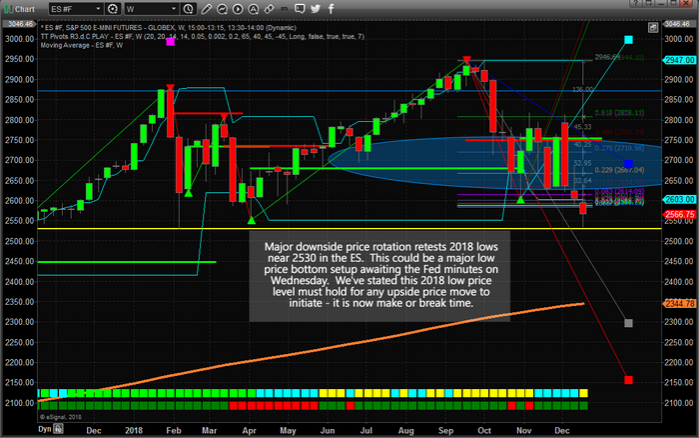
ES Sets Up Major Double Bottom Ahead of the Fed

The downside price rotation in the U.S. markets on Monday, December 17, set up a near perfect double bottom formation near the 2530 price level and also prompted a dramatic price recovery after reaching these lows. Currently, the ES has rallied over 35 pts from this low level and will likely pause before the Fed minutes are announced on Wednesday, December 19.

If the Fed holds true to their earlier promises of continued rate increases, we could see this 2530 level broken as price retreats from any relief rally and attempts to find lower support. If the Fed changes the context of their message and adopts a slower and more insightful rate policy, the markets are poised for one heck of a potential rally. The ES if down by a little more than 400 points (-13.75%) from the peak in September 2018.

Check Out Our 3 Hour Trading Strategy Mastery Video 

We believe the markets have already priced in the expected Fed rate hike and we believe an additional rate hike could become a catalyst for a downside move towards 2300 if the 2530 level is breached. We would like to see the Fed pause, or even decrease rate levels by 25 bp, allowing the markets to parse through the credit/debt issues that have started to plague the global markets before it causes the markets to “turn turtle” and prompt a greater crisis event.


Some of our earlier research, from 2013-2014, was a modeling system dedicated to the Fed interest rates, GDP, Population and Asset Valuations. We modeled various outcomes of the global economy over the future 15 to 20 years including massive debt increases, massive debt decreases, slowing GDP, growing GDP, massive changes in population and asset levels and many others. Overall, our research showed that the 2% Fed Funds Rate level should have been an upper boundary and should have been a near term target back in 2015-2016. As or right now, the Fed should be decreasing rates to allow for a smooth transition through a “deleveraging process”.

The Fed is behind the curve and is failing to properly navigate the future outcomes of global assets, debt and credit cycles. If the US Fed is not cautious over the next 12+ months with how they manage the FFR, they could push the entire global economy over a cliff faster than they can spell “Powell”.

Everything rests on Wednesday, December 19 and the U.S. Fed at this point. Our predictive modeling systems are still suggesting we should see strong upside price activity throughout the end of this year and early next year – assuming the Fed does not pull the floor out from under this market and capsize the global credit markets again.

Learn how we can help you find and execute trades for better success. Our analysis has been well ahead of these market moves for months and we’ve nailed some incredible trades.

Visit The Technical Traders to learn more.

Chris Vermeulen


Monday, August 31, 2015

A Correction Fireside Chat with the "10th Man"

By Jared Dillian 

I don’t really enjoy these things like I used to. Keep in mind, I’ve traded through a lot of blowups, going back to 1997...1998...2001...2002-2003...2007-2009...2011...Today. They all kind of feel the same after a while.

Nobody wins from corrections except for the traders, which today mostly means computers. I forget who said this: “In bear markets, bulls lose money and bears lose money. Everyone loses money. The purpose of a bear market is to destroy capital.”....And that’s what is going on today.

For starters, long-term investors inevitably get sucked into the media MARKET TURMOIL spin cycle and puke their well-researched, treasured positions at the worst possible time. But I’m not trying to minimize the significance of a correction, because some corrections turn into bona fide bear markets. And if you are in a bear market, you should get out. If it is only a correction, you probably want to add to your holdings.

How can you tell the difference?

My Opinion: This Is a Correction


So what were the two big bear markets in the last 20 years? The dot com bust, and the global financial crisis. Two generational bear markets in a 10 year span. Hopefully something we’ll never see again. In one case, we had the biggest stock market bubble ever and in the other, the biggest housing/debt crisis ever.

Both good reasons for a bear market.

What are we selling off for again? Something wrong with China?

Again, not to minimize what is going on in China, because it is now the world’s second-largest economy. Forget the GDP statistics. After a decade of ridiculous overinvestment, it is possible that they’re on the cusp of a very serious recession, whether they admit it or not. But the good news is that the yuan is strong and can weaken a lot, and interest rates are high and can come down a lot. China has a lot of policy tools it can use (unlike the United States).

Let’s think about these “minor” corrections over the last 20 years.....
1997: Asian Financial Crisis
1998: Russia/Long-Term Capital Management (LTCM)
2001: 9/11
2011: Greece

All of these were VIX 40+ events.


In retrospect, these “crises” look kind of silly, even junior varsity. The Thai baht broke—big deal.

Russia’s debt default was only a problem because it was a surprise. And the amount of money LTCM was down—about $7 billion—is peanuts by today’s standards. After 9/11, stocks were down 20% in a week. The ultimate buying opportunity.

And in hindsight, we can see that the market greatly underestimated the ECB’s commitment to the euro.
So what are we going to say when we look back at this correction in 10-20 years? What will we name it? Will we call it the China crisis? I mean, if it’s a VIX 40 event, it needs a name.

I try to have what I call forward hindsight. Like, I pretend it’s the future and I’m looking back at the present as if it were the past. My guess is that we will think this was pretty stupid.

What to Buy


I saw a sell-side research note yesterday suggesting that this crisis is marking the capitulation bottom in emerging markets. I haven’t fully evaluated that statement, but I have a hunch that it is correct. China is cheap, by the way. But if China is too scary, they are just giving away India. I literally cannot buy enough. And I have a hunch that Brazil’s president, Dilma Rousseff, is going to be impeached and the situation in Brazil is going to improve relatively soon.

Think about it. The most contrarian trade on the board. Long the big, old, bloated, corrupt, ugly, bear market BRICs. Also the scariest trade. But the scary trades are often the good trades. There’s more. If you think we’re in the midst of a generational health care/biotech bull market, prices are a lot more attractive today than they were a few weeks ago. I also like gold here because central banks are no longer omnipotent.

That reminds me—there was something I wanted to say on China. The reason everyone hates China isn’t because of the economic situation. It’s because they made complete fools of themselves trying to prop up the stock market. So virtually overnight, we went from “China can do anything” to “China is full of incompetent idiots.” Zero confidence in the authorities.

You want to know when this crisis is going to end? When China manages to restore confidence. When they have that “whatever it takes” moment, like Draghi. If they keep easing monetary policy, sooner or later there will be an effect.

I Am Bored


I used to get all revved up about this stuff. That’s when I made my living timing tops and bottoms. I don’t do that anymore. I do fundamental work, and I go to the gym and play racquetball. The mark-to-market is a nuisance. Also, if you can’t get excited about a VIX 50 event, you have probably been trading for too long.
There is a silver lining. The disaster scenario, where the credit markets collapse due to lack of liquidity, isn’t happening. Everyone is hiding and too scared to trade.

Honestly, high-grade credit isn’t acting all that bad. And it shouldn’t. I don’t see any big changes in the default rate. Anyway, if you want to go be a hero and bid with both hands, be my guest. It’s best to be careful and average into stuff. These prices will look pretty good a couple of months from now, I think.

Jared Dillian
Jared Dillian

If you enjoyed Jared's article, you can sign up for The 10th Man, a free weekly letter, at mauldineconomics.com. Follow Jared on Twitter @dailydirtnap

The article The 10th Man: A Correction Fireside Chat was originally published at mauldineconomics.com.


Get our latest FREE eBook "Understanding Options"....Just Click Here!

Tuesday, July 14, 2015

It Could Never Happen Here

By Jared Dillian


I was watching the 6 o’clock news and saw images of closed banks in Greece and people lined up at ATMs. I’m sure you did, too.

This must seem surreal to most people because it seems so remote. But put yourself in these people’s shoes for a second. You have money in the bank. Suddenly you can’t get to it. After standing in long lines, you can only get 60 euros at a time, which isn’t going to last you very long.

What if you didn’t plan adequately and haven’t stashed away any cash? The banks will be closed for a while. What happens?

How do you pay for rent? Or food?
How does your employer pay you?
Do you go homeless? Or hungry?
Do you get really angry, take to the streets, blame someone or something (probably the wrong thing), break stuff, set things on fire?
Will Greece descend into anarchy?
It might.


Doomsday Preppers


Of course, not everyone in Greece is hurting. Many people saw this coming and took action. They took all their money out of the banks, put it under the mattress, or maybe stored it in a safe. Maybe they bought gold, or diamonds, or something else. These people aren’t standing in lines at ATMs. They aren’t going to go homeless or hungry.

But these people get a pretty bad rap—at least here in the US, where we call them “doomsday preppers.” Or “bunker monkeys.” Or “conspiracy theorists.” Or “gold bugs.” They take a beating. Jim Rickards tweeted the other day, “I’ll bet there a lot of Greeks saying, ‘I wish I had bought some gold.’" Truer words have never been spoken.

This week’s issue of The 10th Man is not a gold promotion, but rather a broader discussion about how you can prepare for financial catastrophe. People keep fire extinguishers and first aid kits in their cars. They test their smoke alarms twice a year. They purchase flood insurance or, in my neighborhood, hurricane shutters.
Why would you do all these things but just leave your money in the bank and hope for the best?

I have studied all kinds of financial crises in all parts of the world, from depressions to hyperinflations. The thing they all have in common is that people who do not prepare get crushed. People who are not appropriately paranoid get crushed.

There is such a thing as being too paranoid (if everything you own is in gold and hard assets, you can miss out on some meaty returns in financial assets), but a little paranoia is healthy. For a few years, I had a pretty concrete escape plan, with assets, just in case.

In case of what?.....In case of anything.

No Sympathy Whatsoever


I don’t feel sorry for Greece. I don’t feel sorry for the people in the ATM lines. They have had years to prepare for this day. Most people in similar situations don’t have so much time. I’m shocked that the banks had any deposits left at all.

Probably what will happen is that the banks will require a Cyprus-like bail-in and the depositors will take a massive haircut, getting only a fraction of what they once owned. There are no wealthy Russians to go after. The burden will fall on ordinary Greeks.

It’s also hard to feel badly for a nation of people who have chosen to pursue this ruinous political path—people who cast 52% of their votes for communists or neo Nazis, and who have proven completely unable to take any responsibility for what has transpired.

Greece will probably respond to the failure of extreme left Syriza by electing even more extreme politicians. It seems likely that they will choose a strongman to “get things done.” I think people fail to understand how totalitarianism can happen in the 21st century. Think of this as a YouTube tutorial video on the subject.

Full Faith and Credit


A financial crisis of similar magnitude will happen in the US someday. The only question is whether it will happen in 20 years or 50 or 100 or 200. But it is a virtual certainty. My only hope is that I won’t live long enough to see it.

Still, I know how to prepare for it. You know, in the old days before deposit insurance, people used to keep their money in five to ten different banks to diversify their counterparty risk. If a bank was perceived to be less creditworthy, the banknotes would trade at a discount.

I think that in the days of FDIC and various investor protections, we are lulled to sleep, believing that things really are safe when in reality, they are not. We were hours away from a complete and total financial collapse when the Reserve Primary fund broke the buck and there was a run on the money market mutual funds. We were that close.

After those dark days in 2008, I vowed that I’d never be in that position again.

You do sacrifice investment returns when you do this kind of stuff. Cash or gold or diamonds doesn’t yield anything. But then again, nowadays, neither do bonds. Don’t let the financial media shame you into thinking that taking basic emergency precautions to protect yourself financially is somehow “crazy.”

You can overdo it, though. You don’t need that many cans of pork and beans.
Jared Dillian
Jared Dillian

The article The 10th Man: “It Could Never Happen Here” was originally published at mauldineconomics.


Get our latest FREE eBook "Understanding Options"....Just Click Here!

Friday, April 24, 2015

Here's Why Gold Will Be Priceless in Three to Five Years

Over the next few years as debt, currencies and countries start to fall apart and individuals will be looking to place their money where it will hold its value and buying power during times of extreme uncertainty.

If you eliminate fiat currencies which are created out of this air and are nothing more than a credit we are left with precious metals and stones. As much as we have evolved over time, we could be valuing things like gold, silver, platinum, and precious stones more so than our currency.

Let’s face it, currencies are swinging in value 20-50% regularly and while most people do not realize it their buying power often is not as strong as it was. Would you rather hold a large portion of your capital in say the EURO which is falling like a rock in value costing you thousands of dollars a month, or would gold and silver which rises in value as your currency falls be a smarter decision?

Click Here to Read Chris Vermeulen's entire article and charts


Get our latest FREE eBook "Understanding Options"....Just Click Here!

Thursday, November 6, 2014

Mark Twain: History Doesn't Repeat Itself....But it Does Rhyme. Gold, Vanderbilt and More

By John Mauldin


“The significant problems that we have created cannot be solved at the level of thinking we were at when we created them.”– Albert Einstein

“Generals are notorious for their tendency to ‘fight the last war’ – by using the strategies and tactics of the past to achieve victory in the present. Indeed, we all do this to some extent. Life's lessons are hard won, and we like to apply them – even when they don't apply. Sadly enough, fighting the last war is often a losing proposition. Conditions change. Objectives change. Strategies change. And you must change. If you don't, you lose.”– Dr. G. Terry Madonna and Dr. Michael Young

“Markets are perpetuating a serious error by acting on the belief that central bankers actually know what they are doing. They do not. Not because they are ill-intentioned but because they are human and subject to the limitations that apply to all human endeavors. If you want proof of their fallibility, simply look at their economic forecasts. Despite their efforts to do so, central banks can’t repeal the business cycle (though they can distort it). While the 2008 financial crisis should have taught them that lesson, it appears to have led them to precisely the opposite conclusion.

“There are limits to knowledge in every field, including the hard sciences, and economics is not a hard science; it is a social science whose knowledge is imprecise, and practitioners’ ability to predict the future is extremely limited. Fed officials are attempting to guide an extremely complex economy with tools of questionable utility, and markets are ignoring their warnings that their ability to manage a positive outcome is highly uncertain. Markets are confusing what they want to happen with what is likely to happen, a common psychological phenomenon. Investors who prosper in the long run will be those who acknowledge the severe limits of economic knowledge and the compelling evidence that trillions of dollars of QE and years of zero interest rates may have saved the system from immediate collapse five years ago but failed to produce sustained economic growth or long-term price stability.”– Michael Lewitt, The Credit Strategist, Nov. 1, 2014

As I predicted months ago in this letter and last year in Code Red, the Japanese have launched another missile in their ongoing currency war, somewhat fittingly on Halloween. Rather than being spooked, the markets saw it as just another round of feel good quantitative easing and climbed to all-time highs on the Dow and S&P 500. The Nikkei soared even more (for good reason). As we will see later in this letter, this is not your father’s quantitative easing. The Japanese, for reasons of their own, will intervene not only in their own equity markets but in foreign equity markets as well, and do so in a size and manner that will be significant. This gambit is going to have ramifications far beyond merely weakening the yen. In this week’s letter we are going to take an in depth look at what the Japanese have done.

It is something of a cliché to quote Mark Twain’s “History doesn’t repeat itself, but it does rhyme.” But it is an appropriate way to kick things off, since we are going to look at the “ancient” history of Mark Twain’s era, and specifically the Panic of 1873. That October saw the beginning of 65 months of recession (certainly longer than our generation’s own Great Recession), which inflicted massive pain on the country. The initial cause was government monetary intervention, but the crisis was deepened by soaring debt and deflation.
As we seek to understand what happened 141 years ago, we’ll revisit the phenomenon of October as a month of negative market surprises. It actually has its roots in the interplay between farming and banking.

The Panic of 1873

Shortly after the Civil War, which saw the enactment of federal fiat money (the “greenback” of that era, issued to finance the war), there was a federal law passed that required rural and agricultural banks to keep 25% of their deposits with certain certified national banks, which were based mainly in New York. The national banks were required to pay interest on those deposits, so they had to put the money out for loans. But because those deposits were “callable” at any time, there was a limit to the types of loans they could do, as long-term loans mismatched assets and liabilities.

The brokers of the New York Stock Exchange were considered an excellent target for such loans. They could use the proceeds of the loans as margin to buy stocks, either for their own trading or on behalf of their clients. As long as the stocks went up – or at the very least as long as the ultimate clients were liquid – there wasn’t a problem for the national banks. Money could be repatriated; or, if necessary, margins could be called in a day. But this was before the era of a central bank, so actual physical dollars (and other physical instruments) were involved as reserves, as was gold. Greenbacks could be used to buy gold, but at a rate that floated. The price of gold could fluctuate significantly from year to year, depending upon the availability of gold and the supply of greenbacks (and of course, market sentiment – which certainly rhymes with our own time).

The driver for October volatility was an annual cycle, an ebb and flow of dollars to and from these rural banks. In the fall when the harvest was ready, the country banks would recall their margin loans in order to pay farmers or loan to merchants to buy crops from farmers and ship them via the railroads. Money would then become tight on Wall Street as the national banks called their loans back in.

This cycle often caused extra volatility, depending on the shortness of loan capital. Margin rates could rise to as much as 1% per day! Of course, this would force speculators to sell their stocks or cover their shorts, but in general it could drive down prices and make margin calls more likely. This monetary tightening often sent stocks into a downward spiral – not unlike the downward pressure that present-day Fed tightening actions have exerted, but in a compressed period of time.

If there was enough leverage in the system, a cascade could result, with stocks dropping 20% very quickly. Since much of Wall Street was involved in railroads, and railroads were nothing if not leveraged loans and capital, falling asset prices would reduce the ability of investors in railroads to find the necessary capital for expansion and maintenance of operations.

This historical pattern no longer explains the present-day vulnerability of markets in October. Perhaps the phenomenon persists simply due to market lore and investor psychology. Like an amputee feeling a twinge in his lost limb, do we still sense the ghosts of crashes past?

(And once more with Mark Twain: “October. This is one of the peculiarly dangerous months to speculate in stocks. The others are July, January, September, April, November, May, March, June, December, August, and February.”)

It was in this fall environment that a young Jay Gould decided to manipulate the gold market in the autumn of 1873, creating a further squeeze on the dollar. Not only would he profit off a play in gold, but he thought the move would help him in his quest to take control of the Erie Railroad. Historian Charles R. Morris explains, in a fascinating book called The Tycoons

Gould’s mind ran in labyrinthine channels, and he turned to the gold markets as part of a strategy to improve Erie’s freights. Grain was America’s largest export in 1869. Merchants purchased grain from farmers on credit, shipped it overseas, and paid off the farmers when they received their remittances from abroad. Their debt to the farmers was in greenbacks, but their receipts from abroad came in gold, for the greenback was not legal tender overseas. It could take weeks, or even months, to complete a transaction, so the merchant was exposed to changes in the gold/greenback exchange rate during that time. If gold fell (or the greenback rose), the merchant’s gold proceeds might not cover his greenback debts.

The New York Gold Exchange was created to help merchants protect against that risk. Using the Exchange, a merchant could borrow gold when he made his contract, convert it to greenbacks, and pay off his suppliers right away. Then he would pay off the gold loan when his gold payment came in some weeks later; since it was gold for gold, exchange rates didn’t matter. To protect against default, the Exchange required full cash collateral to borrow gold. But that was an opening for speculations by clever traders like Gould. If a trader bought gold and then immediately lent it, he could finance his purchase with the cash collateral and thereby acquire large positions while using very little of his own cash.

[Note from JM: In the fall there was plenty of demand for gold and a shortage of greenbacks. It was the perfect time if you wanted to create a “corner” on gold.]

Gould reasoned that if he could force up the price of gold, he might improve the Erie’s freight revenues. If gold bought more greenbacks, greenback-priced wheat would look cheaper to overseas buyers, so exports, and freights, would rise. And because of the fledgling status of the new Gold Exchange, gold prices looked eminently manipulable, since only about $20 million in gold was usually available in New York. [Some of his partners in the conspiracy were skeptical because…] The Grant administration, which had just taken office in March, was sitting on $100 million in gold reserves. If gold started suddenly rising, it would hurt merchant importers, who could be expected to clamor for government gold sales.

So Gould went to President Grant’s brother-in-law, Abel Corbin, who liked to brag about his family influence. He set up a meeting with President Grant, at which Gould learned that Grant was cautious about any significant movements in either the gold or the greenback, noting the “fictitiousness about the prosperity of the country and that the bubble might be tapped in one way as well as another.” That was discouraging: popping a bubble meant tighter money and lower gold.

But Gould plunged ahead with his gold buying, including rather sizable amounts for Corbin’s wife (Grant’s wife’s sister), such that each one-dollar rise in gold would generate $11,000 in profits. Corbin arranged further meetings with Grant and discouraged him from selling gold all throughout September.

Gould and his partners initiated a “corner” in the gold market. This was actually legal at the time, and the NY gold market was relatively small compared to the amount of capital it was possible for a large, well-organized cabal to command. True corners were devastating to bears, as they generally borrowed shares or gold to sell short, betting on the fall in price. Just as today, if the price falls too much, then the short seller can buy the stock back and take his losses. But if there is no stock to buy back, if someone has cornered the market, then losses can be severe. Which of course is what today we call a short squeeze.

The short position grew to some $200 million, most of it owed to Gould and his friends. But there was only $20 million worth of gold available to cover the short sales. That gold stock had been borrowed and borrowed and borrowed again. The price of gold rose as Gould’s cabal kept pressing their bet.

But Grant got wind of the move. His wife wrote her sister, demanding to know if the rumor of their involvement was true. Corbin panicked and told Gould he wanted out, with his $100,000+ of profits, of course. Gould promised him his profits if he would just keep quiet.

Then Gould began to unload all his gold positions, even as some of his partners kept right on buying. You have to keep up pretenses, of course. Gould was telling his partners to push the price up to 160, while he was selling through another set of partners.

It is a small irony that Gould also had a contact in the government in Washington (a Mr. Butterfield) who assured him that there was no move to sell gold from DC, even as that contact was personally selling all his gold as fast as he could. Whatever bad you could say about Gould (and there were lots of bad things you could say), his trading instincts were good. He sensed his contact was lying and doubled down on getting out of the trade. In the end, Gould didn’t make any money to speak of and in fact damaged his intention of getting control of the Erie Railroad that fall.

The attempted gold corner didn’t do much harm to the country in and of itself. But when President Grant decided to step in and sell gold, there was massive buying, which sucked a significant quantity of physical dollars out of the market and into the US Treasury at a time when dollars were short. This move was a clumsy precursor to the open-market operations of the Federal Reserve of today, except that those dollars were needed as margin collateral by brokerage companies. No less than 14 New York Stock Exchange brokerages went bankrupt within a few days, not including brokerages that dealt just in gold.

All this happened in the fall, when there were fewer physical dollars to be had.

The price of gold collapsed. Cornelius Vanderbilt, who was often at odds with Jay Gould, had to step into the market (literally – that is, physically, which was rare for him) in order to quell the panic and provide capital, a precursor to J.P. Morgan’s doing the same during the Panic of 1907.

While many today believe the Fed should never have been created, we have not lived through those periods of panics and crashes. And while I think the Fed now acts in ways that are inappropriate (how can 12 FOMC board members purport to fine-tune an economic cycle, let alone solve employment problems?), the one true and proper role of the Fed is to provide liquidity in time of a crisis.

People Who Live Too Much on Credit”

At the end of the day, it was too much debt that was the problem in 1873. Cornelius Vanderbilt was quoted in the epic book The First Tycoon as saying (emphasis mine)

I’ll tell you what’s the matter – people undertake to do about four times as much business as they can legitimately undertake.… There are a great many worthless railroads started in this country without any means to carry them through. Respectable banking houses in New York, so called, make themselves agents for sale of the bonds of the railroads in question and give a kind of moral guarantee of their genuineness. The bonds soon reach Europe, and the markets of their commercial centres, from the character of the endorsers, are soon flooded with them.… When I have some money I buy railroad stock or something else, but I don’t buy on credit. I pay for what I get. People who live too much on credit generally get brought up with a round turn in the long run. The Wall Street averages ruin many a man there, and is like faro.

In the wake of Gould’s shenanigans, President Grant came to New York to assess the damage; and eventually his Secretary of the Treasury decided to buy $30 million of bonds in a less clumsy precursor to Federal Reserve open market operations, trying to inject some liquidity back into the markets. This was done largely as a consequence of a conversation with Vanderbilt, who offered to put up $10 million of his own, a vast sum at the time.

But the damage was done. The problem of liquidity was created by too much debt, as Vanderbilt noted. That debt inflated assets, and when those assets fell in price, so did the net worth of the borrowers. Far too much debt had to be worked off, and the asset price crash precipitated a rather deep depression, leaving in its wake far greater devastation than the recent Great Recession did. It took many years for the deleveraging process to work out. Sound familiar?

To continue reading this article from Thoughts from the Frontline – a free weekly publication by John Mauldin, renowned financial expert, best-selling author, and Chairman of Mauldin Economics – please click here.

Important Disclosures

The article Thoughts from the Frontline: Rhyme and Reason was originally published at mauldin economics


Get our latest FREE eBook "Understanding Options"....Just Click Here!

Tuesday, September 9, 2014

Europe Takes the QE Baton

By John Mauldin


If the wide, wide world of investing doesn’t seem a little strange to you these days, it can only be because you’re not paying attention. If you’re paying attention, strange really isn’t the word you’re probably using in your day-to-day investing conversations; it may be more like weird or bizarre. It increasingly feels like we’re living in the world dreamed up by the creators of DC Comics back in the 1960s, called Bizarro World. In popular culture "Bizarro World" has come to mean a situation or setting that is weirdly inverted or opposite from expectations.

As my Dad would say, “The whole situation seems about a half-bubble off dead center” (dating myself to a time when people used levels that actually had bubbles in them). But I suppose that now, were he with us, he might use the expression to refer to the little bubbles that are effervescing everywhere. In a Bizarro French version of very bubbly champagne (I can hardly believe I’m reporting this), the yield on French short term bonds went negative this week. If you bought a short-term French bill, you actually paid for the privilege of holding it. I can almost understand German and Swiss yields being negative, but French?

And then Friday, as if to compound the hilarity, Irish short term bond yields went negative. Specifically, roughly three years ago Irish two year bonds yielded 23.5%. Today they yield -0.004%! In non-related un-news from Bizarro World, the Spanish sold 50-year bonds at 4% this week. Neither of these statistics yielded up by Bloomberg makes any sense at all. I mean, I understand how they can technically happen and why some institutions might even want 50-year Spanish bonds. But what rational person would pay for the privilege of owning an Irish bond? And does anyone really think that 4% covers the risk of holding Spanish debt for 50 years? What is the over-under bet spread on the euro’s even existing in Spain in 50 years? Or 10, for that matter?

Don't miss a single free Trading webinar, tonight "Beating the Market Makers Trading Weekly Options"

We might be able to lay the immediate, proximate cause of the bizarreness at the feet of ECB President Mario Draghi, who once again went all in last Monday for his fellow teammates in euroland. He gave them another round of rate cuts and the promise of more monetary easing, thus allowing them to once again dodge the responsibility of managing their own economies. The realist in me scratches my already well scratched head and wonders exactly what sort of business is going to get all exuberant now that the main European Central Bank lending rate has dropped to 0.05% from an already negligible 0.15%. Wow, that should make a lot of deals look better on paper.

We should note that lowering an already ridiculously low lending rate was not actually Signor Draghi’s goal. This week we’ll look at what is happening across the pond in Europe, where the above-mentioned negative rates are only one ingredient in a big pot of Bizarro soup. And we’ll think about what it means for the U.S. Federal Reserve to be so close to the end of its quantitative easing, even as the ECB takes the baton to add €1 trillion to the world’s liquidity. And meanwhile, Japan just keeps plugging away. (Note: this letter will print longer than usual as there are a significant number of graphs. Word count is actually down, for which some readers may be grateful.)

But first, I’m glad that I can finally announce that my longtime friend Tony Sagami has officially come to work for us at Mauldin Economics. Tony has been writing our Yield Shark advisory since the very beginning, but for contractual reasons we could not publicize his name. I will say more at the end of the letter, but for those of you interested in figuring out how to increase the yield of your investments, Tony could be a godsend.

The Age of Deleveraging

Extremely low and even negative interest rates, slow growth, unusual moves by monetary and fiscal authorities, and the generally unseemly nature of the economic world actually all have a rational context and a comprehensible explanation. My co-author Jonathan Tepper and I laid out in some detail in our book End Game what the ending of the debt supercycle would look like. We followed up in our book Code Red with a discussion of one of the main side effects, which is a continual currency war (though of course it will not be called a currency war in public). Both books stand up well to the events that have followed them. They are still great handbooks to understand the current environment.

Such deleveraging periods are inherently deflationary and precipitate low rates. Yes, central banks have taken rates to extremes, but the low rate regime we are in is a natural manifestation of that deleveraging environment. I’ve been doing a little personal research on what I was writing some 15 years ago (just curious), and I came across a prediction from almost exactly 15 years ago in which I boldly and confidently (note sarcasm) projected that the 10-year bond would go below 4% within a few years. That was a little edgy back then, as Ed Yardeni was suggesting it might go below 5% by the end of the following year. That all seems rather quaint right now. The Great Recession would send the 10-year yield below 2%.

Sidebar: The yield curve was also negative at the time, and I was calling for recession the next year. With central banks holding short-term rates at the zero bound, we no longer have traditional yield curve data to signal a recession. What’s a forecaster to do?

I was not the only one talking about deflation and deleveraging back then. Drs. Gary Shilling and Lacy Hunt (among others) had been writing about them for years. The debt supercycle was also a favorite topic of my friend Martin Barnes (and prior to him Tony Boeckh) at Bank Credit Analyst.

Ever-increasing leverage clearly spurs an economy and growth. That leverage can be sustained indefinitely if it is productive leverage capable of creating the cash flow to pay for itself. Even government leverage, if it is used for productive infrastructure investments, can be self sustaining. But ever increasing leverage for consumption has a limit. It’s called a debt supercycle because that limit takes a long time to come about. Typically it takes about 60 or 70 years. Then something has to be done with the debt and leverage. Generally there is a restructuring through a very painful deflationary bursting of the debt bubble – unless governments print money and create an inflationary bubble. Either way, the debt gets dealt with, and generally not in a pleasant manner.

We are living through an age of deleveraging, which began in 2008. Gary Shilling summarized it this week in his monthly letter:

We continue to believe that slow worldwide growth is the result of the global financial deleveraging that followed the massive expansion of debt in the 1980s and 1990s and the 2008 financial crisis that inevitably followed, as detailed in our 2010 book, The Age of Deleveraging: Investment strategies for a decade of slow growth and deflation. We forecast back then that the result in the U.S. would be persistent 2% real GDP growth until the normal decade of deleveraging is completed. Since the process is now six years old, history suggests another four years or so to go.

We’ve also persistently noted that this deleveraging is so powerful that it has largely offset massive fiscal stimuli in the form of tax cuts and rebates as well as huge increases in federal spending that resulted in earlier trillion dollar deficits. It has also swamped the cuts in major central bank interest rates to essentially zero that were followed by gigantic central bank security purchases and loans that skyrocketed their balance sheets.  Without this deleveraging, all the financial and monetary stimuli would surely have pushed real GDP growth well above the robust 1982–2000 3.7% average instead of leaving it at a meager 2.2% since the recovery began in mid-2009.

The problems the developed world faces today are the result of decisions made to accumulate large amounts of debt over the past 60 years. These problems cannot be solved simply by the application of easy-money policies. The solution will require significant reforms, especially labor reforms in Europe and Japan, and a restructuring of government obligations.

Mohammed El-Erian called it the New Normal. But it is not something that happens for just a short period of time and then we go back to normal. Gary Shilling cites research which suggests that such periods typically last 10 years – but that’s if adjustments are allowed to happen. Central banks are fighting the usual adjustment process by providing easy money, which will prolong the period before the adjustments are made and we can indeed return to a “normal” market.

How Bizarre Is It?

We are going to quickly run through a number of charts, as telling the story visually will be better than spilling several times 1000 words (and easier on you). Note that many of these charts display processes unfolding over time. We try to go back prior to the Great Recession in many of these charts so that you can see the process. We are going to focus on Europe, since that is where the really significant anomalies have been occurring.

First, let’s look at what Mario Draghi is faced with. He finds himself in an environment of low inflation, and expectations for inflation going forward are even lower. This chart depicts inflation in the two main European economies, Germany and France.


Note too that inflation expectations for the entire euro area are well below 1% for the next two years – notwithstanding the commitment of the European Central Bank to bring back inflation.


But as I noted at the beginning, ECB policy has already reached the zero bound. In fact the overnight rate is negative, making cash truly trash if it is deposited with the ECB.


With inflation so low and a desperate scramble for yield going on in Europe, rates for 10-year sovereign debt have plummeted. It is not that Italy or Spain or Greece or Ireland or France is that much less risky than it was five years ago.

Note that banks can get deposits for essentially nothing. They can lever those deposits up (30 or 40 times), and the regulators make them reserve no capital against investments made in sovereign debt. Even after their experience with Greek debt, they essentially claim that there is no risk in sovereign debt. If your bank’s profits are being squeezed and it’s hard to find places to put money to work in the business sector, then the only game in town is to buy sovereign debt, which is what banks are doing. Which of course pushes down rates. Low interest rates in Europe are as much a result of regulatory policy as of monetary policy.

Next is a chart of 10 year bond yields. We’ve also included the US, Japan, and Switzerland. Note that Japan and Switzerland are in the 50-basis point range. (Japan is at 0.52%, and Switzerland is at 0.45%). Italy and Spain now have 10 year bond yields below that of the US.


The following chart is a screenshot of a table from Bloomberg, listing 10 year bond yields around Europe. Note that Greece is at 5.48%. Hold that thought while you look at the table.


This next chart requires a minute or two of analysis, and looking at it in black and white probably won’t work. Essentially, this is the spread of the yields of 10-year bonds of various European countries over German bunds. Note that only two years ago Greek debt paid 25% per year more than German debt did. Anyone who bought Greek debt when that country was busy defaulting has scored big. (While I probably take far too much risk in my portfolio, I will readily admit to not having enough nerve to do something like that.) The other thing to note, and it is a little bit more difficult to see on this chart, is that for all intents and purposes the market is treating European-wide EFSF debt as German debt. There are only 10 basis points of difference.


Now let’s take a little stroll through history and view a chart of the yield curve of French debt. The top dotted line is where the yield curve was on January 1, 2007. We took our first look at this chart last Tuesday in preparation for this letter, noting that short-term French debt was at the zero bound. It went negative on Thursday, and negative all the way out to two years! Note that a 50-year French note (which I’m not sure actually trades) yields a hypothetical 2.5%, only modestly more than a 30-year would yield. You might have to have the patience of Job, and I’m not sure quite how you would go about executing the trade, but that has to be one of the most loudly screaming shorts I’ve ever seen!


Here is the equivalent chart for the German yield curve going back to January 2007. Note that German debt has a negative yield out to three years!!!


While it should surprise no one, German long-term bond yields are at historic lows. I recall reading that Spanish bond yields are lower now than they have been at any other time in their history. I actually applaud the Spanish government for issuing 50-year bonds at 4%. I can almost guarantee you the day will come when Spain looks back at those 4% bonds with fondness. (I assume that the buyers are pension funds or insurance companies engaged in a desperate search for yield. I guess the extra 2% over a ten-year bond looks attractive … at least in the short term.)

And finally, let’s really widen our time horizon on German yields:


Time to Ramp up the Currency War

The yen hit a six-year low this week (over 105 to the dollar), creating even more of a problem for Germany and other European exporters to Asia. The chart below shows that Germany’s exports to the BRIICS except China are down significantly over the past few years, partially due to competition from Japan as the yen has dropped against the euro.

The yen-versus-euro problem (at least from Germany’s standpoint) is exacerbated by the remarkable appetite of Japanese investors for French bonds. This has been going on for over a year. In May and June of this year alone, Japanese investors bought $29.3 billion worth of French notes maturing at one year or more (presumably, this was before rates went negative). Note that even with minimal yields, the Japanese investors are up because of the currency play. (Interestingly, Japanese investors are dumping German bonds, again a yield play.)

Japanese analysts say that Japanese investors are hesitant to take the risks on the higher-yielding Italian and Spanish bonds, but for some reason they see almost no risk in French bonds. (Obviously not many Thoughts from the Frontline readers in Japan.) This behavior, of course, helps to drive down the price of the yen relative to the euro. (Source, Bloomberg)


Interesting side note: the third-largest country holding of US treasuries behind Japan and China is now Belgium. When you first read that, you have to do a double-take. Digging a little deeper, you find out there’s been a 41% surge in Belgian ownership of US bonds in just the first five months of this year. As it turns out, Euroclear Bank SA, a provider of security settlements for foreign lenders, is based in Belgium and is where countries can go to buy bonds they are not holding in their own treasuries. This buying surge is helping hold down US yields even as the Federal Reserve is reducing its QE program. Further, there is serious speculation, or rather speculation from serious sources, that Russian oligarchs are piling into US dollars by the tens of billions, again through Belgium.

Europe Takes the Baton

It is probably only a coincidence that just as the Fed ends QE, Europe will begin its own QE program. Note that the ECB has reduced its balance sheet by over $1 trillion in the past few years (to the chagrin of much of European leadership). There is now “room” for the ECB to work through various asset-buying programs to increase its balance sheet by at least another trillion over the next year or so, taking the place of the Federal Reserve. Draghi intends to do so.

Risk-takers should take note. European earnings per share are significantly lower than those of any other developed economy. Indeed, while much of the rest of the world has seen earnings rise since the market bottom in 2009, the euro area has been roughly flat.


Both the US and Japanese stock markets took off when their respective central banks began QE programs. Will the same happen in Europe? QE in Europe will have a little bit different flavor than the straight-out bond buying of Japan or the US, but they will still be pushing money into the system. With yields at all-time lows, European investors may start looking at their own stock markets. Just saying.

Draghi also knows there is really no way to escape his current conundrum without reigniting European growth. One of the textbook ways to achieve easy growth is through currency devaluation; and as we wrote in Code Red, the ECB will step up and do what it can to cheapen the euro in competition with Japan.
Just as the world is getting fewer dollars (in a world where global trade is done in dollars), Draghi is going to flood the world with euros.

Bank of Japan Governor Kuroda has steered the BOJ to where it now owns 20% of all outstanding Japanese government debt and is buying 70% of all newly issued Japanese bonds. The BOJ hoped that by driving down long-term rates it could encourage Japanese banks to invest and lend more, but bond-hungry regional Japanese banks are still snapping up long-term Japanese bonds, even at 50 basis points of yield. Given the current environment, the Bank of Japan cannot stop its QE program without creating a spike in yields that the government of Japan could not afford. Hence I think it’s unlikely that Japanese QE will end anytime soon, thus putting further pressure on the yen.

The BOJ is going to continue to buy massive quantities of bonds and erode the value of the yen over time in an effort to get 2% inflation.

In a world where populations in developed countries are growing older and are thus more interested in fixed-income securities, yields are going to be challenged for some time. Those planning retirement are going to generally need about twice what would have been suggested only 10 or 15 years ago in order to be able to achieve the same income. Welcome to the world of financial repression, brought to you by your friendly local central bank.

Introducing Tony Sagami

When we first launched Mauldin Economics some two years ago, my partners and I thought there was a need for a good fixed-income letter with a little different style and focus. My very first phone call was to my longtime friend Tony Sagami, to ask if he would write it. I have known Tony for almost 25 years. We have worked together, he has worked for me, and we have been competitors, but we’ve always been good friends.

Even though he now lives in Bangkok most of the year, we still visit regularly by email and Skype, and try to make a point of catching up in some part of the world at least twice a year. In addition to his talents as a writer, Tony brings a seasoned perspective and huge experience as a trader and investor. (Seasoned is a technical term for getting older, having made lots of instructive mistakes in your early years.) He has a way of taking my macro ideas and efficiently and effectively putting them to work. I know Yield Shark subscribers must be happy, because our renewal rates are very high by industry standards.

As I mentioned early in the letter, for contractual reasons we haven’t been able to name Tony as the editor of Yield Shark. I’m really pleased that we can do so now. Tony was recently in Dallas, and we did a short video together so that I could introduce him. You can watch the video and learn more about Tony here. You will soon be receiving information from my partners about a new newsletter that Tony will also be writing, which we are tentatively calling The Rational Bear.

San Antonio, Washington DC, Chicago, and Boston

My respite from travel will be over in a few weeks as I head to the Casey Research Summit in San Antonio, September 17-21. It actually takes place at a resort in the Hill Country north of San Antonio, which is a fun place to spend a weekend with friends. Then the end of the month will see me traveling to Washington DC for a few days.

I'll be back in Dallas in time for my 65th birthday on October 4, and then I get to spend another two weeks at home before the travel schedule picks back up. I will make a quick trip to Chicago, then swing back to Athens, Texas, before I head on to Cambridge, Massachusetts, for conferences. There are a few other trips shaping up as well.

My time at home has been well spent, as I’m catching up on all sorts of projects, spending more time in the gym, and just enjoying being home. Surprisingly, being at home has allowed me to see more friends than usual as they’ve come through town. Dennis Gartman was in yesterday, and we spent two pleasant hours catching up over lunch. He is one of the truly consummate gentlemen in our business and a bottomless reservoir of great stories. A perfect evening would be Dennis Gartman and Art Cashin holding court at the Friends of Fermentation after the market closes. You’d just sit there and scribble notes.

The other thing about being home is that it makes me want to get on a plane and go see even more friends! Yesterday I caught up with George and Meredith Friedman on the phone, and we realized it has been well over a year since we’ve seen each other, which is unusual for us. I really enjoy them, and they are their own source of endless stories. George and Meredith travel much more than I do, and all over the world at that, doing speeches and research and the like; but we agreed that sometime in October we will make a visit happen, whoever is doing the flying. I think one of the reasons that God made planes was so that friends could see each other more often.

A special hat tip goes to my associate Worth Wray for finding and creating most of the charts for this week. Plus helping me think through the letter. He has been a huge help this last year.
You have a great week and take a friend who tells great stories to lunch. It will do wonders for your outlook on life.

Your still can’t believe negative French interest rates analyst,


Make sure to check out our next webinar "How to Beat the Market Makers with Weekly Options"....Just Click Here!


Friday, August 22, 2014

Stop Investing in Leveraged ETFs

By Andrey Dashkov

Bigger, faster, better. That’s the turbocharged investment we all want. Miller’s Money Forever subscribers who pay close attention to our portfolio, though, will notice that we don’t hold leveraged ETFs—those with “2x” or “inverse” or “ultra” in their names, which some investors mistake for “better.”

Exchange-traded funds (ETFs) are a great tool for many portfolios. They allow investors to profit from movements in a huge variety of assets grouped by industry, geography, presence in a certain index, or other criteria. You can find ETFs tracking automobile producers, cotton futures, or cows.

For our purposes, ETFs make it easier to diversify within a certain group of companies—easier because you don’t have to buy them individually. You buy the ETF and leave it to its managers to balance the portfolio when needed.

We have several ETFs in the Money Forever portfolio, and they have served us well so far. They expose us to several universes, such as international stocks, foreign dividend-paying companies, convertible securities, and others.

Why Turbocharged Isn’t Always Better


So, if we think the underlying index or asset class will move in our favor, why wouldn’t we opt for the turbocharged version—the versions that use leverage (credit) to achieve gains two times higher?
First, because we’re very cautious about volatility, and leveraged ETFs are designed to be less stable than the underlying assets. Second, there is a trick to leveraged ETFs that can make your investment in them stink even if the underlying index or asset does well.

Before we get to the details, let me pose two questions:
  • If the S&P 500 goes up by 5% over several days, how much would a 2x leveraged ETF based on the index earn?
  • If the S&P 500 goes up and down, then rises, and after a while ends up flat, will our ETF end up flat too?

If you answer 10% to the first question, you may be correct, and that’s the caveat: you won’t be correct 100% of the time. You can’t just multiply an index’s total gain by the ETF’s factor to gauge how much you’ll earn, because leveraged ETFs track daily gains, not total ones.

To show how that works, here’s a brief example that will also answer question number two.

Day # Index Price Daily Return ETF Price
Index ETF
1,900 $100.00
1 1,800 -5.26% -10.53% $89.47
2 1,870 3.89% 7.78% $96.43
3 2,000 6.95% 13.90% $109.84
4 1,900 -5.00% -10.00% $98.86
Total return 0.0% -1.1%
Source: TheTradeSurfer


What you’re looking at here is a hypothetical index with a value of 1,900 at the beginning of our period. It goes up and down for four days, and then is back to 1,900 by the end of day 4. There is also an ETF that starts with a price of $100 and doubles the daily gains of the index.


On the first day, the index goes down to 1,800 for a daily loss of 5.26%. This forces the daily loss of the ETF to be 10.53% (including rounding error), and the resulting price of the ETF is $89.47. The next day the index is up 3.89%, forcing the ETF to grow by 7.78%, to $96.43, and so on.

We designed this table to show that even though the underlying index is back to 1,900 in five days, returning 0% in total gain, the ETF is down 1.1% by the end of day 4.

It works like this because ETFs are designed to track daily returns, not mirror longer-term performance of the underlying index, and because of how cumulative returns work. If one share of the ETF costs $100 at the beginning of the period and the market dropped 5%, we should expect double the drop. Our share would now be worth $90. If the next day it reverses and goes up 5%, we should expect double the increase. We would be right in doing so, but our share would be worth $99 now, not $100—because it increased 10% above the $90 closing price the day before.

Leveraged ETFs Are for Traders, Not Investors


If a trader is smart and lucky, she or he would buy the ETF at the beginning of day 3 at $96.43, sell at $109.84, and realize a gain of 14%. But if one bought at day 0 and held until the end of our period, one would lose money even though the underlying index ended up flat.

In general, no one can predict where an ETF will end up because it’s impossible to tell in advance what pattern the underlying index will follow. In practice, it means that an ETF only partially tracks the underlying index; its performance also depends on its own past results.

The ideal case for investing in an ETF (we assume it’s long the market) would be to buy it at the beginning of a multi-day, uninterrupted uptrend. In that case, it would come very close to doubling the market’s performance. But such winning streaks are impossible to forecast, and short-term trading like this is not our focus.

We don’t recommend leveraged ETFs in our portfolio because they’re geared for traders, and we take a longer-term perspective. We are investors.

The additional potential reward from a turbocharged ETF doesn’t warrant the additional risk, particularly when you’re investing retirement money. There are safer ways to maximize your retirement income. Learn more about our strategies for doing just that by signing up for Miller’s Money Weekly, our free weekly e-letter that educates conservative investors about timely investment strategies. You’ll receive ahead-of-the-curve financial insight and commentary right in your inbox every Thursday. Start building a rich retirement by signing up today.

The article Stop Investing in Leveraged ETFs was originally published at Millers Money


Make sure to check out our "Beginners Guide to Trading Options"....Just Click Here!

Wednesday, June 11, 2014

Can Central Planners Revive China’s Economic Miracle?

By John Mauldin

For years, when asked whether I thought China would experience a hard landing, I would simply answer, “I don't understand China. Making a prediction would be pretending that I did, so I can’t.” The problem is that today China is the most significant macroeconomic wildcard in the global economy. To understand both the risks and the potentials for the future you have to reach some understanding of what is happening in China today. Last week we started a two part series on what my young associate Worth Wray and I feel is the significant systemic risk that China poses to global growth.

The first thing in my inbox this morning here in Tuscany was a note from a friend about the growing scandal in Quingdao. For a long time many of us have known that there has been “double counting” in the commodities trade sector in China, where local “entrepreneurs” create multiple warehouse receipts on which to borrow money cheaply, and then invest in what are essentially subprime securities that pay higher rates. Everyone “knows” that the government is not going to let anyone lose money on investments, so what could possibly go wrong? It turns out that Chinese warehouse officials are now emigrating in significant numbers to parts unknown around the world, armed with only their passports and whatever money they made through producing such bogus receipts.

My sources suggest that the size of the problem is approaching $1.3 billion (far greater than the number being bandied about in public reports). Since one of the guiding principles operative in any scandal is that there is never just one cockroach, I expect the ultimate losses to be far larger. And it appears that the People’s Bank of China is finally going to let people lose money on these fraudulent schemes. Good for them. But to suggest there is no risk in cleaning up corruption and fraud misses the point of our own subprime crisis. In a world where global economic trade and international banks are so intricately linked, trying to determine the actual risk to the system is difficult. And as I will note in my “final thoughts” section, corruption is a very real issue.

We are going to try gamely to finish with China today, having left at least three or four letters worth of copy on the editing floor. There is just so much information and misinformation to cover. I’m going to turn it over to Worth and then follow up with a few final thoughts of my own. (Please note that this letter will print exceptionally long as there are a number of charts and other graphics.) Now let’s do a deep dive into part two.

Can Central Planners Revive China’s Economic Miracle?

By Worth Wray
In my Thoughts from the Frontline debut this past March (“China’s Minsky Moment?”), I highlighted the massive bubble in Chinese private-sector debt and explored the near-term prospects for either (1) a reform-induced slowdown or (2) a crisis-induced recession. Unfortunately, it was not an easy or straightforward analysis, considering the glaring inconsistencies between “official” state compiled data and more concrete measures of all real economic activity, which is why I suggested that China is simultaneously the most important and most misunderstood economic force in the world today.

With the stakes now higher than ever, I returned to Asia’s “miracle” last week (“Looking at the Middle Kingdom with Fresh Eyes”) and probed deeper into the shadows (including China’s shadow banks) with the help of my new friend Leland Miller and a few illuminating excerpts from his Q1 2014 China Beige Book (the largest and most comprehensive survey series ever conducted on a closed or semi-closed economy).
Pulling back the Bamboo Curtain, Leland’s data revealed aspects of the Chinese economy that John and I could have only guessed at before, giving us a rare opportunity to explore regional contrasts in Chinese economic activity, to survey the modest (but still insufficient) rebalancing among sectors, and to identify a series of pressure points within the credit markets that suggest last summer’s interbank volatility may return in 2014.

Unfortunately, Leland’s key insights confirmed our fears that China’s consumption-repressing, debt-fueled, investment-led growth model is slowing down and starting to sputter… but not collapsing (at least not yet). 

What happens next – with huge implications for global markets – depends largely on the economic wisdom and political resolve of China’s central planners, who must find a way to gradually deleverage overextended regional governments and investment-intensive sectors while also rebalancing the national economy toward a consumption driven growth model.

Finessing the challenges will require not just one but a series of miracles.

Like Every Other Investment-Driven Growth “Miracle” 

After 34 years of booming economic growth averaging over 9% per year (the longest sustained period of rapid economic growth in human history), China’s credit-fueled, investment-driven growth model is exhausted and increasingly unstable. As you can see in the chart below, the Middle Kingdom’s credit boom is well past the point of diminishing marginal returns; and no one can deny that the misallocation is widespread, with capacity utilization now below 60%. (I should also note that Societe Generale’s Wei Yao has consistently published some of the best research on China in recent quarters; personally, I won’t be surprised to see her vault to rock-star status as the People’s Republic decelerates.)


Source: Wei Yao & Claire Huang, “SG Guide to China Reform.” Societe Generale Research, May 14, 2014.

Moreover, state perpetuated distortions in the cost and availability of financing are (1) funneling huge amounts of capital toward increasingly unproductive, state directed investments, and (2) pushing household and private business borrowers into the shadows, where the burden of substantially higher interest rates drags on household consumption.


Source: Wei Yao & Claire Huang, “SG Guide to China Reform.” Societe Generale Research, May 14, 2014.

It doesn’t require much imagination to connect the dots. Structural distortions in Chinese financial markets are a major cause of debt fueled overinvestment; and without sweeping structural reforms (along with a major crackdown on corruption at all levels of government), captive capital will continue to flow toward unproductive investments, capacity utilization will continue to fall, and China’s investment boom will continue its march toward a mega Minsky moment.

This kind of structural distortion is a classic symptom of an overextended investment boom and a warning sign that rebalancing – whether it’s induced by voluntary reforms or an involuntary debt crisis – will not be easy. The critical adjustments – gradual deleveraging and structural rebalancing – will require a greater slowdown in economic growth and a sharper fall in still-bubbly asset prices than China’s policymakers are letting on.

“This is not an easy task,” The Daily Telegraph’s Ambrose Evans Pritchard says, in a truly brilliant article published this week, “not least because land sales and taxes make up 39% of state revenue in China, and the property sector employs 20% of workers one way or another. It is clearly a bubble of epic proportions and already losing air. Mao Daqing from Vanke – China’s top developer – says total land value in Beijing has been bid up to such extremes that is on paper worth 61.6pc of America’s GDP. The figure was 63.3pc for Tokyo at the peak of the bubble in 1990.” Yikes.

As Peking University professor Michael Pettis explains in his 2013 book, Avoiding the Fall: China’s Economic Restructuring, “Every country that has followed a consumption-repressing, investment-driven growth model like China’s has ended with an unsustainable debt burden caused by wasted debt-financed investment. This has always led to either a debt crisis or a lost decade of very low growth.”
China’s “miracle” is no different from any other investment-driven growth binge where high levels of leverage (directly or indirectly paid for by the household sector), combined with high levels of fixed investment, eventually result in excessive and unsustainable debt loads. Pettis elaborates:

While these policies can generate tremendous growth early on, they also lead inexorably to deep imbalances. As demonstrated by the history of every investment-driven growth miracle, including that of Brazil, high levels of state-directed subsidized investment run an increasing risk of being misallocated, and the longer this goes on the more wealth is likely to be destroyed even as the economy posts high GDP growth rates. Eventually the imbalances this misallocation created have to be resolved and the wealth destruction has to be recognized. What’s more, with such heavy distortions imposed and maintained by the central government, there is no easy way for the economy to adjust on its own…. [Furthermore], Beijing [will] not be able to raise the consumption share of GDP without abandoning the investment-driven growth model altogether.

In other words, the world’s second largest economy is approaching its debt limit and the end of the line for investment led growth… but China’s financial system is structurally designed to prevent capital from flowing freely toward more productive uses. One way or another, the world’s largest contributor to global economic growth must slow down – either because Beijing has the foresight, resolve, and political capital to pursue aggressive economic and financial market reforms or because party elites fail to address the country’s structural imbalances and policy-induced distortions before the credit bubble pops. “Debt,” Pettis explains, “as we will learn over the next few years in China, has always been the Achilles’ heel of the investment-driven growth model…”

Which Way to Sustainable Growth?

Among the various reforms set forth in last November’s Communist Party Third Plenum, ranging from financial liberalization to a crackdown on corruption and pollution, the most challenging is the gradual deleveraging of the Chinese economy while simultaneously rebalancing the national economy toward a more sustainable, consumption-driven growth model.

To continue reading this article from Thoughts from the Frontline – a free weekly publication by John Mauldin, renowned financial expert, best-selling author, and Chairman of Mauldin Economics – Please Click Here.


Sign up for our new "2.0 Mentoring Program"....Just Click Here!


Monday, April 28, 2014

The Cost of Code Red

By John Mauldin


(It is especially important to read the opening quotes this week. They set up the theme in the proper context.)

 “There is no means of avoiding the final collapse of a boom brought about by credit expansion. The alternative is only whether the crisis should come sooner as the result of a voluntary abandonment of further credit expansion, or later as a final and total catastrophe of the currency system involved.”
– Ludwig von Mises
“No very deep knowledge of economics is usually needed for grasping the immediate effects of a measure; but the task of economics is to foretell the remoter effects, and so to allow us to avoid such acts as attempt to remedy a present ill by sowing the seeds of a much greater ill for the future.”
– Ludwig von Mises
“[Central banks are at] serious risk of exhausting the policy room for manoeuver over time.”
– Jaime Caruana, General Manager of the Bank for International Settlements
“The gap between the models in the world of monetary policymaking is now wider than at any time since the 1930s.”
– Benjamin Friedman, William Joseph Maier Professor of Political Economy, Harvard

To listen to most of the heads of the world’s central banks, things are going along swimmingly. The dogmatic majority exude a great deal of confidence in their ability to manage their economies through whatever crisis may present itself. (Raghuram Rajan, the sober minded head of the Reserve Bank of India, is a notable exception.)

However, there is reason to believe that there have been major policy mistakes made by central banks – and will be more of them – that will lead to dislocations in the markets – all types of markets. And it’s not just the usual anti-central bank curmudgeon types (among whose number I have been counted, quite justifiably) who are worried. Sources within the central bank community are worried, too, which should give thoughtful observers of the market cause for concern.

Too often we as investors (and economists) are like the generals who are always fighting the last war. We look at bank balance sheets (except those of Europe and China), corporate balance sheets, sovereign bond spreads and yields, and say it isn’t likely that we will repeat this mistakes which led to 2008. And I smile and say, “You are absolutely right; we are not going to repeat those mistakes. We learned our lessons. Now we are going to make entirely new mistakes.” And while the root cause of the problems, then and now, may be the same – central bank policy – the outcome will be somewhat different. But a crisis by any other name will still be uncomfortable.

If you look at some of the recent statements from the Bank for International Settlements, you should come away with a view much more cautious than the optimistic one that is bandied about in the media today. In fact, to listen to the former chief economist of the BIS, we should all be quite worried.

I am of course referring to Bill White, who is one of my personal intellectual heroes. I hope to get to meet him someday. We have discussed some of his other papers, written in conjunction with the Dallas Federal Reserve, in past letters. He was clearly warning about imbalances and potential bubbles in 2007 and has generally been one of the most prescient observers of the global economy. The prestigious Swiss business newspaper Finanz und Wirtschaft did a far reaching interview with him a few weeks ago, and I’ve taken the liberty to excerpt pieces that I think are very important. The excerpts run a few pages, but this is really essential reading. (The article is by Mehr zum Thema, and you can read the full piece here.)

Speculative Bubbles

The headline for the interview is “I see speculative bubbles like in 2007.” As the interviewer rolls out the key questions, White warns of grave adverse effects of ultra loose monetary policy:

William White is worried. The former chief economist of the Bank for International Settlements is highly skeptical of the ultra-loose monetary policy that most central banks are still pursuing. “It all feels like 2007, with equity markets overvalued and spreads in the bond markets extremely thin,” he warns.

Mr. White, all the major central banks have been running expansive monetary policies for more than five years now. Have you ever experienced anything like this?

The honest truth is no one has ever seen anything like this. Not even during the Great Depression in the Thirties has monetary policy been this loose. And if you look at the details of what these central banks are doing, it’s all very experimental. They are making it up as they go along. I am very worried about any kind of policies that have that nature.

But didn’t the extreme circumstances after the collapse of Lehman Brothers warrant these extreme measures?

Yes, absolutely. After Lehman, many markets just seized up. Central bankers rightly tried to maintain the basic functioning of the system. That was good crisis management. But in my career I have always distinguished between crisis prevention, crisis management, and crisis resolution. Today, the Fed still acts as if it was in crisis management. But we’re six years past that. They are essentially doing more than what they did right in the beginning. There is something fundamentally wrong with that. Plus, the Fed has moved to a completely different motivation. From the attempt to get the markets going again, they suddenly and explicitly started to inflate asset prices again. The aim is to make people feel richer, make them spend more, and have it all trickle down to get the economy going again. Frankly, I don’t think it works, and I think this is extremely dangerous.

So, the first quantitative easing in November 2008 was warranted?

Absolutely.

But they should have stopped these kinds of policies long ago?

Yes. But here’s the problem. When you talk about crisis resolution, it’s about attacking the fundamental problems that got you into the trouble in the first place. And the fundamental problem we are still facing is excessive debt. Not excessive public debt, mind you, but excessive debt in the private and public sectors. To resolve that, you need restructurings and write-offs. That’s government policy, not central bank policy. Central banks can’t rescue insolvent institutions. All around the western world, and I include Japan, governments have resolutely failed to see that they bear the responsibility to deal with the underlying problems. With the ultraloose monetary policy, governments have no incentive to act. But if we don’t deal with this now, we will be in worse shape than before.

But wouldn’t large-scale debt write-offs hurt the banking sector again?

Absolutely. But you see, we have a lot of zombie companies and banks out there. That’s a particular worry in Europe, where the banking sector is just a continuous story of denial, denial and denial. With interest rates so low, banks just keep ever-greening everything, pretending all the money is still there. But the more you do that, the more you keep the zombies alive, they pull down the healthy parts of the economy. When you have made bad investments, and the money is gone, it’s much better to write it off and get fifty percent than to pretend it’s still there and end up getting nothing. So yes, we need more debt reduction and more recapitalization of the banking system. This is called facing up to reality.

Where do you see the most acute negative effects of this monetary policy?

The first thing I would worry about are asset prices. Every asset price you could think of is in very odd territory. Equity prices are extremely high if you at valuation measures such as Tobin’s Q or a Shiller-type normalized P/E. Risk-free bond rates are at enormously low levels, spreads are very low, you have all these funny things like covenant-lite loans again. It all looks and feels like 2007.

And frankly, I think it’s worse than 2007, because then it was a problem of the developed economies. But in the past five years, all the emerging economies have imported our ultra low policy rates and have seen their debt levels rise. The emerging economies have morphed from being a part of the solution to being a part of the problem.

Do you see outright bubbles in financial markets?

Yes, I do. Investors try to attribute the rising stock markets to good fundamentals. But I don’t buy that. People are caught up in the momentum of all the liquidity that is provided by the central banks. This is a liquidity-driven thing, not based on fundamentals.

So are we mostly seeing what the Fed has been doing since 1987 – provide liquidity and pump markets up again?

Absolutely. We just saw the last chapter of that long history. This is the last of a whole series of bubbles that have been blown. In the past, monetary policy has always succeeded in pulling up the economy. But each time, the Fed had to act more vigorously to achieve its results. So, logically, at a certain point, it won’t work anymore. Then we’ll be in big trouble. And we will have wasted many years in which we could have been following better policies that would have maintained growth in much more sustainable ways. Now, to make you feel better, I said the same in 1998, and I was way too early.

What about the moral hazard of all this?

The fact of the matter is that if you have had 25 years of central bank and government bailout whenever there was a problem, and the bankers come to appreciate that fact, then we are back in a world where the banks get all the profits, while the government socializes all the losses. Then it just gets worse and worse. So, in terms of curbing the financial system, my own sense is that all of the stuff that has been done until now, while very useful, Basel III and all that, is not going to be sufficient to deal with the moral hazard problem. I would have liked to see a return to limited banking, a return to private ownership, a return to people going to prison when they do bad things. Moral hazard is a real issue.

Do you have any indication that the Yellen Fed will be different than the Greenspan and Bernanke Fed?

Not really. The one person in the FOMC that was kicking up a real fuss about asset bubbles was Governor Jeremy Stein. Unfortunately, he has gone back to Harvard.

The markets seem to assume that the tapering will run very smoothly, though. Volatility, as measured by the Vix index, is low.

Don’t forget that the Vix was at [a] record low in 2007. All that liquidity raises the asset prices and lowers the cost of insurance. I see at least three possible scenarios how this will all work out. One is: Maybe all this monetary stuff will work perfectly. I don’t think this is likely, but I could be wrong. I have been wrong so many times before. So if it works, the long bond rates can go up slowly and smoothly, and the financial system will adapt nicely. But even against the backdrop of strengthening growth, we could still see a disorderly reaction in financial markets, which would then feed back to destroy the economic recovery.

How?

We are such a long way away from normal long term interest rates. Normal would be perhaps around four percent. Markets have a tendency to rush to the end point immediately. They overshoot. Keynes said in late Thirties that the long bond market could fluctuate at the wrong levels for decades. If fears of inflation suddenly re-appear, this can move interest rates quickly. Plus, there are other possible accidents. What about the fact that maybe most of the collateral you need for normal trading is all tied up now? What about the fact that the big investment dealers have got inventories that are 20 percent of what they were in 2007? When things start to move, the inventory for the market makers might not be there. That’s a particular worry in fields like corporate bonds, which can be quite illiquid to begin with. I’ve met so many people who are in the markets, thinking they are absolutely brilliantly smart, thinking they can get out in the right time. The problem is, they all think that. And when everyone races for the exit at the same time, we will have big problems. I’m not saying all of this will happen, but reasonable people should think about what could go wrong, even against a backdrop of faster growth.

And what is the third scenario?

The strengthening growth might be a mirage. And if it does not materialize, all those elevated prices will be way out of line of fundamentals.

Which of the major central banks runs the highest risk of something going seriously wrong?

At the moment what I am most worried about is Japan. I know there is an expression that the Japanese bond market is called the widowmaker. People have bet against it and lost money. The reason I worry now is that they are much further down the line even than the Americans. What is Abenomics really? As far as I see it, they print the money and tell people that there will be high inflation. But I don’t think it will work. The Japanese consumer will say prices are going up, but my wages won’t. Because they haven’t for years. So I am confronted with a real wage loss, and I have to hunker down. At the same time, financial markets might suddenly not want to hold Japanese Government Bonds anymore with a perspective of 2 percent inflation. This will end up being a double whammy, and Japan will just drop back into deflation. And now happens what Professor Peter Bernholz wrote in his latest book. Now we have a stagnating Japanese economy, tax revenues dropping like a stone, the deficit already at eight percent of GDP, debt at more than 200 percent and counting. I have no difficulty in seeing this thing tipping overnight into hyperinflation. If you go back into history, a lot of hyperinflations started with deflation.

Many people have warned of inflation in the past five years, but nothing has materialized. Isn’t the fear of inflation simply overblown?

One reason we don’t see inflation is because monetary policy is not working. The signals are not getting through. Consumers and corporates are not responding to the signals. We still have a disinflationary gap. There has been a huge increase in base money, but it has not translated into an increase in broader aggregates. And in Europe, the money supply is still shrinking. My worry is that at some point, people will look at this situation and lose confidence that stability will be maintained. If they do and they do start to fear inflation, that change in expectations can have very rapid effects.

More from the BIS

The Bank for International Settlements is known as the “central bankers’ central bank.” It hosts a meeting once a month for all the major central bankers to get together for an extravagant dinner and candid conversation. Surprisingly, there has been no tell-all book about these meetings by some retiring central banker. They take the code of “omertà” (embed) seriously.

Jaime Caruana, the General Manager of the BIS, recently stated that monetary institutions (central banks) are at “serious risk of exhausting the policy room for manoeuver over time.” He followed that statement with a very serious speech at the Harvard Kennedy School two weeks ago. Here is the abstract of the speech (emphasis mine):

This speech contrasts two explanatory views of what he characterizes as “the sluggish and uneven recovery from the global financial crisis of 2008-09.” One view points to a persistent shortfall of demand and the other to the specificities of a financial cycle-induced recession – the “shortfall of demand” vs. the “balance sheet” view. The speech summarizes each diagnosis [and]… then reviews evidence bearing on the two views and contrasts the policy prescriptions to be inferred from each view. The speech concludes that the balance sheet view provides a better overarching explanation of events. In terms of policy, the implication is that there has been too much emphasis since the crisis on stimulating demand and not enough on balance sheet repair and structural reforms to boost productivity. Looking forward, policy frameworks need to ensure that policies are more symmetrical over the financial cycle, so as to avoid the risks of entrenching instability and eventually running out of policy ammunition.

Coming from the head of the BIS, the statement I have highlighted is quite remarkable. He is basically saying (along with his predecessor, William White) that quantitative easing as it is currently practiced is highly problematical. We wasted the past five years by avoiding balance sheet repair and trying to stimulate demand. His analysis perfectly mirrors the one Jonathan Tepper and I laid out in our book Code Red.

How Does the Economy Adjust to Asset Purchases?

In 2011 the Bank of England gave us a paper outlining what they expected to be the consequences of quantitative easing. Note that in the chart below they predict exactly what we have seen. Real (inflation-adjusted) asset prices rise in the initial phase. Nominal demand rises slowly, and there is a lagging effect on real GDP. But note what happens when a central bank begins to flatten out its asset purchases or what is called “broad money” in the graph: real asset prices begin to fall rather precipitously, and consumer price levels rise. I must confess that I look at the graph and scratch my head and go, “I can understand why you might want the first phase, but what in the name of the wide, wide world of sports are you going to do for policy adjustment in the second phase?” Clearly the central bankers thought this QE thing was a good idea, but from my seat in the back of the plane it seems like they are expecting a rather bumpy ride at some point in the future.


Let’s go to the quote in the BoE paper that explains this graph (emphasis mine):

The overall effect of asset purchases on the macroeconomy can be broken down into two stages: an initial ‘impact’ phase and an ‘adjustment’ phase, during which the stimulus from asset purchases works through the economy, as illustrated in Chart 1. As discussed above, in the impact phase, asset purchases change the composition of the portfolios held by the private sector, increasing holdings of broad money and decreasing those of medium and long-term gilts. But because gilts [gilts is the English term for bonds] and money are imperfect substitutes, this creates an initial imbalance. As asset portfolios are rebalanced, asset prices are bid up until equilibrium in money and asset markets is restored. This is reinforced by the signalling channel and the other effects of asset purchases already discussed, which may also act to raise asset prices. Through lower borrowing costs and higher wealth, asset prices then raise demand, which acts to push up the consumer price level.

[Quick note: I think Lacy Hunt thoroughly devastated the notion that there is a wealth effect and that rising asset prices affect demand in last week’s Outside the Box. Lacy gives us the results of numerous studies which show the theory to be wrong. Nevertheless, many economists and central bankers cling to the wealth effect like shipwrecked sailors to a piece of wood on a stormy sea. Now back to the BoE.]

In the adjustment phase, rising consumer and asset prices raise the demand for money balances and the supply of long-term assets. So the initial imbalance in money and asset markets shrinks, and real asset prices begin to fall back. The boost to demand therefore diminishes and the price level continues to increase but by smaller amounts. The whole process continues until the price level has risen sufficiently to restore real money balances, real asset prices and real output to their equilibrium levels. Thus, from a position of deficient demand, asset purchases should accelerate the return of the economy to equilibrium.

This is the theory under which central banks of the world are operating. Look at this rather cool chart prepared by my team (and specifically Worth Wray). The Fed (with a few notable exceptions on the FOMC) has been openly concerned about deflationary trends. They are purposely trying to induce a higher target inflation. The problem is, the inflation is only showing up in stock prices – and not just in large cap equity markets but in all assets around the world that price off of the supposedly “risk-free” rate of return.


I hope you get the main idea, because understanding this dynamic is absolutely critical for navigating what the Chairman of the South African Reserve Bank, Gill Marcus, is calling the next phase of the global financial crisis. Every asset price (yes, even and especially in emerging markets) that has been driven higher by unnaturally low interest rates, quantitative easing, and forward guidance must eventually fall back to earth as real interest rates eventually normalize.

Trickle-Down Monetary Policy

For all intents and purposes we have adopted a trickle-down monetary policy, one which manifestly does not work and has served only to enrich financial institutions and the already wealthy. Now I admit that I benefit from that, but it’s a false type of enrichment, since it has come at the expense of the general economy, which is where true wealth is created. I would rather have my business and investments based on something more stably productive, thank you very much.

Monetary policies implemented by central banks around the world are beginning to diverge in a major way. And don’t look now, but that sort of divergence almost always spells disaster for all or part of the global economy. Which is why Indian Central Bank Governor Rajan is pounding the table for more coordinated policies. He can see what is going to happen to cross-border capital flows and doesn’t appreciate being caught in the middle of the field of fire with hardly more than a small pistol to defend himself. And the central banks even smaller than his are bringing only a knife to the gunfight.


The Fed & BoE Are Heading for the Exits…

In the United States, Federal Reserve Chairwoman Janet Yellen is clearly signaling her interest – if not outright intent – to turn the Fed’s steady $10 billion “tapering” of its $55 billion/month quantitative easing program into a more formal exit strategy. The Fed is still actively expanding its balance sheet, but by a smaller amount after every FOMC meeting (so far)… and global markets are already nervously anticipating any move to sell QE-era assets or explicitly raise rates. Just like China’s slowdown (which we have written about extensively), the Fed’s eventual exit will be a global event with major implications for the rest of the world. And US rate normalization could drastically disrupt cross-border real interest rate differentials and trigger the strongest wave of emerging-market balance of payments crises since the 1930s.

In the United Kingdom, Bank of England Governor Mark Carney is carefully broadcasting his intent to hike rates before selling QE-era assets. According to his view, financial markets tend to respond rather mechanically to rate hikes, but unwinding the BoE’s bloated balance sheet could trigger a series of unintended and potentially destructive consequences. Delaying those asset sales indefinitely and leaning on rate targeting once more allows him to guide the BoE toward tightening without giving up the ability to rapidly reverse course if financial markets freeze. Then again, Carney may be making a massive, credibility-cracking mistake.


While the BoJ & ECB Are Just Getting Started

In Japan, Bank of Japan Governor Haruhiko Kuroda is resisting the equity market’s call for additional asset purchases as the Abe administration implements its national sales tax increase – precisely the same mistake that triggered Japan’s 1997 recession. As I have written repeatedly, Japan is the most leveraged government in the world, with a government debt-to-GDP ratio of more than 240%. Against the backdrop of a roughly $6 trillion economy, Japan needs to inflate away something like 150% to 200% of its current debt-to-GDP… that’s roughly $9 trillion to $12 trillion in today’s dollars.

Think about that for a moment. At some point I need to do a whole letter on this, but I seriously believe the Bank of Japan will print something on the order of $8 trillion (give or take) over the next six to ten years. In relative terms, this is the equivalent of the US Federal Reserve printing $32 trillion. To think this will have no impact on the world is simply to ignore how capital flows work. Japan is a seriously large economy with a seriously powerful central bank. This is not Greece or Argentina. This is going to do some damage.

I have no idea whether Japan’s BANG! moment is just around the corner or still several years off, but rest assured that Governor Kuroda and his colleagues at the Bank of Japan will respond to economic weakness with more… and more… and more easing over the coming years.

In the euro area, European Central Bank Chairman Mario Draghi – with unexpected support from his two voting colleagues from the German Bundesbank – is finally signaling that more quantitative easing may be on the way to lower painfully high exchange rates that constrain competitiveness and to raise worryingly low inflation rates that can precipitate a debt crisis by steepening debt-growth trajectories. This QE will be disguised under the rubric of fighting inflation, and all sorts of other euphemisms will be applied to it, but at the end of the day, Europe will have joined in an outright global currency war.

I don’t expect the Japanese and Europeans to engage in modest quantitative easing. Both central banks are getting ready to hit the panic button in response to too low inflation, steepening debt trajectories, and inconveniently strong exchange rates.

While the Federal Reserve, European Central Bank, Swiss National Bank, Bank of England, and Bank of Japan have collectively grown their balance sheets to roughly $9 trillion today, the next wave of asset purchases could more than double that balance in relatively quick order.

This is what I mean by Code Red: frantic pounding on the central bank panic button that invites tit-for-tat retaliation around the world and especially by emerging-market central banks, leading to a DOUBLING of the assets shown in the chart below and a race to the bottom, as the “guardians” of the world’s primary currencies become their executioners.


The opportunity for a significant policy mistake from a major central bank is higher today than ever. I share Bill White’s concern about Japan. I worry about China and seriously hope they can keep their deleveraging and rebalancing under control, although I doubt that many parts of the world are ready for a China that only grows at 3 to 4% for the next five years. That will cause a serious adjustment in many business and government models.

It is time to hit the send button, but let me close with the point that was made graphically in the Bank of England’s chart back in the middle of the letter. Once central bank asset purchases cease, the BoE expects real asset prices to fall… a lot. You will notice that there is no scale on the vertical axis and no timeline along the bottom of the chart. No one really knows the timing. My friend Doug Kass has an interview (subscribers only) in Barron’s this week, talking about how to handle what he sees as a bubble.

“Sell in May and go away” might be a very good adage to remember.

Amsterdam, Brussels, Geneva, San Diego, Rome, and Tuscany

I leave Tuesday night for Amsterdam to speak on Thursday afternoon for VBA Beleggingsprofessionals. There will be a debate-style format around the theme of “Are there any safe havens left in this volatile world?” I plan to write my letter from Amsterdam on Friday and then play tourist on Saturday in that delightful city full of wonderful museums. Then, if all goes well, I will rent a car and take a leisurely drive to Brussels through the countryside, something I have always wanted to do. I may try to get lost, at least for a few hours. Who knows what you might stumble on?

I will be speaking Monday night in Brussels for my good friend Geert Wellens of Econopolis Wealth Management before we fly to Geneva for another speech with his firm, and of course there will be the usual meetings with clients and friends. I find Geneva the most irrationally expensive city I travel to, and the current exchange rates don’t suggest I will find anything different this time.

I come back for a few days before heading to San Diego and my Strategic Investment Conference, cosponsored with Altegris. I have spent time with each of the speakers over the last few weeks, going over their topics, and I have to tell you, I am like a kid in a candy store, about as excited as I can get. This is going to be one incredible conference. You really want to make an effort to get there, but if you can’t, be sure to listen to the audio CDs.  You can get a discounted rate by purchasing prior to the conference.

The Dallas weather may be an analogy for the current economic environment. To look out my window is to see nothing but blue sky with puffy little clouds, and the temperature is perfect. My good friend and business partner Darrell Cain will be arriving in a little bit for a late lunch. We’ll go somewhere and sit outside and then move on to an early Dallas Mavericks game against the San Antonio Spurs. Contrary to expectations, the Mavs actually trounced the Spurs down in San Antonio last week. Of course the local fans would like to see that trend continue, but I would not encourage my readers to place any bets on the Mavericks’ winning the current playoff series.

I live only a few blocks from American Airlines Center, and so normally on such a beautiful day we would leisurely walk to the game. But the local weather aficionados are warning us that while we are at the game tornadoes and hail may appear, along with the attendant severe thunderstorms. That kind of thing can happen in Texas. Then again, it could all blow south of here. That sort of thing also happens.

So when I warn people of an impending potential central bank policy mistake, which would be the economic equivalent of tornadoes and hail storms, I also have to acknowledge that the whole thing could blow away and miss us entirely. I think someone once said that the role of economists is to make weathermen look good. Recently, 67 out of 67 economists said they expect interest rates to rise this year. We’ll review that prediction at the end of the year.

I’ve been interrupted while trying to finish this letter by daughter Tiffani, who is frantically trying to figure out how to buy tickets to get us to Italy (Tuscany) for the first part of June for a little vacation (along with a few friends who will be visiting). I am going to take advantage of being in Rome at the end of that trip, in order to spend a few days with my friend Christian Menegatti, the managing director of research for Roubini Global Economics. We will spend June 16-17  visiting with local businessmen, economists, central bankers, and politicians. Or that’s the plan. If you’d like to be part of that visit, drop me a note.

Finally I should note that my Canadian partners, Nicola Wealth Management, are opening a new office in Toronto. They will be having a special event there on May 8. If you’re in the area, you may want to check it out.

Have a great week, and make sure you take a little time to enjoy life. Avoid tornadoes.

Your hoping for a major upset analyst,

John Mauldin, Editor
Mauldin Economics


Have you watched this video yet? Trading against the High Frequency Traders....Just Click Here!