Showing posts with label financial. Show all posts

Wednesday, April 17, 2019

Watch the Financial Sector for the Next Topping Pattern

A very interesting price pattern is setting up in the financial sector that could lead to a very big move in the US & Global markets. Remember how in 2008-09, the Financial sector and Insurance sector were some of the biggest hit stock sectors to prompt a global market crisis? Well, the next few weeks and months for the financial sector are setting up to be critical for our future expectations of the US stock market and global economy.

Right now, many of the financial sector stocks are poised near an upper price channel that must be breached/broken before any further upside price advance can take place. The current trend has been bullish as prices have rallied off the December 2018 lows. Yet, we are acutely aware of the bigger price channels that could become critical to our future decision making. If there is any price weakness near these upper price channel levels and any downside price rotation, the downside potential for the price is massive and could lead to bigger concerns.

Let’s start off by taking a look at these Monthly charts

This first Monthly Bank Of America chart is best at showing the price channel (in YELLOW) as well as a key Fibonacci price level (highlighted by the MAGENTA line). We’ve also highlighted a price zone with a green shaded box that we believe is key support/resistance for the current price trend.

As you can see from this chart, since early February 2018, the overall trend has shifted into a sideways bearish trend. The price recovery from December 2018 was impressive, yes, but it is still rotating within this sideways/bearish price channel. Our belief is that this YELLOW upper price channel level MUST be broken in order for the price to continue higher at this point. Any failure to accomplish this will result in a price reversal that could precipitate a 30% price decline in the value of BAC. In other words, “it is do-or-die time – again”.


This Monthly JPM chart shows a similar pattern, yet the price channel is a bit more narrow visually. We have almost the same setup in JPM as we do in BAC. The same channels, the same type of Fibonacci price support level, the same type of sideways price support zone (the shaded box) and the same overall setup. As traders, we have to watch for these types of setup and be aware of the risks that could unfold with a collapse of the financial sector over the next few weeks.

We believe the next few weeks could be critical for the financial sector and for the overall markets. If weakness hits the financial sector as global growth continues to stagnate we could enter a period where the global perception of the future 12~24 months may change. Right now, perception has been relatively optimistic in the global stock markets. Most traders have been optimistic that the markets will recover and a US/China trade deal will get settled. The biggest concern has been the EU and the growth of the European countries.

What if that suddenly changed?


We are not saying it will or that we know anything special about this setup. We are just suggesting that the Monthly charts, above, are suggesting that price will either break above this upper price channel or fail to break this level and move lower. We are suggesting that, as skilled traders, we need to be acutely aware of the risks within the financial sector right now and prepare for either outcome.

This last chart, a Weekly FAS chart, shows a more detailed view of this same price rotation and sideways expanding wedge/channel formation. Pay very close attention to the shaded support channel shown with the GREEN BOX on this chart. Any price rotation within this level should be considered “within a support channel” and not a real risk initially. We want to see price break above the upper price channel fairly quickly, within the next 2 to 5+ weeks, and we can to see it establish a new high (above $78 on this chart) to confirm a new bullish price trend. Once this happens, we’ll be watching for further price rotation and setups. If it fails to happen, then the RED DOWN ARROW is the most likely outcome given the current price setup.


Any downside price move in the Financial sector would have to be associated with some decreased future expectations by investors. Thus, our bigger concern is that something is lurking just below the surface right now that could pull the floor out from under this sector. Is it a surprise Fed rate increase? Is it some news from the EU? Is it a sudden increase in credit defaults? What is the “other shoe” – so to say.

Be prepared. If all goes well, then we’ll know within a few more weeks if the upside price rally will continue or if we need to start digging for clues as to why the support for the financial sector is eroding. This really is a “do or die” setup in the financial sector and we urge all traders to pay very close attention to this sector going forward. We believe it will be the leading sector for any major price weakness across the global markets.

Do you want to find a team of dedicated researchers and traders that can help you find and execute better trades in 2019 and beyond? Please visit The Technical Traders to learn how we can help you prepare for the big moves in the global markets and find better opportunities for greater success in the future. Our team of researchers and traders continue to scan the markets for new trades and incredible research for all our members and followers.

Chris Vermeulen

Tuesday, September 13, 2016

The Next Big Short


The "Next Big Short" is a collection of looming market risks from The Heisenberg. This 37 page special report will show you the risks in the markets. How to explain The Heisenberg?

Essentially, it's a collective brain trust of skilled traders willing to discuss markets with the freedom of anonymity. You can enjoy Heisenberg's lively market commentary in the TheoDark Report section of their public blog.

Get the "Next Big Short " free special report....Just Click Here

For more backstory, here's Heisenberg in his own words: Heisenberg spent a long time in college. Probably too long. Be that as it may, the experience afforded him extensive cross disciplinary experience. From Aristotle to Kant to Wittgenstein, from Hobbes to Locke to Rousseau, from plain vanilla equities to FX to CDS, Heisenberg is right at home. With degrees in political science and business, as well as extensive post graduate work in political science and public administration, Heisenberg is uniquely positioned to analyze markets from a holistic perspective. He also has a sense of humor, which allows him to fully appreciate how entertaining it is to talk about himself in the third person.

Heisenberg has traded pretty much everything at one time or another and if he hasn’t traded it, he’s studied it enough to drive himself just as crazy as if he had. He doesn’t sleep much because the terminal doesn’t sleep and neither, generally speaking, do currency markets.

Heisenberg once took the law school admission test (LSAT) for fun with no intention of actually going to law school. He then took it again to try and beat his first score. He paid for the second test with profits he made from long calls on a Brazilian water utility ADR that he sold to close from the first iPhone (the 2.5G version that no one remembers) in the middle of a graduate political science class. His score on the verbal section of the graduate management admission test (GMAT) was near perfect. As was his score on the analytical writing portion. Don’t ask about the math section. He got bored after two hours and didn’t care about using the Pythagorean theorem to determine how long Timmy’s shadow was when he was standing next to a 90 degree flag pole.

Professionally, Heisenberg has worked in Manhattan and many other locales and has years of experience generating and monetizing financial web content. He’s continually amused at those who make it seem hard. You provide quality content for users on a consistent basis. Everything else falls into place. Build it, and they will come.

Get the "Next Big Short " free special report....Just Click Here


See you in the markets putting the Next Big Short to work,
The Stock Market Club


Tuesday, December 29, 2015

By Far the Biggest Threat to Your Wealth in 2016

By Justin Spittler

Today, we begin with a warning. We’re going to tell you about a dangerous event that is very likely to happen within the next year. You’ve probably never thought about this threat. Until now, Casey Research has never discussed it in public. This threat isn’t a stock market collapse…it’s not a failure of the Social Security system…it’s not even a national debt or currency crisis. It’s much more dangerous and much more likely to happen than any of those things.

We’re talking about a major financial terrorist attack. A total wipeout of your financial data, assets, and records and those of many millions of other people. If you’re like most people, you think, “There’s no way that could happen here. Surely the financial system is completely safe.” But think about it….

If you have $100,000 in the bank, what do you really have?

These days, it’s not a claim to hard assets like gold or silver. And it’s certainly not real cash in a bank. Many local banks don’t even keep that much cash on hand! Just try asking your bank for $25,000 in cash. The teller will say, “We can’t give you that much money.” If you keep your life savings in a bank or brokerage account, what you have are electronic entries that hackers can easily and quickly delete. All the money you’ve earned...the hard work, the sweat, the sacrifice...the nest egg you’ve built to provide for your family, GONE. In an instant.

Cyberterrorists have already broken into the world’s most secure digital systems....

For example…..


➢ In May, hackers stole information on 300,000 private tax returns from the Internal Revenue Service (IRS). They used the information to claim tens of millions of dollars in fraudulent tax refunds.
➢ In April, hackers gained access to President Obama’s email. They gathered details on Obama’s personal schedule as well as private conversations with foreign officials.
➢ And earlier this year, we learned that a group of hackers infiltrated some of America’s largest and most sophisticated financial firms. The victims include JPMorgan Chase, E*Trade, and Scottrade. The hackers stole the personal data of more than 100 million customers. They even manipulated stock prices.

A large scale cyber attack could cripple the financial system….

E.B. Tucker, editor of The Casey Report, explains: In today’s high tech world, the lifeblood of our economy is a complex system of digital payments, digital book entries, and digital money. Billions of dollars are electronically transferred every day. We bank online, shop on our computers, and pay for lunch with credit and debit cards. Even the stock exchanges are now 100% electronic. The money in your savings, brokerage, and credit card accounts are just bits and bytes. A skilled hacker could steal it or make it vanish completely.

Enemy foreign governments are likely to attack the U.S.’s financial system.…

Here’s E.B....The U.S. has enemies all over the world: Russia, China, Iran, Syria, Iraq, and Saudi Arabia come to mind. There are millions of people out there who want to see the West burn. And it’s only a matter of time before they strike us at one of our most vulnerable points: Our digital financial system. As cybersecurity expert, Mary Galligan, recently told Bloomberg News, state sponsored cyberterrorism is “the FBI’s worst nightmare.”

The fallout from a cyberattack could be catastrophic….

E.B. explains…Just imagine, what if all of the accounts at a major bank like Wells Fargo were suddenly erased? What if businesses couldn’t process digital payments? What if your brokerage told you its records had been destroyed and all evidence of your stock portfolio had disappeared? What if a cyberattack shut down our electrical grid? I’ll tell you what would happen: An explosion of chaos. Society would break down. When people are wiped out financially, they’re often wiped out mentally and morally, too…they’ll do anything to survive, including resort to violence.

The government and central banks cannot protect you from cyberterrorists….

They don’t want people talking about this massive threat. They want to keep it quiet. You see, the U.S. dollar isn’t backed by gold like it was in the past. Our monetary system is built on confidence, and confidence alone. If lots of people questioned the safety of the system and pulled their money out, it could trigger a nationwide run on the banks, a stock market collapse, and a currency crisis. It could literally lead to rioting in the streets.

If you keep most of your money in digital form….

You must take steps to protect yourself and your family before an attack happens. The first step is to store a sizable amount of cash in a safe place you can easily access. We recommend at least three months’ worth of living expenses. Six months’ worth is even better.

You can store the cash in a safe, in a public storage container, or bury it in a waterproof container in your backyard. This might sound extreme, but think about it…if the financial system is compromised and your debit and credit cards become useless, you’ll need enough cash on hand to pay for groceries, gasoline, and other daily necessities.

Otherwise, you’re in a vulnerable position. Having no cash on hand means you could struggle to feed your family in an emergency. Because we believe most Americans are overlooking this huge threat, we put together a new special report titled “How to Protect Yourself from a Financial Terrorist Attack.” We talked with top cybersecurity experts and put hundreds of hours of research into this report. It explains seven specific steps you can take now to protect your money from financial terrorism. Click here to learn more.

Switching gears, the Dow Jones U.S. Trucking Index is headed for its worst year ever….

Yesterday, it closed down 17% on the year. It’s dropped 7.1% in December alone. The Dow Trucking Index tracks the performance of major U.S. trucking stocks. It’s only had three down years since 2001. Over that period, it’s averaged annual returns of 12%. The chart below shows trucking stocks have been in a clear downtrend all year.


E.B. Tucker says investors should watch this trend even if they don’t own trucking stocks. Trucks carry inventory to stores. They carry parts to the assembly plant. Then they carry assembled products to buyers. When sales are rising, it tends to show up in trucking companies before retailers. Trucking companies also feel the pinch first when sales are falling. This is why trucking stocks often give clues about where the market’s going long before other industries.

E.B. also says the collapse in trucking stocks is an early warning sign for the rest of the market. Transport stocks have given investors early warning signs for the past 100 years. Right now, the Dow Trucking Index is telling us business is not great. The trucks aren’t full. This is a dire sign. It’s saying we’re in for some negative surprises in 2016.

The U.S. stock market looks fragile….

From March 2009 through December 2014, the S&P 500 gained 204%. But the bull market has stalled this year. The S&P 500 is down 1% since January. If this trend continues, 2015 will the S&P’s first down year since 2008. On its own, this isn’t a huge concern. However, Dispatch readers know there are many other signs U.S. stocks have already topped out

For one, the current bull market in stocks is now 81 months old. It’s run 31 months longer than the average bull market since World War II. Of course, bull markets don’t die of old age. But they all die eventually. On top of that, U.S. stocks are expensive. The S&P 500 is now 57% more expensive than its historical average. Again, bull markets don’t end just because stocks are expensive. But expensive stocks can fall much harder during a big selloff.

We recommend investing with caution right now. You should own a significant amount of cash and physical gold...and you should sell any overpriced stocks that are vulnerable to an economic downturn.

Chart of the Day

Oil tanker rates are at their highest level in seven years. Today’s chart shows the daily shipping rates for very large crude carriers (VLCC), the second largest type of oil tanker. Each VLCC can carry 2 million barrels of oil. From 2011 through 2014, VLCC shipping rates averaged $20,000/day. This year, rates have soared 79%. Earlier this month, VLCC daily rates reached $112,775, their highest level since 2008.

Meanwhile, the price of oil has plunged 32% this year. Earlier this month, oil fell to its lowest level since 2009. Oil tanker rates can go up when oil prices go down…because ship operators charge based on how much oil they move. Their rates are not directly tied to the price of oil.

Dispatch readers know the world has a huge surplus of oil right now. All this oil needs to go somewhere, and oil tankers get paid to move it. As you can see in the chart, it’s a great time to be an oil tanker company.


Get our latest FREE eBook "Understanding Options"....Just Click Here!

Thursday, December 10, 2015

How Big the Gig Economy Really Is

By John Mauldin

There is growing awareness of what is being called the “gig economy.” It’s not just Uber driving or Airbnb. There are literally scores of websites and apps where you can advertise your services, get temporary or part time work, and do so from anywhere you happen to be.

Some “gigs” actually pay pretty good money, but they are for people with specialized skills who prefer to live a somewhat different lifestyle than the typical 9 to 5’er does. My hedge fund friend Murat Köprülü has been busy researching and documenting this phenomenon and regularly regales me with what he finds.

He goes and spends evenings and weekends with young gig workers, trying to figure out what it is they really do and how they make ends meet in New York City. It turns out they need a lot less to support their lifestyle than you might imagine, and they prefer working intermittent gigs, being able to do what they want, and having no boss.

A close look at the data indicates that the gig economy is indeed big and growing. But there is a great deal of debate among economists about how big it really is.

It’s Much Bigger Than the Employment Data Suggests

Gig workers don’t seem to show up clearly in the BLS employment data. Typically, we would expect those working in the gig economy to appear in the self employed category, but that category is actually drifting downward in numbers—relatively speaking.

But Harvard economist Larry Katz and Princeton’s Alan Krueger, who are working on research to document the rise of the gig economy in America, says that our current measures ignore the bulk of the gig economy.

 From a story at fusion.net:
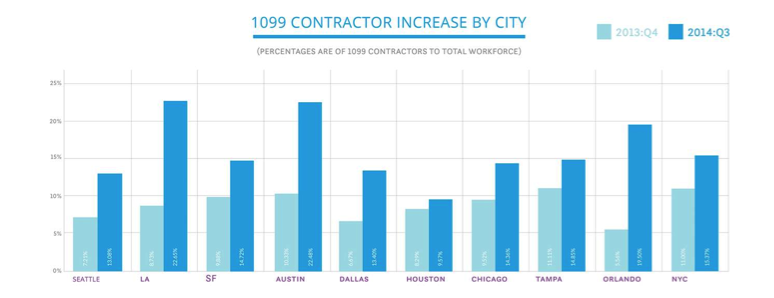
Katz said two pieces of evidence suggest current measures of self-employment and multiple-job holding are “missing a large part of the gig economy.” The first is that the share of the employed (and of the adult population) filing a 1099 form, the tax document “gig economy” workers must file, increased in the 2000s, even as standard measures of self-employment declined in the 2000s. Other groups have confirmed this: Zen Payroll, a site that tracks the sharing economy, found increases in the share of 1099 workers across many major U.S. metros.

Mauldin-Economics-Gig-Economy
Source: Zen Payroll via Small Business Labs

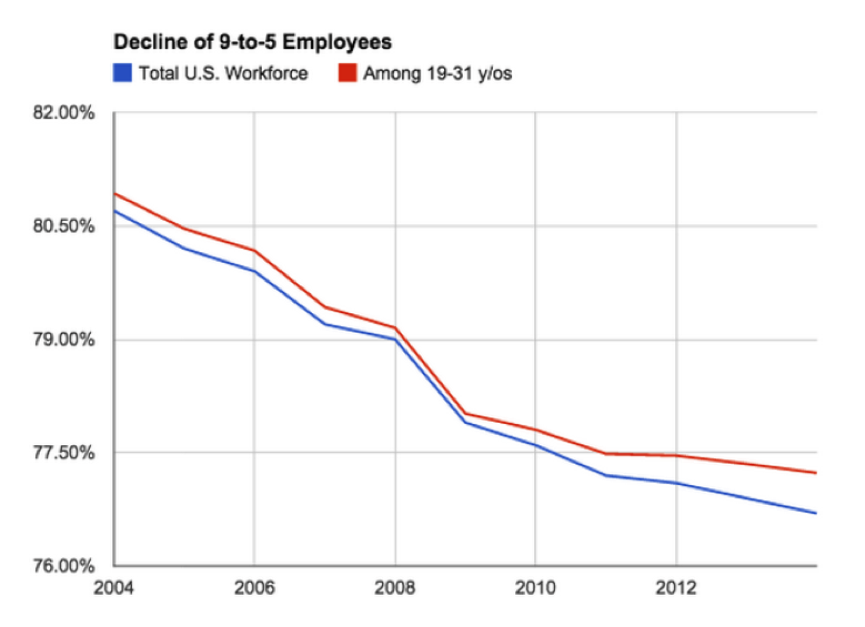
And data from research group EconomicModeling.com show the share of traditional, 9-to-5 workers in the labor force has declined…..

Mauldin-Economics-Gig-Economy
Source: Fusion, data via EconomicModeling.com

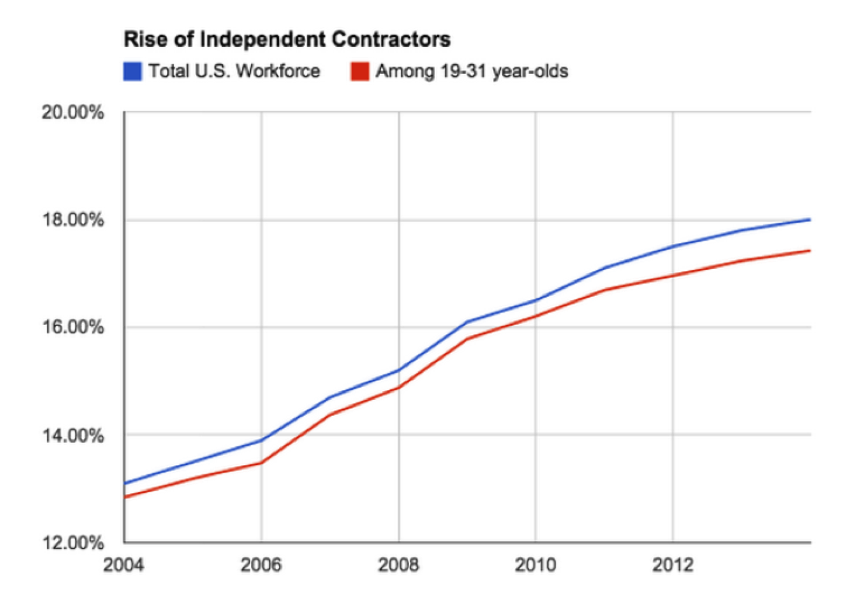
… while those who categorize themselves as “miscellaneous proprietors” is climbing.

Mauldin-Economics-Gig-Economy
Source: Fusion, data via EconomicModeling.com

A recent survey found 60 percent of such workers get at least 25 percent of their income from gig economy work.

The problem with the BLS estimates is that they overlook a sizable chunk of the true gig economy.
And this report absolutely squares with what my friend Murat’s research is showing: that gig economy is not shrinking. On the contrary, it’s on the rise, and a quite rapid rise.

Subscribe to Thoughts from the Frontline

Follow Mauldin as he uncovers the truth behind, and beyond, the financial headlines in his free publication, Thoughts from the Frontline. The publication explores developments overlooked by mainstream news to help you understand what’s happening in the economy and navigate the markets with confidence.

The article was excerpted from John F. Mauldin’s Thoughts from the Frontline. Follow John Mauldin on Twitter. The article How Big the Gig Economy Really Is was originally published at mauldineconomics.com.


Get our latest FREE eBook "Understanding Options"....Just Click Here!

Monday, August 31, 2015

How I Learned to Stop Worrying and Love Market Fluctuations

By Patrick Cox

Most of you know that my day job involves finding disruptive technologies for investors. Most of you also know that the stock market has recently taken a southward plunge.

When I was younger, I always wondered why big fluctuations in markets seemed to cause so many people so much anxiety and consternation. It’s not as if we don’t know that, historically, markets have always displayed big swings. Understanding this, it always seemed clear to me that a rational individual would not invest money in equities if that money might be needed in the short run.

Obviously, I have a tendency to overestimate other people’s rationality because every one of these big swings inevitably creates the same predictable tsunami of lamentation and dread. So, once again, I’m feeling like an outsider in this industry. Not only am I emotionally unaffected by the market’s downturn, I’m pleased… for several interrelated reasons.

One reason is that fluctuations induce resiliency. A steady predictable market is a market that is susceptible to being stampeded, either up or down. Neither is particularly good for the economy. Nevertheless, the traders who take big paper losses when the market takes a nose dive tend to sell off, allowing investors to buy at reduced prices. This is good for the economy. Big fluctuations tend to move resources into the hands of investors, where they are less volatile and better serve the overall economy.

This means that fluctuations serve the interests of serious investors. The secret to success in the market is to “buy low and sell high.” Mathematically, this investment philosophy is pretty much impossible to implement if the market is never low. If you’re an investor rather than a trader, you welcome big downturns because they provide bargain prices.

I’ve talked to several other investment analysts recently about this and none of them share my perspective. They know that I’m right about the long run, but they worry when their customers are worried. My policy, however, is to make sure that my subscribers know that such events are going to happen as surely as the seasons change.

Moreover, I make sure to tell them that they should always be prepared to exploit the panic of the herd to add beaten-down stocks to their portfolios. If you implement this strategy, big downturns (like the one we’ve been seeing) are huge financial opportunities as well as a reason to celebrate.

There is, however, a third reason to welcome downturns. Sometimes, markets need to go down.

If the world reflected the wishes of investors and analysts, stocks would all go up… forever. But that’s not how the world or capitalism works. For progress to be made, innovation has to replace established and formerly successful businesses. Joseph Schumpeter, probably my favorite economist, coined the term “creative destruction” to describe this process.

The concept of creative destruction may seem oxymoronic simply because most people don’t think of destruction as a positive or creative process. Schumpeter, however, was an economist versed in the biological sciences. He was well aware of the fact that evolutionary processes always move forward by doing away with less adaptive systems. Creation of the new requires the destruction of the old.

A lot of people don’t understand or like this, but the extinction of species is the cost of adaptation. For innovation to move forward, the old order must die. Typically, investors are among those who fear this sort of change.

This brings me back to my original question: “Why aren’t I bothered by the destruction inherent in market downturns?” Prior to having my genome sequenced and analyzed, I had no clue. In fact, I never expected to have any sort of insight into why I am the way I am.

That changed when my genome was sequenced and analyzed by brilliant genomicists. Besides having markers associated with autism, I have significant contribution of genes associated with Neanderthal ancestry. Both characteristics are believed to reduce emotional sensitivities, though hopefully not in any sort of sociopathic way. In fact, the analysis of my genome was unsettling in many ways… simply because I saw so many of my personal characteristics in the code of my DNA. I’m not saying we are biological machines.

I am saying, however, that there are sophisticated and subtle things about every one of our personalities and natures rooted in our genes. Next week, I think I’ll get around to telling you how my sequenced genome settled a generations long argument my father’s family has had about our racial makeup.

I think it’s appropriate that there be some sort of personal impact from genomics. The decoding of our software is, after all, changing everything. Genomics may be the single greatest source of creative destruction our species has yet seen.

What we know today about the genetic causes of disease is changing medicine, but we’ve only begun to unravel the double helices of our fates. Every day, some new genetic discovery opens up new avenues to increase human health and health spans. The implementation of this new knowledge will not be a consistent process. It will be creative destruction at its best, yielding dramatic improvements in healthcare technologies while leaving entire sectors of the economy in ruin.

Despite the fact that everybody knows our healthcare institutions are obsolete and failing, many of those in the crosshairs of creative destruction are whistling in the wind, pretending that all is well. Moreover, they will resist change with their considerable institutional resources. But they will lose. And they will lose sooner than almost anybody expects.

Last week, I talked about Eric Topol, M.D., the cardiologist, geneticist, researcher, and writer who serves as Director of the Scripps Translational Science Institute in La Jolla, California. Topol is predicting rapid and radical change in the ways that healthcare is delivered. I’m currently reading his new book, “The Patient Will See You Now: The Future of Medicine is in Your Hands.”

If you don’t want to read a book, I would really recommend watching the following video about the way digital medicine will change and improve healthcare. This wakeup call is appropriately titled, “Creative Destruction of Medicine.”


Delivered at Strictly Mobile 2014 in Mountain View, CA, it is primarily about the impact of mobile devices on healthcare, but he refers to the much bigger impact that genomics will have on medicine. It’s not surprising that he only glosses over this area, however, as it is a topic way too big for a YouTube video.
Patrick Cox

From the TransTech Digest research team: To begin reading Patrick’s Tech Digest newsletter for free each Friday, simply click here. At Patrick’s Transformational Technologies site, you can join Tech Digest by entering your email address at the top right of the page. Thanks for reading.


Get out latest FREE eBooK "Understanding Options"....Just Click Here

Saturday, August 22, 2015

Why You Should Go to Africa Instead of College

By Doug Casey

Recently Doug Casey was a guest on the always excellent podcast, The Tom Woods Show. Tom and Doug talked about the enormous economic potential in Africa, Doug’s efforts to build a truly free market country, and better uses of your time and money than going to college.

It’s an exciting and informative conversation.


Tom Woods: What a pleasure and a delight it is to welcome back to the show Doug Casey. Doug is a libertarian economist, best selling financial author, international investor, entrepreneur, and the founder and chairman of Casey Research. Doug, welcome back to the show.

Doug Casey: Thanks, Tom. It is my pleasure.

Tom: You’ve been up to some interesting activity in Africa that I’d like to ask you about. Let’s start off by telling us what you’ve been busy doing there.

Doug: Well, the last two weeks, I’ve been visiting the Islamic Republic of Mauritania with a short side trip to Senegal. I’ve been pursuing my hobby, which is to propose to a backward country a plan for complete and total free marketization… including taking the country itself public on a major stock exchange and distributing most of the shares directly to the people who theoretically own the government assets. I felt like I had Maria Muldaur’s “Midnight at the Oasis” playing in the back of my mind the whole time I was there.

Tom: Suppose you got everything you wanted, what would the outcome look like?

Doug: Well, 100% of all government assets, land, state owned companies - everything - initially go into a corporation and we distribute the shares.

Let’s say, 70% pro-rata to every man, woman, and child in the country, so they don’t just theoretically own the government, now they actually do. 15% would be put it in trust for the next unborn generation to defuse that time bomb. 10% would be distributed to people who, let’s say, are of significant help to making this happen, and people who are important, whose rice bowls would be broken, and 5% to take public in major stock markets to raise some capital. Then we get rid of all duties, taxes, and regulations.

Dubai was absolutely nothing in 1980. You know what Dubai is now. If we go back further, in 1960, Hong Kong and Singapore both were very poor and look what has happened to them. So I think in today’s world if somebody is daring enough to want to do this, I think it could be of world historic importance. So I’m looking for the right guy.

Tom: I’d like to get a glimpse inside of a meeting like this. If you’re sitting down with the president, you’re sitting down with top officials, how do you make that case, especially when the response is going to be, “What’s in it for me”?

Doug: Well, that’s always the first question, of course. I start my presentation with three things I can do for you, Mr. President. It’s always a question of the benefit to the buyer. Number one, this plan will make you legitimately a multibillionaire. That always goes down very smoothly, because they know that doing what Mobutu and Mugabe did doesn’t work quite as well now as it did in the past. So it gets their attention.

Number two, the people will love you and treat you as the new George Washington. That sounds pretty good too. Half the time in these places most of the population wants to kill them. And number three, we will put you on the front cover of all the world’s magazines in a favorable light for the next decade. Now that sounds good, because these people, if they are even known to exist, are considered pariahs.

So they always listen to the rest of presentation. Of course then things start to go wrong… usually from people under the president. It’s the people under the president who are usually making the big money, not so much the president himself. So they are often the problem.

It always makes for a fun adventure and interesting cocktail party stories that I can tell and retell to people for hours. But it’s my hobby. It’s not an occupation. I haven’t made any money on it yet, although I always have a plan B when I go to these countries: look for mining concessions and so forth.

Tom: Suppose you had to do it all over again. Let’s say you turned 18 in 2015. Have conditions changed to the point where you would take a different path, and incidentally would you go to college?

Doug: I would definitely not go to college. Even then, I only did it because everybody from my socioeconomic class was going to college, so there was no thought involved on my part. It was just like going from eighth grade into high school. I counsel students against it today. College serves no useful purpose unless you want to learn a trade like doctoring or lawyering or you need a piece of paper to practice a particular occupation, or there is a formal discipline, like a hard science or engineering.

You will pick up lots of bad ideas. You will spend a huge amount of money, get yourself under a huge financial rock that will take you years to dig yourself out from under. What I suggest people do instead is lay out what the most intelligent thing to do with that four years of time and probably $200,000 of capital. I like the idea of traveling. The place that I would put first and foremost on my travel list today for economic reasons is Africa. Go someplace where you can be a big fish in a small pond quickly.

Tom: Back in the ’50s and ’60s in the wake of decolonization in Africa, you had a bunch of Western educated semi-Marxist political leaders who were nationalizing property and confiscating assets from rich people and so on, you wouldn’t touch Africa with a ten foot pole. What has changed since then?

Doug: Well, politics always draws the worst kinds of people of course. Most of the presidents of Africa even today are ex-generals or ex-colonels or something like that. It has economically improved a lot. The population has exploded and it’s going to explode more in the years to come. It’s chaotic. But if you can bring order to chaos, that’s opportunity.

If you go to the Orient, there are a lot of rich, smart people there. You are not going to have much of a competitive advantage. That’s true to a lesser extent in South America too. Africa is actually the place, I think, you want to go.

Tom: Do you have any particular parts of Africa? I’ve heard good things about Botswana. Do you have any place in particular that attracts you?

Doug: Other than South Africa, I’d say Botswana is the most developed country in Southern Africa for sure. But where would I go now? Well, of course, the nice thing about Africa is that it’s divided basically into three parts, Anglophone Africa, Francophone Africa, and Lusophone Africa, and my French is still adequately conversational. I lived in France and Switzerland for a year during college. My Spanish is functional. The language thing is a consideration of course. But on the other hand, most of the educated people in most countries of the world speak English, which is the world’s lingua franca today.

Where would I go? There are around 50 countries in Africa. I like small, obscure ones. Maybe Ghana is too developed. Look at Benin or Togo or maybe the Ivory Coast. Mauritania, where I just was, is actually quite interesting. Guinea-Bissau, Guinea-Conakry, you’ve got lots of choices. Somebody should get on a plane and just take a look. Then when they get into a country, a capital city, which is always where the action happens, get on the telephone to local lawyers and real estate agents and businessmen to set up appointments and see who you can get along with. One thing will lead to another.

I wouldn’t go to Africa as a lifestyle choice. I would go there for economic reasons and for the adventure that it would yield. I’d say as a lifestyle choice, it comes down to South America or the Orient. I lived in the Orient for years and I loved it.

Tom: What about the language barrier?

Doug: Well, I lived in Hong Kong and when I was there it was much more English. Of course everybody in China is learning English today, everybody, everywhere that you basically would want to talk to. I’m not trying to be elitist but the educated people - put it that way - all speak English today as a second language. This is one of the things that will slow down your progress on learning the local language, is that they all want to speak English to you. So that’s a double edged sword… but it’s really an advantage. No, don’t worry about the language problem.

Tom: Well, I sure appreciate your time, Doug Casey. You are the International Man himself, and we are always grateful for your time.

Doug: Well, thank you Tom. It is a pleasure to talk to you under any circumstances.

Editor’s Note: International Man is all about helping you make the most of your personal freedom and financial opportunities around the world. A great way to get started is to check out Going Global 2015. Normally, this book retails for $99. But we believe this book is so important, especially right now, that we’ve arranged a way for US residents to get a free copy. Click here to secure your copy.

The article was originally published at internationalman.com.


Get our latest FREE eBook "Understanding Options"....Just Click Here!

Friday, August 21, 2015

Riding the Energy Wave to the Future

By John Mauldin 

“Formula for success: rise early, work hard, strike oil.” –  J. Paul Getty

This week’s yuan devaluation was big news, but it’s really part of a much bigger saga. Events around the globe are combining to create huge economic change over the next few years. We are watching giant, multidimensional chess games played by some master players. Energy is the chessboard that connects all the players. What happens when the board changes shape in the middle of the game? If you don’t know the new energy landscape, you’ll have a hard time playing to a draw, much less winning.

Today I’ll tell you about some big shifts in the energy industry. These shifts are about as positive as can be, unless you need high oil prices to run your country. In the long run, these changes are bullish for the whole world, which I think this will surprise many of you. And though we’ve been used to thinking about energy and technology as two different facets of modern life, today they are inextricably linked.
When energy changes, everything else changes, too.

16 Candles

Thoughts from the Frontline is now entering its 16th year of continuous weekly publication. I constantly meet readers who have been with me since the beginning – and even some who read an earlier print version of my letters. I put TFTF on the Internet in August 2000 as a free letter, starting with just a few thousand names, and was amazed at how rapidly it grew. It took just a few years for me to realize that this new thing called the Internet was the real deal, and I discontinued my print version. We now push the letter out to almost one million readers each week, and the letter is posted on dozens of websites.

I began to archive the letter in January 2001; and every issue – the good, the bad, and the sometimes very ugly – is still there in the archives, just as I wrote it. I will admit there are a few paragraphs, and maybe even a whole letter or two, that I would like to go back and expunge from the record. But I think it’s better just to let it all be what it is.

Investing in energy without the risk....Here's what our trading partner John Carter is doing.

I thank you for allowing me to come into your homes and offices each week. I consider it a privilege and honor to be able to offer you my research and thoughts. This letter has been free from the beginning, and my full intent is that it will always remain that way. Longtime readers know the topics can vary widely over the course of the year. I write about what I find interesting that week. I find that writing helps me focus my own thinking.

If you are reading this for the first time, you can go to www.mauldineconomics.com, subscribe by giving us your email address, and join my one million closest friends who get my letter each week. And if you’re a regular reader, why not give me a 16th birthday present and suggest to your friends that they subscribe too! I also want to thank the staff and my partners, who make it possible for me to spend the bulk of my time thinking and writing. And traveling, of course. And now let’s think about energy.

The Cover Pic Indicator

Contrarian and value investors like to buy assets that are in distress, or at least “out of favor.” You don’t hear much about those assets at the time. That’s part of being distressed – everyone ignores you. So, following that logic, the last thing you want to buy is a stock or industry that appears on the cover page of popular financial publications. Commodity and energy bulls should take note of last weekend’s Barron’s cover.


“COMMODITIES: TIME TO BUY,” Barron’s practically screamed at its readers. In case you can’t read the fine print on the cover, it says, The harsh selloff in energy, gold, and other commodities is starting to look like capitulation. Opportunities in Exxon, Chevron, BHP, Goldcorp. Plus six funds and six ETFs to help build a position in this oversold sector.

I presume the photo is supposed to show the sun rising on an oil rig, not setting. The article quotes some very smart people who are bullish on commodities right now. Some energy stocks look like real bargains. Barron’s is simply repeating the market’s conventional wisdom: After a brutal decline, oil prices are stabilizing and should head higher as the global economy recovers.

That’s a perfectly defensible position – but I think it’s wrong.

It’s wrong because it misses a major shift in the way we produce energy. Many people think OPEC’s high oil and gas prices led to the US shale energy boom. That’s not right. The shale boom was born in a time of lower energy prices, and it was the result of new technologies that make recovering large quantities of oil and gas less expensive than ever.

I used to get the occasional letter from James Howard Kunstler, who would tell me that whatever letter I had just written was completely bass-ackwards, and how his books explained that we were going to run out of energy and then collapse. His books (Wikipedia lists about a dozen) and dozens of others warned us of Peak Oil. (For the record, James, a certain longtime editor on my staff made sure I got all your letters, reports, and more, as he is firmly in your camp! I kept smiling and saying that he was (and is) wrong; but Charley is a phenomenal editor, and you put up with a few quirks for brilliant editing that makes you look better. Besides, if the world does come to an end, I can wend my way to his survivalist farm and beg for a job and food, although I’m not exactly sure I’m ready to milk goats. Just for old time’s sake.)

I have written for years that Peak Oil is nonsense. Longtime readers know that I’m a believer in ever-accelerating technological transformation, but I have to admit I did not see the exponential transformation of the drilling business as it is currently unfolding. The changes are truly breathtaking and have gone largely unnoticed.

By now, you probably know about fracking, the technology where drillers pump liquids into a well to “fracture” the ground and release oil and gas deposits. It’s controversial in certain quarters, especially among those who hate anything carbon-related.

Fracking technology is moving forward like all other technologies: very fast. Newer techniques promise to reduce the side effects, at even lower operating costs. Furthermore, fracking is only the beginning of this revolution. The Manhattan Institute recently published an excellent (bordering on brilliant) report by Mark P. Mills, Shale 2.0: Technology and the Coming Big Data Revolution in America’s Shale Oil Fields. I highly recommend it.

Mills outlines the way the new technologies are turning this industry on its head. Shale production or “unconventional” production is really a completely new industry.

Here is a short quote: The price and availability of oil (and natural gas) are determined by three interlocking variables: politics, money, and technology. Hydrocarbons have existed in enormous quantities for millennia across the planet. Governments control land access and business freedoms. Access to capital and the nature of fiscal policy are also critical determinants of commerce, especially for capital-intensive industries. But were it not for technology, oil and natural gas would not flow, and the associated growth that these resources fuel would not materialize.

While the conventional and so-called unconventional (i.e., shale) oil industries display clear similarities in basic mechanics and operations – drills, pipes, and pumps – most of the conventional equipment, methods, and materials were not designed or optimized for the new techniques and challenges needed in shale production. By innovatively applying old and new technologies, shale operators propelled a stunningly fast gain in the productivity of shale rigs (Figure 4), with costs per rig stable or declining.


[Look at the above chart for a few moments; it’s truly staggering. In just seven years, the amount of oil per well in some shale plays has risen by a factor of 10! That is almost all due to new technologies that are increasingly coming online.]

Shale companies now produce more oil with two rigs than they did just a few years ago with three rigs, sometimes even spending less overall. At $55 per barrel, at least one of the big players in the Texas Eagle Ford shale reports a 70 percent financial rate of return. If world prices rise slightly, to $65 per barrel, some of the more efficient shale oil operators today would enjoy a higher rate of return than when oil stood at $95 per barrel in 2012.

Read that last paragraph again. Some shale operators can make good money at $55 a barrel. At $65, they can make higher returns than they did three years ago with oil at $95. I have friends here in Dallas who are raising money for wells that can do better than break even at $40 per barrel, although they think $60 is where the new normal will settle out. Texans are nothing if not optimistic.

To continue reading this article from Thoughts from the Frontline – a free weekly publication by John Mauldin, renowned financial expert, best selling author, and Chairman of Mauldin Economics – please click here.


Get our latest FREE eBook "Understanding Options"....Just Click Here!

Thursday, August 13, 2015

Closing the Sausage Factory

By John Mauldin

“Bureaucracy destroys initiative. There is little that bureaucrats hate more than innovation, especially innovation that produces better results than the old routines. Improvements always make those at the top of the heap look inept. Who enjoys appearing inept?”
– Frank Herbert, Heretics of Dune

“Economies naturally grow. People innovate as they go through life. They also look around at what others are doing and adopt better practices or tools. They invest, accumulating financial, human and physical capital. Something is deeply wrong if an economy is not growing, because it means these natural processes are impeded. That is why around the world, since the Dark Ages, lack of growth has been a signal of political oppression or instability. Absent such sickness, growth occurs.”
– Adam Posen, “Debate: The Case for Slower Growth

Today’s letter will be shorter than usual, because I’m at Camp Kotok in Grand Lake Stream, Maine, where the first order of business today is trying to outfish my son (not likely to happen, this year). But I’ve been looking closer at productivity barriers, and I want to give you some points to ponder.

The New Normal?

Like many of you readers, I’m old enough to remember a time when 2.3% annual GDP growth was a disappointment. We always knew America could do better. Not anymore, apparently. Some people actually cheered last week’s first estimate for 2Q real GDP growth. It was 4.4% in nominal terms, but inflation brought the figure back down. While certain segments are growing like crazy, for the most part we are muddling along in a slow growing malaise. You might even call it “stagnant.”

I for one still think the United States can do more. We have a large population of intelligent people who want to build a solid future for their children. They’re willing to work hard to do it. If that’s not happening – and clearly it isn’t – some barrier must be standing in their way. What is this barrier to productivity and growth? There are actually several, but government red tape is one of the biggest. I thought about this after reading an excellent Holman Jenkins column in the Wall Street Journal last week.

Jenkins led me to an audio recording of an interesting discussion on “The Future of Freedom, Democracy and Prosperity,” conducted at a symposium held at Stanford University’s Hoover Institution last month.
Government research & development funding has fallen off considerably from its peak in the 1970s moonshot days. This holds back worker productivity. The federal government is doing too much to slow down business and not enough to boost it.

The three economists who spoke at Stanford all pointed to important productivity barriers emanating from Washington DC.....

One of the participants, Hoover economist John Cochrane, spoke of fears that America is drifting toward a “corporatist system” with diminished political freedom. Are rules knowable in advance so businesses can avoid becoming targets of enforcement actions? Is there a meaningful appeals process? Are permissions received in a timely fashion, or can bureaucrats arbitrarily decide your case by simply sitting on it?

The answer to these questions increasingly is “no.” Whatever the merits of 1,231 individual waivers issued under ObamaCare, a law implemented largely through waivers and exemptions is not law-like. In such a system, where even hairdressers and tour guides are subjected to arbitrary licensing requirements, all the advantages accrue to established, politically connected businesses.

The resources that businesses put into complying with government regulations is staggering. I have often envied people outside the highly regulated financial industry for their freedom to operate rationally. In my business we seem to spend half our time – and an ungodly fraction of our money – just maneuvering through the regulatory morass.

Intrusive federal regulations touch every part of the economy:
  • Energy and mining companies have to deal with environmental protection rules.
  • Drug companies and health care providers must satisfy the FDA and Medicare.
  • Cloud technology companies have to process FBI and NSA demands for user information.
  • Retailers and consumer product makers are required to abide by the fine print on millions of product labels.
I could go on, but you get the point. Anything you do attracts bureaucratic oversight now. We may laugh at “helicopter parents” hovering over their children at school, but we all have a helicopter government looking over our shoulders at work.

Before anyone calls me an anarchist, I think some government regulation is perfectly appropriate. We all want clean drinking water. Everyone appreciates knowing our cars meet crash survival standards. I’m glad FAA is keeping order in the skies.

The problem arises when agencies enforce confusing, contradictory, and excessive regulations and try to micromanage the nation’s businesses. Every business owner I know is glad to play by the rules. They just want to know what the rules say, and that is frequently very hard to do.

A few weeks ago, in “Productivity and Modern-Day Horse Manure,” I explained that growth is really quite simple: if we want GDP to grow, we need some combination of population growth and productivity growth.

The US population is growing, thanks mainly to immigration, but the effectiveness of the workforce is another matter. Baby Boomer retirements are rapidly removing productive assets from the economy. To offset that trend, we need to make younger workers more productive.The red tape that constantly spews out of Foggy Bottom is not helping matters.

Regulatory Capture

The red tape hurts the economy overall, but it does help certain parties. The largest players in any niche often “capture” their regulators. Then they use their influence to tilt enforcement away from themselves and toward smaller competitors.

Put simply, new regulations can be great for your business if you are already well established and have the resources to comply with government mandates. New entrants rarely have those resources. The resulting lack of competition boosts profits for the big players but hurts consumers. The competition that would normally lead to better, less expensive goods and services never happens.

Holman Jenkins makes another great point about how over regulation affects growth.

Another participant, Lee Ohanian, a UCLA economist affiliated with Hoover, drew the connection between the regulatory state and today’s depressed growth in labor productivity. From a long-term average of 2.5% a year, the rate has dropped to 0.7% in the current recovery. Labor productivity is what allows rising incomes. A related factor is a decline in business start ups. New businesses are the ones that bring new techniques to bear and create new jobs. Big, established companies, in contrast, tend to be net job shrinkers over time.

Recall our economic growth formula: population growth plus productivity growth. The US population grew at a peak rate of 1.4% in 1992, and growth has been trending down ever since. Now it is around 0.75% per year. Add that to 0.7% productivity growth, and you see why Jeb Bush’s 4% growth target will be so hard to hit.

Blame Flows Downhill

Business leaders love to complain about the bureaucrats who run Washington’s alphabet-soup agencies. I think the problem goes deeper. With only a few exceptions, the regulators I’ve met over the years have been competent professionals. They weren’t intentionally trying to hurt my business. Often the regulations confused them as much as they confused me.

The real blame, I think, starts on Capitol Hill. Our legislative process is a sausage factory. Congress passes vague, complicated laws riddled with exceptions for this and zero tolerance for that. The result is superficially attractive but a mess inside. People in the alphabet agencies then have to remove the sausage skin and make sense of the contents. This would be a tough job for anyone. I certainly don’t envy them.

Jenkins mentions Obamacare’s convoluted waivers and exemptions. Even its advocates admit the law is a crazy mess. But how and why did it get that way?

To continue reading this article from Thoughts from the Frontline – a free weekly publication by John Mauldin, renowned financial expert, best selling author, and Chairman of Mauldin Economics – please click here.


Get our latest FREE eBook "Understanding Options"....Just Click Here!

Tuesday, July 14, 2015

It Could Never Happen Here

By Jared Dillian


I was watching the 6 o’clock news and saw images of closed banks in Greece and people lined up at ATMs. I’m sure you did, too.

This must seem surreal to most people because it seems so remote. But put yourself in these people’s shoes for a second. You have money in the bank. Suddenly you can’t get to it. After standing in long lines, you can only get 60 euros at a time, which isn’t going to last you very long.

What if you didn’t plan adequately and haven’t stashed away any cash? The banks will be closed for a while. What happens?

How do you pay for rent? Or food?
How does your employer pay you?
Do you go homeless? Or hungry?
Do you get really angry, take to the streets, blame someone or something (probably the wrong thing), break stuff, set things on fire?
Will Greece descend into anarchy?
It might.


Doomsday Preppers


Of course, not everyone in Greece is hurting. Many people saw this coming and took action. They took all their money out of the banks, put it under the mattress, or maybe stored it in a safe. Maybe they bought gold, or diamonds, or something else. These people aren’t standing in lines at ATMs. They aren’t going to go homeless or hungry.

But these people get a pretty bad rap—at least here in the US, where we call them “doomsday preppers.” Or “bunker monkeys.” Or “conspiracy theorists.” Or “gold bugs.” They take a beating. Jim Rickards tweeted the other day, “I’ll bet there a lot of Greeks saying, ‘I wish I had bought some gold.’" Truer words have never been spoken.

This week’s issue of The 10th Man is not a gold promotion, but rather a broader discussion about how you can prepare for financial catastrophe. People keep fire extinguishers and first aid kits in their cars. They test their smoke alarms twice a year. They purchase flood insurance or, in my neighborhood, hurricane shutters.
Why would you do all these things but just leave your money in the bank and hope for the best?

I have studied all kinds of financial crises in all parts of the world, from depressions to hyperinflations. The thing they all have in common is that people who do not prepare get crushed. People who are not appropriately paranoid get crushed.

There is such a thing as being too paranoid (if everything you own is in gold and hard assets, you can miss out on some meaty returns in financial assets), but a little paranoia is healthy. For a few years, I had a pretty concrete escape plan, with assets, just in case.

In case of what?.....In case of anything.

No Sympathy Whatsoever


I don’t feel sorry for Greece. I don’t feel sorry for the people in the ATM lines. They have had years to prepare for this day. Most people in similar situations don’t have so much time. I’m shocked that the banks had any deposits left at all.

Probably what will happen is that the banks will require a Cyprus-like bail-in and the depositors will take a massive haircut, getting only a fraction of what they once owned. There are no wealthy Russians to go after. The burden will fall on ordinary Greeks.

It’s also hard to feel badly for a nation of people who have chosen to pursue this ruinous political path—people who cast 52% of their votes for communists or neo Nazis, and who have proven completely unable to take any responsibility for what has transpired.

Greece will probably respond to the failure of extreme left Syriza by electing even more extreme politicians. It seems likely that they will choose a strongman to “get things done.” I think people fail to understand how totalitarianism can happen in the 21st century. Think of this as a YouTube tutorial video on the subject.

Full Faith and Credit


A financial crisis of similar magnitude will happen in the US someday. The only question is whether it will happen in 20 years or 50 or 100 or 200. But it is a virtual certainty. My only hope is that I won’t live long enough to see it.

Still, I know how to prepare for it. You know, in the old days before deposit insurance, people used to keep their money in five to ten different banks to diversify their counterparty risk. If a bank was perceived to be less creditworthy, the banknotes would trade at a discount.

I think that in the days of FDIC and various investor protections, we are lulled to sleep, believing that things really are safe when in reality, they are not. We were hours away from a complete and total financial collapse when the Reserve Primary fund broke the buck and there was a run on the money market mutual funds. We were that close.

After those dark days in 2008, I vowed that I’d never be in that position again.

You do sacrifice investment returns when you do this kind of stuff. Cash or gold or diamonds doesn’t yield anything. But then again, nowadays, neither do bonds. Don’t let the financial media shame you into thinking that taking basic emergency precautions to protect yourself financially is somehow “crazy.”

You can overdo it, though. You don’t need that many cans of pork and beans.
Jared Dillian
Jared Dillian

The article The 10th Man: “It Could Never Happen Here” was originally published at mauldineconomics.


Get our latest FREE eBook "Understanding Options"....Just Click Here!

Wednesday, January 7, 2015

Q3 GDP Jumps 5%; Ha! The Crap Behind the Numbers

By Tony Sagami


I was raised on a farm and I’ve shoveled more than my share of manure. I didn’t like manure back then, and I like the brand of manure that comes out of Washington, DC, and Wall Street even less. A stinky pile of economic manure came out of Washington, DC, last week and instead of the economic nirvana that it was touted to be, it was a smokescreen of half truths and financial prestidigitation.


According to the newest version of the Bureau of Economic Analysis (BEA), the US economy is smoking hot. The BEA reported that GDP grew at an astonishing 5.0% annualized rate in the third quarter.
5% is BIG number.

The New York Times couldn’t gush enough, given a rare chance to give President Obama an economic pat on the back. “The American economy grew last quarter at its fastest rate in over a decade, providing the strongest evidence to date that the recovery is finally gaining sustained power more than five years after it began.”


Moreover, this is the second revision to the third quarter GDP—1.1 percentage points higher than the first revision—and the strongest rate since the third quarter of 2003.


However, that 5% growth rate isn’t as impressive if you peek below the headline number.

Fun with Numbers #1: The biggest improvement was in the Net Exports category, which increased by 112 basis points. How did they manage that?  There was a downturn in Imports.

Fun with Numbers #2: Of the 5% GDP growth, 0.80% was from government spending, most of which was on national defense. I’m a big believer in a strong national defense, but building bombs, tanks, and jet fighters is not as productive to our economy as bridges, roads, and schools.

Fun with Numbers #3: Almost half of the gain came from Personal Consumption Expenditures (PCE) and deserves extra scrutiny. Of that 221 bps of PCE spending:
  • Services spending accounts for 115 bps. Of that 115, 15 bps was from nonprofits such as religious groups and charities. The other 100 bps was for household spending on “services.”
     
  • Of that 100 bps, the two largest categories were Healthcare spending (52 bps) and Financial Services/Insurance (35 bps).
The end result is that 85% of the contribution to GDP from Household Spending on Services came from healthcare and insurance! In short… those are code words for Obamacare! While the experts on Pennsylvania Avenue and Wall Street were overjoyed, I see just another pile of white collar manure and nothing to shout about.

Fun with Numbers #4: Lastly, the spending on Goods—the backbone of a health, growing economy—declined by 27 bps.

In a related news, the November durable goods report showed a -0.7% drop in spending, quite the opposite of the positive number that Wall Street was expecting.

Of course, Wall Street doesn’t want little things like facts to get in the way of their year-end bonus. As we close out 2014, the stock market marched higher and ignored things like:
  • The reaction of the bond market to the 5% number. Bonds should have softened in the face of such strong economic numbers, but the “adults” (the bond traders) on Wall Street saw the same manure that I did.
     
  • If the economy was as healthy as the BEA wants us to believe, the “patience” and “considerable time” promise of the FOMC should soon be broken…...right?
I spend most of the year in Asia, including China, and I am seeing the same level of numbers massaging by our government as China’s. In China, the government leaders establish statistical goals and the government bean counters find creative ways to tweak the data to achieve those goals.

Zero interest rates.
24/7 central bank printing.
See no evil analysts.
Financial smoke and mirrors.

That’s the financially dangerous world we live in, and I hope that you have some type of strategy in place to deal with the bursting of what’s becoming a very big, debt-fueled bubble.
Tony Sagami
Tony Sagami

30-year market expert Tony Sagami leads the Yield Shark and Rational Bear advisories at Mauldin Economics. To learn more about Yield Shark and how it helps you maximize dividend income, click here.

To learn more about Rational Bear and how you can use it to benefit from falling stocks and sectors, click here.


Get our latest FREE eBook "Understanding Options"....Just Click Here!

Wednesday, December 24, 2014

Here is the Ideal Year End Portfolio Fix

By Dennis Miller

Some years back, my wife and I embarked on a cross country trip in our first motor home. Driving a 40 foot bus was a bit frightening at first. I was poking along in the center lane of I-75 and big tractor trailers were whizzing past me. The bus came with a Citizens Band radio. I tuned in to channel 19, listened to the truckers, and sure enough they were complaining about my slow driving. So I announced myself, told them I was a rookie and asked for their patience.

There was a brief pause. Then one savvy old trucker came on and said in a deep southern drawl, “Son, there is only one rule you need to know to stay safe. Keep’er ‘tween the lines!” That’s precisely what my team and I recommend every investor do this month: keep your portfolio between the lines. One of the more popular investment strategies is to ride your winners and dump your losers. It’s hard to argue with that approach. You can buy 10 stocks, have five winners and five losers, and still make a lot of money.

Another popular strategy is to buy and hold, particularly larger companies that are big, profitable, and not likely to go anywhere. Those who recommend this strategy point to historical gains. That’s all well and good; but as Mike Tyson said, “Everybody has a plan until they get punched in the mouth.” Many of my friends were punched square in the jaw during the 2007-2008 meltdown.

Many had recently retired, taken a lump sum out of their 401(k)s, and invested 100% of their retirement savings in the market. Talk about a right hook! You work for the better part of 50 years, diligently make projections with your financial planner, and then your life savings shrinks by half... almost overnight. Follow that up with a trip to your advisor who says, “Trust me. Don’t worry. It will come back. It always does.”

Don’t worry?

In this case, they were right, eventually. The market recovered in less than six years. Does it always do that? Should we just hold an index fund and ride it out? The answer to both questions is “no.”

Protect Yourself Against the Next Right Hook


Portfolio rebalancing can be a very effective strategy, particularly with money earmarked for retirement. No one can guarantee the market will come back quickly from a downturn. Retirement investors must protect their principal because they might not have time to recover from a 40-50% drop in their net worth. Rebalancing your retirement portfolio is a critical step in protecting your assets. Instead of trying to maximize gains with excessive risk taking, anyone approaching retirement age should look to avoid catastrophic losses so that their portfolio can steadily provide income if and when they stop working.

The Best Protection


At Miller’s Money, protection starts with our three investment category allocations: 50% in Stocks, 20% in High Yield, and 30% in Stable Income (cash account substitutes). Within those categories we’ve implemented significant asset class and geographical diversification. We also recommend holding no more than 5% in any individual investment.

Rebalancing is nothing more than readjusting your portfolio at least annually to keep’er ‘tween the lines.
If you start with a $100,000 portfolio, then allocate $50,000 to your personal Stocks category with no more than $5,000 in any single investment. If you have a good year and your nest egg rises to $120,000, you adjust your stock allocation to $60,000 with no more than $6,000 in any single investment.

We hope that every year our portfolio grows and we have to sell some stocks at a gain to rebalance. Our strategy is to ride the winners and cut short any losses, minimizing the potential for Tyson style punches to the mouth. Buy and hold may work for 30 somethings, but it can be a death sentence for someone approaching retirement age.

Mr. Market does not care if you are working or retired; at some point there will be another sizable downturn. Rebalancing is key to keeping your wealth in tact when that happens. And, if you’re wondering where (if anywhere) bonds fit in to today’s best retirements plans, you can download a complimentary copy of the new Miller’s Money special report, The Truth About Bonds here.

The article The Ideal Year End Portfolio Fix was originally published at millers money


Get our latest FREE eBook "Understanding Options"....Just Click Here!

Friday, September 5, 2014

What does a “good” Chinese adjustment look like?

By John Mauldin


People of privilege will always risk their complete destruction rather than surrender any material part of their advantage. Intellectual myopia, often called stupidity, is no doubt a reason. But the privileged also feel that their privileges, however egregious they may seem to others, are a solemn, basic, God-given right. The sensitivity of the poor to injustice is a trivial thing compared with that of the rich.
– John Galbraith, The Age of Uncertainty

Malinvestment occurs when people do stupid things with free money. One of the characteristics of malinvestment is its dominance; i.e., other investments have little chance of competing. Malinvestments always bust and end in liquidation.
–  Joan McCullough, writing yesterday in her daily commentary

Worth Wray and I have been writing for some time now about the problems that are developing in China. Worth is somewhat more pessimistic about the outcomes than I am, but we agree that China is problematic. China is the number one risk, in my opinion, to global financial economic stability, more so than Europe or Japan, which are also ticking time bombs.

I contend that Xi and Li are the most radical leaders of the Chinese nation since Deng Xiaoping, with the emphasis being on Xi. He is shaking up the current power structure by going after some of the entrenched leaders for corruption. He has earned rebukes from a former president for his actions in op-eds in the Financial Times. This is extraordinary pushback and clearly shows that what is happening is beyond the normal regime-change shakeups we have seen in China.

Make sure you catch this weeks video "What Market Makers Don't Want You to Know".....Just Click Here

For today’s Outside the Box, we turn to my friend professor Michael Pettis to get his latest take on China. Michael’s biography describes him as a “Wall Street veteran, merchant banker, equities trader, economist, finance professor, entrepreneur – iconoclast – Michael Pettis is a unique individual living and working in China, at the heart of the world’s most exciting and vibrant economy.” He is certainly all that and more and just an all-around fun guy to hang out with. I mean, where else do you get a professor who also helps found an indie rock club in Beijing? I should note that he is a professor at Peking University’s Guanghua School of Management. He is published everywhere and gets to talk to “everyone” in China. So I pay attention to what Michael Pettis says when it comes to China. Michael writes a free blog but also has a subscription service that you can get to on his website.

He posted a blog on Monday asking the question, “What does a ‘good’ Chinese adjustment look like?” Which of course assumes there might be a bad Chinese adjustment.

And while the consequences of a smooth transition would be important for those who live in China, the consequences if Xi and Li get it wrong would be significant for the world. We need to be paying attention. This piece is a good overview of what “we” would like to see happen. But as Michael points out, there are some in China who very much don’t want our favored scenario to play out.

For most of the Western world, summer is officially over with the beginning of September, although technically the equinox will not arrive for another 20 days. For the most part, I enjoyed a lazy Labor Day (apart from the obligatory workout), ending with a cookout by the pool with family and friends, joined by David Tice (formerly of the Prudent Bear and my neighbor in the building) and his crew.

My kids gave me a lot of grief because I mentioned Henry’s birthday last week as being his 31st. It is his 33rd. In my defense I at least got the birthday part right. I cannot believe how fast my kids are growing up / have grown up. To see them interacting as adults is both pleasurable and unsettling. I don’t feel any older than they look, although my body complains every now and then and more than it used to. But I know that technically speaking I am anywhere from 29 to 45 years older.

But for the nonce I think I will ignore the technical part and go with my feelings. At least until reality issues a true wake-up call.

Your not ready to give up the game analyst,
John Mauldin, Editor
Outside the Box

Stay Ahead of the Latest Tech News and Investing Trends...
Each day, you get the three tech news stories with the biggest potential impact.

What does a “good” Chinese adjustment look like?

By Michael Pettis
Michael Pettis’ China Financial Markets

I have always thought that the soft landing/hard landing debate wholly misses the point when it comes to China’s economic prospects. It confuses the kinds of market-based adjustments we are likely to see in the U.S. or Europe with the much more controlled process we see in China. Instead of a hard landing or a soft landing, the Chinese economy faces two very different options, and these will be largely determined by the policies Beijing chooses over the next two years.

Beijing can manage a rapidly declining pace of credit creation, which must inevitably result in much slower although healthier GDP growth. Or Beijing can allow enough credit growth to prevent a further slowdown but, once the perpetual rolling-over of bad loans absorbs most of the country’s loan creation capacity, it will lose control of growth altogether and growth will collapse.

The choice, in other words, is not between hard landing and soft landing. China will either choose a “long landing”, in which growth rates drop sharply but in a controlled way such that unemployment remains reasonable even as GDP growth drops to 3% or less, or it will choose what analysts will at first hail as a soft landing – a few years of continued growth of 6-7% – followed by a collapse in growth and soaring unemployment.

A “soft landing” would, in this case, simply be a prelude to a very serious and destabilizing contraction in growth. Rather than hail the soft landing as a signal that Beijing is succeeding in managing the economic adjustment, it should be seen as an indication that Beijing has not been able to implement the reforms that it knows it must implement. A “soft landing” should increase our fear of a subsequent “hard landing”. It is not an alternative.

Surprisingly enough, until the announcement last month that Zhou Yonkang was under investigation, Premier Li has been pretty insistent that China will make its 7.5% growth targets, even as many analysts have lowered their expectations (Moody’s and the IMF are now saying that 6.5% is a possibility), and it is clear that President Xi is taking far more responsibility for and control of the economy than any recent president. My guess is that as the problems of the real estate sector kick in, with lower prices causing a drop in real estate development, which matters for employment, we are likely to see additional stimulus spending aimed at managing the threat of unemployment and, perhaps more importantly, at managing the possibility of rising anger among provincial elites as the glorious prospect of easy money continues to retreat.

This, to me, is the explanation for the rather surprising insistence by Premier Li in June that 7.5% GDP growth was a hard target. GDP targets are part of domestic signaling about the expected pain of adjustment. I suspect that lower growth targets are likely to generate greater opposition.

Certainly it does seem that growth has temporarily bottomed out. According to this June’s Financial Times, “Expenditure by local and central governments in China jumped nearly 25 per cent from the same month a year earlier, a sharp acceleration from the 9.6 per cent growth registered in the first four months of the year, according to figures released by the finance ministry,” and HSBC’s Flash PMI index suggests for the first time in six months that there has been an expansion in manufacturing, although the flash index is, of course, preliminary and may be revised.

Can Beijing rein in credit?


There should be nothing surprising about the improvement in some of the numbers. The “soft landing” that we are seeing is a consequence of credit growth. It means that it is proving politically hard to implement reforms as quickly as some in the administration would like, and it also means that we are getting closer to debt capacity constraints. We would be better off with the long landing scenario, in which GDP growth rates drop sharply but manageably by 1-2 percentage points every year.

I have written many times before that what will largely determine the path China follows is the political struggle the Xi administration will have in imposing the needed reforms on an elite that will strongly resist these reforms – mainly of course because these reforms must necessarily come at their expense. As an aside my friend, Ken Miller, with whom I was having a very different discussion last week, just sent me one of his favorite John Galbraith quotes (from The Age of Uncertainty) that seemed apropos.

People of privilege will always risk their complete destruction rather than surrender any material part of their advantage. Intellectual myopia, often called stupidity, is no doubt a reason. But the privileged also feel that their privileges, however egregious they may seem to others, are a solemn, basic, God-given right. The sensitivity of the poor to injustice is a trivial thing compared with that of the rich.

Although I don’t think China’s economy is adjusting quickly enough, especially credit growth, I remain cautiously optimistic that Beijing knows what it must do and will be able to pull it off. In an older issue of my blog, I tried to place the last 3-4 decades of Chinese growth in a historical context that recognizes four different stages of this growth process. By doing so I try to show how China’s own recent history can help us understand how to consider the policies President Xi must implement.

The first stage of China’s growth story, which occurred mainly during the 1980s, consisted of liberalizing reforms that undermined the Communist elite and which were strongly opposed by them. Because power was highly centralized under Deng Xiaoping, however, including a loyal PLA, he and the reform faction were nonetheless able to force through the reforms.

The next two stages of growth, I argued, required policies that had a very different relationship to the interests of the Chinese elite. Because they involved the accumulation and distribution of resources to favored groups whose role was to achieve specific economic targets, they helped to reinforce the wealth and power of a new elite, many of whose members were, or were related to, the old elite. Not surprisingly this new elite strongly supported the growth model imposed by Beijing during these stages.

The fourth stage, I argued, is the stage upon which we are currently trying to embark. In an important sense it involves liberalizing reforms similar politically to those that Deng imposed during the 1980s, making it vitally important to their success that the current administration is able to centralize power and create support to overcome the inevitable opposition, which it seems to be doing.

This is why, even though Beijing doesn’t seem to have yet gotten its arms around the problem of excess credit creation, I nonetheless think it is moving in the right direction. For now I would give two chances out of three that Beijing will manage an orderly “long landing”, in which growth rates continue to drop sharply but without major social disruption or a collapse in the economy. In this issue of the newsletter I want to write out a little more explicitly what such an orderly adjustment might look like.

Will financial repression abate?


The key economic policy for China over the past two decades has been financial repression. There have been three components to financial repressive policies. First, by constraining the growth of household income and subsidizing production, China forced up its savings rates to astonishingly high levels. Second, by limiting the ways in which Chinese households could save, mostly in the form of bank deposits, Beijing was able to control the direction in which these savings flowed. Finally, Beijing controlled the lending and deposit rates and set them far below any “natural” level.

Very low interest rates had several important impacts. First, because they represented a transfer from net savers to net borrowers, they helped to exacerbate the split between the growth in household income (households are net savers) and the growth in GDP (which is generated by net borrowers), and so led directly to the extraordinary imbalance in the Chinese economy in which consumption, as a share of GDP, has declined to perhaps the lowest level ever recorded in history.

Second, by making credit extremely cheap for approved borrowers, it created among them an almost infinite demand for credit. Financial repression helped foster tremendous growth in economic activity as privileged borrowers took advantage to borrow and invest in almost any project for which they could get approval.
Third, when China desperately needed investment early in its growth period, this growth in economic activity represented real growth in wealth. But low interest rates, along with the moral hazard created by implicit guarantee of nearly all approved lending, led almost inevitably to a collapse in investment discipline. Financial repression has been the main explanation for the enormous misallocation of capital spending we have seen in China during the past decade.

This is why understanding financial repression is so important to understanding the way in which China will adjust. There are two ways to think about the “cost” of financial repression to net savers. The least sophisticated but easiest to explain is simply to look at the real return on loans and deposits. In this case you would subtract the appropriate deflator from the lending or deposit rate.

In the US we usually use CPI inflation as the deflator, but for many reasons this won’t do in China. Consumption is a much lower share of GDP in China than in the US or anywhere else, so that it is less “representative” of economic activity, and there is anyway a great deal of dispute about the rate at which the consumption basket is actually deflating (Chinese households seem to think it seriously understates inflation). I prefer to use the GDP deflator, which until about 3-4 years ago was in the 8-10% region and currently runs around 1-2% or even less, depending on the period you are looking at.

Using the GDP deflator suggests that the real rate for savers has been very negative for most of this century until the past three years – with savers implicitly losing perhaps as much as 5-8% of their real savings every year. It also suggests that the real rate for borrowers has also been negative, perhaps by 1-3% for most of this century. Clearly these interest rates are too low, especially for a very volatile, poor, and rapidly growing economy.

The more appropriate measure of financial repression is not the deflator, whichever one we choose to use, but rather very roughly the gap between the nominal lending rate and the nominal GDP growth rate, the latter of which broadly represents the return on investment within the economy. Until a few years ago nominal GDP grew at around 18-21% while the lending rate was around 7%.

This is a huge gap. In this case the “cost” of financial repression to households was the gap between nominal GDP growth and nominal lending rates, plus an additional 1-1.5% to account for the larger than normal gap between the lending rate and the deposit rate. This is because in China the gap between lending and deposit rates during this century has been much higher than in other developing countries, probably as part of the process of recapitalizing the banks after the last banking crisis at the turn of the century.

If you multiply the sum of these two gaps by the total amount of household and farm deposits (very roughly around 80-100% of GDP a few years ago, when I last checked), you get an estimate of the total transfer from the household sector to banks and borrowers. Because I think China’s nominal GDP growth has been overstated by a substantial amount because of its systematic failure to write down bad loans, I usually have subtracted 2-4 percentage points from the nominal GDP growth rate before I did my very rough calculation. This was how I got my 5-8% of GDP estimate for the amount of the annual transfer from households to savers. This of course is a huge transfer, and can easily explain most of the decline in the household share of GDP over this period.

It is worth noting by the way that a recent widely-discussed study by Harry Wu of the Conference Board claims the China’s average GDP growth from 1978 to the present was not 9.8% but rather 7.2%. The main reason for the revision, according to Wu, is that the GDP deflator had been significantly underestimated which, if even partially true, means real interest rates were even lower (more negative) than I have assumed.
There is some controversy about whether it is true that the nominal lending rate should be broadly equal to the nominal GDP growth rate. In fact most studies of developed countries suggest that over the medium and long term this is indeed the case. UBS tried to show that this was not applicable to China and did a study several years ago showing that among developing countries this relationship didn’t hold. Their studies suggested that among developing countries nominal lending rates had on average been around two-thirds on nominal GDP growth rates (although China, at around one-third, was still well below anyone else’s at the time).

I had a real problem with their sample of countries however. Their sample included a lot of small OPEC countries, who necessarily had high growth and low interest rates when oil prices were high, as well as a lot of Asian countries that followed the Japanese development model and themselves practiced financial repression, which of course made them pretty useless as points of comparison. Neither group of countries, in other words, could help us determine what a “normal” interest rate is compared to nominal GDP.

But regardless of the debate, the point to remember is that when the nominal lending rate is much below the nominal GDP growth rate, two very important things happen. First, it helps eliminate capital allocation discipline. If GDP is growing nominally at 20%, for example, and you can borrow at 7% (which was the case in China for much of this century), you should rationally borrow as much as you can and invest it into anything that moves, no matter how poorly thought out the investment. Imagine a totally ineffective investor, or one whose incentives do not include earning a reasonable return on capital, who manages to earn on his investment only half of nominal GDP. This would be a pretty poor use of capital.

Adjusting the repression gap


But with nominal GDP is growing at 20%, this extremely incapable investor still makes a substantial profit by borrowing at 7% and earning 10%, even though his investment creates no value for the economy. His “profit”, in this case, is simply transferred from the pockets of saving households.

Under these conditions it should be no surprise that borrowers with access to bank credit overuse capital, and use it very inefficiently. They would be irrational if they didn’t, especially if their objective was not profit but rather to maximize employment, revenues, market share, or opportunities for rent capture (as economists politely call it).

The second point to remember is that in a severely financially repressed system the benefits of growth are distributed in ways that are not only unfair but must create imbalances. Because low-risk investments return roughly 20% on average in a country with 20% nominal GDP growth, financial repression means that the benefits of growth are unfairly distributed between savers (who get just the deposit rate, say 3%), banks, who get the spread between the lending and the deposit rate (say 3.5%) and the borrower, who gets everything else (13.5% in this case, assuming he takes little risk – even more if he takes risk).

This “unfair” distribution of returns is the main reason why the household share of income has collapsed from the 1990s until recently. I calculate that for most of this century as much as 5-8% of GDP was transferred from households to borrowers. The IMF calculated a transfer amount equal to 4% of GDP, but said it might be double that number, so we are in the same ballpark. This is a very large number, and explains most of why the growth in household income so sharply lagged the growth in GDP.

This was why financial repression, although useful in the early stages of China’s growth period because it turbocharged investment, ultimately became one of the county’s biggest problems once investment no longer needed turbocharging. For many years nominal GDP growth in China was 18-21% and the official lending rate was around 7%. This, combined with widespread moral hazard, had inevitably to result in both tremendous misuse of capital and a sharp decline in the consumption share of GDP (as the household income share declined) – both of which of course happened to a remarkable degree in China.

In the last year or so, however, the official lending rate has risen to 7.5% and nominal GDP has dropped to 8-9% (and just under 8% in the first quarter of 2014). This changes everything in China. First, it is now much harder for borrowers to justify investment in non-productive projects because they can no longer count on the huge gap between nominal GDP growth and the lending rate to bail them out of bad investments. Of course this also means a dramatic slowdown in economic activity, but because this slowdown is occurring by the elimination of non-productive investment, the slowdown in Chinese growth actually represents higher wealth creation and greater real productivity growth. China is getting richer faster now than it did before, even though it looks like wealth creation is slowing (the difference is in the slower required accumulation of bad debt).

Second, the huge transfer from net savers to net borrowers has collapsed, so that growth in the future must be far more balanced. Over time this means that households will retain a growing share of China’s total production of goods and services (at the expense of the elite, of course, who benefitted from subsidized borrowing costs) and so not only will they not be hurt by a sharp fall in GDP growth, but their consumption will increasingly drive growth and innovation in China.

Interest rates are still too low, but not by nearly as much as in the past, and over the next two years as nominal GDP growth continues to drop, the financial repression “tax” will be effectively eliminated. When this happens solvent Chinese businesses will be forced to use capital much more productively, and slowly they will learn to do so. In that case the PBoC will be able to liberalize interest rates (although not without tremendous political opposition from those that have depended on having great access to very cheap capital for their wealth) without worrying about either the deposit rate of the lending rate surging.

There is, however, one group of wasteful borrowers for whom higher interest rates will not represent a more careful approach to borrowing and investing and these, of course, are borrowers that are already effectively insolvent or otherwise unable to repay loans coming due. In that case as long as they can borrow they will do so, no matter the interest rate. It is not clear to me how many such borrowers exist, but I’d be surprised if there weren’t an awful lot of them. These borrowers can only really be disciplined by constraining credit growth and eliminating government support, including implicit guarantees, but this might not be happening.
One of the ways Beijing seems to be reducing the pain of more expensive borrowing (relative to nominal GDP growth) is to loosen credit in a targeted way. We have heard talk of targeted bond purchases although it is not yet clear what exactly Beijing plans to do.

An article in Caixin suggests that regulators may also be trying to relax the loan to deposit constraint:
The China Banking Regulatory Commission (CBRC) will change the rules for figuring the loan-to-deposit ratio so banks can have more money to lend to businesses, an official with the regulator says. The requirement that the ratio not exceed 75 percent – meaning banks cannot lend more than 75 percent of their deposits out – would remain the same, but the way ratio is calculated would be adjusted, Wang Zhaoxing, deputy chairman of the CBRC, said June 6.
The regulator would consider broadening the scope of deposits to include “relatively stable” funds that are not now used to calculate the ratio, he said. He did not say what the funds could be, and added that a precondition for doing this was keeping the money market stable.

I suspect that over the next few months we are going to get very inconsistent signals about credit control. But as long as the PBoC can continue to withstand pressure to lower interest rates – and it seems that the traditional poor relations between the PBoC and the CBRC have gotten worse in recent months, perhaps in part because the PBoC seems more determined to reduce financial risk and more willing to accept lower growth as the cost – China will move towards a system that uses capital much more efficiently and productively, and much of the tremendous waste that now occurs will gradually disappear. Just as importantly, lower growth will not create social disturbance because Chinese households, especially the poor and middle classes, will keep a larger share of that growth.

So what does “good” rebalancing look like?


It seems pretty clear to me that the great distortions in the Chinese economy that led both to rapid but unhealthy growth and to the consumption imbalance (by forcing down the household income share of GDP) are gradually being squeezed out of the system. One distortion has been the excessively low exchange rate, but after seven years of 30-40% net appreciation against the dollar, the RMB is far less undervalued today than it has been in the past. I still do not agree, however, with analysts who say the currency is actually overvalued and call for a depreciation, nor, more importantly, does the PBoC seem to agree.

Another one of the great distortions that led to China’s current imbalances was the very low growth in wages relative to productivity. This too has improved. The surge in wages in 2010-11, and their continued relatively rapid pace of growth, has reduced this distortion significantly, especially as it is becoming increasingly clear that productivity growth has been overstated in recent years.

Most importantly, with nominal GDP growth rates having dropped from 20% to 8-9%, the greatest of all the distortions, the interest rate distortion, has been the one most dramatically to adjust in the past three years. This is why even though many people I respect are still insisting that China has not really rebalanced, I am moderately optimistic that in fact China is adjusting as quickly as could be expected. Credit growth remains a serious problem, but the forces that put China in the position of relying on excess credit growth have genuinely abated.

And it is this abatement of the great distortions that have caused growth to slow so rapidly, and although we haven’t seen much evidence of significant rebalancing yet, it should take a few years for the effects fully to be worked out. Chinese growth is less dependent than ever on the hidden transfers from the household sector, and these transfers both encouraged massive waste and created the imbalances that required this massive waste to continue.

China is still vulnerable to a debt crisis, but if President Xi can continue to restrain and frighten the vested interests that will inevitably oppose the necessary Chinese economic adjustment, he may in the next one or two years be able even to get credit growth under control, before debt levels make an orderly adjustment impossible.

It won’t be easy, and already there are many worried about the politically destabilizing impact his measures may have. The Financial Times, for example, had the following article:

Mr Xi came of age in that turbulent time and watched as his elite revolutionary family and everything he knew were torn to pieces. Now it seems it is his turn to wreak havoc on the cozy networks of power and wealth that have established themselves in the era of “socialism with Chinese characteristics”. In recent weeks, the president’s signature campaign against official corruption appears to have spilled into something more significant and potentially destabilising for the increasingly autocratic regime.

Clearly there are many risks to Xi’s political campaign, and unfortunately I have no special insight into how these are likely to play out, but if Xi is able to consolidate power enough to impose the reforms proposed during the Third Plenum, Chinese growth rates will continue to decline sharply but in an orderly way. Average growth during the decade of his administration will drop to below 3-4%, but an orderly adjustment means that not only will the hidden transfers from the household sector be eliminated, they will also be reversed.

If China can reform land ownership, reform the hukou system, enforce a fairer and more predictable legal system on businesses, reduce rent-capturing by oligopolistic elites, reform the financial system (both liberalizing interest rates and improving the allocation of capital), and even privatize assets, 3-4% GDP growth can be accompanied by growth in household income of 5-7%. Remember that by definition rebalancing means that household income must grow faster than GDP (as happened in Japan during the 1990-2010 period).

This has important implications. First, the idea that slower GDP growth will cause social disturbance or even chaos because of angry, unemployed mobs is not true. If Chinese households can continue to see their income growth maintained at 5% or higher, they will be pretty indifferent to the seeming collapse in GDP growth (as indeed Japanese households were during the 1990-2010 period). Second, because consumption creates a more labor-intensive demand than investment, much lower GDP growth does not necessarily equate to much higher unemployment.

A “good” and orderly adjustment, in other words, might look a little like this:

1.  GDP growth must drop every year for the next five or six years by at least 1 percentage point a year. If it drops faster, the period of low growth will be shorter. If it drops more slowly, the period of low growth will be stretched out. On average, GDP growth during President Xi’s administration will not exceed 3-4%.

2.  But this does not mean that household income growth will drop by nearly that amount. Rebalancing means, remember, that household consumption growth must outpace GDP growth, and the only sustainable way for this to happen is for household income growth also to outpace GDP growth. If consumption grows by four percentage points more than GDP, Chinese household consumption will be 50-55% of GDP in a decade – still low, but no longer exceptionally low and quite manageable for the Chinese economy. This suggests that if investment growth is zero and the trade surplus does not vary much, 3-4% GDP growth is consistent with 6-7% household income growth. It might be in principle possible to pull this off if Beijing is able to transfer 2-4% of GDP from the state or elite sector to the household sector by reforming the hukou system, land reform, privatizations, and other transfers, but of course we shouldn’t assume that this level of household income growth will be easy to maintain once investment growth, and with it GDP growth, drops sharply.

3.  What about employment? If investment growth falls sharply, especially investment in the real estate sector, it should cause unemployment to surge, which of course puts downward pressure on household income growth as well as on consumption growth, potentially pushing China into a self-reinforcing downward spiral. This, I think, is one of the biggest risks to an orderly adjustment. The good news is that if large initial wealth transfers to households can kick start a rise in consumption, growth driven by household consumption, especially growth in services, tends to be much more labor intensive than the capital-intensive investment growth that too-low interest rates have forced onto China. A transfer of domestic demand from investment to consumption implies, in other words, that employment growth can be maintained at much lower levels of GDP growth.

4.  What about the debt, which is the other great risk to an orderly and successful Chinese adjustment? There are two things China can do to address its substantial debt problem. First, it can simply transfer debt directly onto the government balance sheet so as to clean up banks, SOEs and local governments, thus preventing financial distress costs from causing Chinese growth to collapse. As long as this government debt is rolled over continuously at non-repressed interest rates, which will be low as nominal GDP growth drops, China can rebalance the economy without a collapse in growth. This, essentially, is what Japan did in the 1990s.

The problem with this solution is that it is politically attractive (no wealth transfers from the elite to ordinary households) but it does not fundamentally address China’s debt problem, but rather simply rolls it forward. In that case the burgeoning government debt will itself prevent China, once the economy is rebalanced, from ever regaining rapid growth. I have previously explained why the debt burden can prevent growth in my discussions of why I do not think Abenomics can succeed, if by success we mean raising inflation and real GDP growth. What’s more, if a relatively poor, volatile economy like that of China cannot bear the debt levels that a country lie Japan can bear, it is not clear that this solution will work even during the rebalancing period.

A real solution to the debt problem, in other words, may involve initially a transfer of debt onto the government balance sheet, but ultimately Beijing must then take real steps to lower debt relative to debt capacity. This may involve using privatization proceeds to pay down debt, higher corporate taxes, and even higher income taxes if other forms of wealth transfer are robust enough to support them, but one way or another total government debt must be reduced, or at least its growth must be contained to less than real GDP growth.

5.  Although it may be hard to see it in the economic ratios, or in any real restraint in credit expansion, in fact Beijing has already taken serious steps towards rebalancing, although it may take a few more years to see this in the consumption share of GDP. The three most important of the transfers that created the imbalance have all reversed. The currency may still be undervalued, but not by nearly the extent it has been in the past, wages have risen quickly in recent years, and, most importantly by far, the financial repression tax has collapsed, and even nearly disappeared, which it will do fully in the next two years as nominal GDP growth continues to fall (as long as the PBoC does not reduce rates by much more than one or two percentage points over the next two years). Even the much-ballyhooed decision to improve the environment represents a partial reversal of one of the sources of the household share imbalance.

All of these mean that the hidden transfers that both generated spectacular growth in economic activity (if not always in economic value creation) and the unprecedented drop in the household income share of GDP no longer exist, or do so to a significantly reduced extent. It will take time for the elimination of these transfers to work themselves fully though the economy, but we are already seeing their very obvious initial impacts in the much lower GDP growth numbers, even as credit creation remains high.

Credit creation remains the great risk to the economy. It is still growing much too quickly. I think there are few people in Beijing who do not understand the risk, so my guess is that political constraints are the main reason that credit has not been more sharply reduced. I believe that the president cannot allow too sharp a contraction in credit growth until he feels fully secure politically, and for me the pace at which credit is brought under control is, to a large extent, an indication of the pace of the process of power consolidation.

The best-case scenario


Although I am still cautiously optimistic that Beijing will pull off an orderly rebalancing, I want to stress that the scenario described above is not my predicted scenario. It is, instead, an examination of the best case of an orderly transition towards a more balanced economy.

As regular readers know I am not very comfortable making predictions, preferring instead to try to understand the structure of an economic system and work out logically the various ways in which that system can evolve. The description above is one of the ways in which it can evolve, and because I think this is probably the best-case scenario, I thought it might prove useful as a way of framing thinking about the adjustment process for China.

One caveat: This is not necessarily the best-case assumption. I can make certain assumptions, which I haven’t made because I believe them to be implausible, although not impossible, that lead to a better outcome. If the global economy were to recover much more quickly than most of us expect, and, much more importantly, if Beijing were to initiate a far more aggressive program of privatization and wealth transfer than I think politically possible, perhaps transferring in the first few years the equivalent of as much as 2-5% of GDP, the surge in household income could unleash much stronger consumption growth than we have seen in the past. This could cause GDP growth over the Xi administration period to be higher than my 3-4% best-case scenario.

The amount of the direct or indirect wealth transfer from the state sector to ordinary households is, I think, the most important variable in understanding China’s adjustment. The pace of growth will be driven largely by the pace of household income growth, which will itself be driven largely by the pace of direct or indirect wealth transfers to ordinary Chinese households. If we could guess this right, much else would almost automatically follow.

Academics, journalists, and government and NGO officials who want to subscribe to my newsletter, which sometimes includes potions of this blog and sometimes does not, should write to me at chinfinpettis@yahoo.com, stating your affiliation, please.  Investors who want to buy a subscription should write to me, also at that address.

Like Outside the Box?

Sign up today and get each new issue delivered free to your inbox.


It's your opportunity to get the news John Mauldin thinks matters most to your finances.

Important Disclosures



Make sure you get this weeks free eBook "Understanding Options"....Just Click Here!