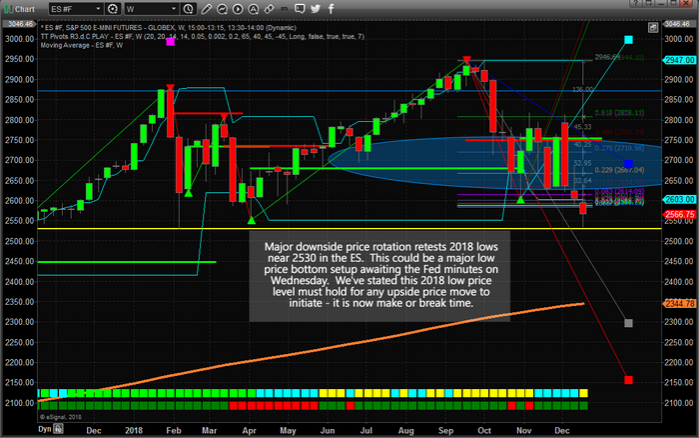
The downside price rotation in the U.S. markets on Monday, December 17, set up a near perfect double bottom formation near the 2530 price level and also prompted a dramatic price recovery after reaching these lows. Currently, the ES has rallied over 35 pts from this low level and will likely pause before the Fed minutes are announced on Wednesday, December 19.
If the Fed holds true to their earlier promises of continued rate increases, we could see this 2530 level broken as price retreats from any relief rally and attempts to find lower support. If the Fed changes the context of their message and adopts a slower and more insightful rate policy, the markets are poised for one heck of a potential rally. The ES if down by a little more than 400 points (-13.75%) from the peak in September 2018.
Check Out Our 3 Hour Trading Strategy Mastery Video
We believe the markets have already priced in the expected Fed rate hike and we believe an additional rate hike could become a catalyst for a downside move towards 2300 if the 2530 level is breached. We would like to see the Fed pause, or even decrease rate levels by 25 bp, allowing the markets to parse through the credit/debt issues that have started to plague the global markets before it causes the markets to “turn turtle” and prompt a greater crisis event.
Some of our earlier research, from 2013-2014, was a modeling system dedicated to the Fed interest rates, GDP, Population and Asset Valuations. We modeled various outcomes of the global economy over the future 15 to 20 years including massive debt increases, massive debt decreases, slowing GDP, growing GDP, massive changes in population and asset levels and many others. Overall, our research showed that the 2% Fed Funds Rate level should have been an upper boundary and should have been a near term target back in 2015-2016. As or right now, the Fed should be decreasing rates to allow for a smooth transition through a “deleveraging process”.
The Fed is behind the curve and is failing to properly navigate the future outcomes of global assets, debt and credit cycles. If the US Fed is not cautious over the next 12+ months with how they manage the FFR, they could push the entire global economy over a cliff faster than they can spell “Powell”.
Everything rests on Wednesday, December 19 and the U.S. Fed at this point. Our predictive modeling systems are still suggesting we should see strong upside price activity throughout the end of this year and early next year – assuming the Fed does not pull the floor out from under this market and capsize the global credit markets again.
Learn how we can help you find and execute trades for better success. Our analysis has been well ahead of these market moves for months and we’ve nailed some incredible trades.
Visit The Technical Traders to learn more.
Chris Vermeulen
Showing posts with label interest. Show all posts
Tuesday, December 18, 2018
Sunday, September 4, 2016
The Subprime Loan Crisis Is Back…Here’s What It Could Mean for the Economy
By Justin Spittler
Subprime loans are going bad again. A “subprime” loan is a loan made to someone with bad credit. If the term sounds familiar, it’s because lenders issued millions of subprime loans during the early to mid-2000s. Banks made these risky loans thinking housing prices would “never fall.” When they did, subprime borrowers stopped paying their mortgages. The U.S. housing market collapsed, triggering the worst economic downturn since the Great Depression.These days, lenders aren’t making as many reckless mortgages. But subprime lending is alive and well in the auto market. Since the financial crisis, subprime auto lending has exploded. According to Experian, subprime auto loans now make up more than 20% of all U.S. auto loans. Millions of Americans with bad credit now own cars they should have never bought in the first place. Risky subprime loans have also made the auto loan market incredibly fragile.
Right now, people are falling behind on their car loans at an alarming rate. As you'll see, this isn't just a big problem for lenders and car companies. It could also spell trouble for the entire U.S. economy.
Subprime auto loan delinquencies are skyrocketing…..
CNBC reported on Friday:
Delinquencies of at least 60 days for subprime auto loans are up 13 percent month over month for July, according to Fitch Ratings, and 17 percent higher from the same period a year ago.Folks with good credit are falling behind on their car loans too. CNBC continues:
Even prime delinquencies are on the rise — Fitch Ratings' survey said that last month's prime auto loans were 21 percent more delinquent than in July 2015.Prime loans are loans made to people with good credit.
The auto industry is preparing for more delinquencies…..
Last month, Ford (F) and General Motors (GM) warned that rising delinquencies could hurt their businesses in the second half of this year.
According to USA Today, both giant carmakers have set aside millions of dollars to cover potential losses:
In a quarterly filing with the Securities and Exchange Commission, Ford reported in the first half of this year it allowed $449 million for credit losses, a 34% increase from the first half of 2015.Investors who own subprime loans are taking heavy losses.....
General Motors reported in a similar filing that it set aside $864 million for credit losses in that same period of 2016, up 14% from a year earlier.
USA Today reported on Thursday:
[T]hese loans are packaged into bundles which are sold to investors, much like mortgages were packaged into bundles a decade ago before rising interest rates caused many of them to default, eventually triggering the deepest economic crisis since the Great Depression. The annualized net loss rate — the percentage of those subprime loan bundles regarded as likely to default — rose 7.39% in July, up 28% from July 2015.You may recall that Wall Street did the same thing with mortgages during the housing boom. They made securities from a bunch of bad mortgages. They marked them as safe and then sold them to investors. When the underlying mortgages went bad, folks who owned these securities suffered huge losses. These dangerous products allowed the housing crisis to turn into a full-blown global financial crisis.
By itself, a collapse of the auto loan market probably won’t trigger a repeat of the 2008 financial crisis..…
That’s because the auto loan market is much smaller than the mortgage market. The value of outstanding auto loans is “only” about $1 trillion. While that’s an all-time high, the auto loan market comes nowhere close to the $10 trillion residential mortgage market. Still, we’re keeping a close eye on the auto loan market.
If Americans are struggling to pay their car loans, they’re going to have trouble paying their mortgages, student loans, and credit cards too. This would obviously create problems for lenders and credit card companies. It will also hurt companies that depend on credit to make money.
E.B. Tucker, editor of The Casey Report, is shorting one of America’s most vulnerable retailers..…
In June, E.B. shorted (bet against) one of America’s biggest jewelry companies. According to E.B., credit customers make up 62% of its customers. These customers are 350% more valuable to the company than cash customers.
In other words, this company depends heavily on credit. This is a huge problem…and will only get worse as more folks continue to fall behind on their credit card bills—or stop paying them altogether. This is already happening at the company E.B shorted. He explained in the June issue of The Casey Report:
And the company is facing another problem…consumers failing to pay back their loans. From 2014 to fiscal 2016, its annual bad debt expenses rose from $138 million to $190 million. That’s a 30% increase. Over the same period, credit sales grew by only 20%. That means bad debt expenses rose 50% faster than credit sales.He warned that “tough times are coming for the jewelry business.”
E.B.’s call was spot on..…
Last Thursday, the company reported bad second quarter results. For the second straight quarter, the company’s earnings fell short of analysts’ estimates. The company’s stock plummeted 13% on the news. It’s now down 10% since E.B. recommended shorting it in June. But E.B. says the stock is headed even lower:
We think there’s more pain to come as credit financing dries up…sales continue to drop…and more loans go unpaid.You can learn more about this short by signing up for The Casey Report. If you act today, you can begin for just $49 a year. Watch this short video to learn how.
This is easily one of the best deals you'll come across in our industry..…
That’s because Casey readers are crushing the market. E.B.’s portfolio is up 19% this year. He’s beat the S&P 500 3-to-1. What’s more, Casey Report readers are set up to make money no matter what happens to the economy—and that’s never been more important. To learn why, watch this short presentation.
Chart of the Day
Not all dividend-paying stocks are safe to own..…Today’s chart compares the annual dividend yield of the U.S. 10-year Treasury with the annual dividend yield of the S&P 500. Right now, 10 years are paying about 1.5%. Companies in the S&P 500 are yielding 2.0%.
You can see the S&P 500 almost never yields more than 10 years. It’s only happened two other times since 1958. The first time was during the 2008 financial crisis. The other time was just after the recession.
If you’ve been reading the Dispatch, you know the Federal Reserve is partly responsible for this. For the past eight years, the Fed has held its key interest rate near zero. This caused bond yields to crash. With Treasuries yielding next to nothing, many investors have bought stocks for income. But there’s a problem.
Companies in the S&P 500 are paying out $0.38 for every $1.00 they make in earnings. That’s close to an all time high. About 44 companies in the S&P 500 are paying out more in dividends than they earned over the past year. Meanwhile, corporate earnings have been in decline since 2014. Clearly, companies can’t continue to pay out near-record dividends for much longer.
As we explained yesterday, some companies may cut their dividends. This could cause certain dividend-paying stocks to crash. Some investors could see years’ worth of income disappear in a day. If you own a stock for its dividend, make sure the company can keep paying you even if the economy runs into trouble. We like companies with healthy payout ratios, little or no debt, and proven dividend track records.

The article The Subprime Loan Crisis Is Back…Here’s What It Could Mean for the Economy was originally published at caseyresearch.com.
Get our latest FREE eBook "Understanding Options"....Just Click Here!

Friday, March 18, 2016
How Negative Interest Rates Will Turbocharge the Migrant Crisis
By Nick Giambruno
In the 1989 Batman movie, the Joker (played by Jack Nicholson) showers a crowded Gotham street with free money. In the scene, it looks like it’s raining hundred dollar bills. The people love it. Little do they know, the money is actually a trap. Once the Joker has lured them into the street, he unleashes poisonous gas.I think the latest gimmick to stimulate the economy is pretty much the same thing. It’s one of the most absurd ideas I’ve heard in a while. And that’s saying something, considering the outrageous schemes our economic luminaries have recently come up with, like..…
- Faking a space alien invasion to help stimulate the economy.
- Minting a trillion dollar coin.
- Negative interest rates.
- Banning physical cash.
- Cash for clunkers.
- Increasing rounds of money printing, euphemistically called “quantitative easing.”
Helicopter Money
Politicians and establishment economists call this scary idea “a basic income.” I call it sheer lunacy. It’s where the government gives you money just because. There’s no requirement to work or even display a willingness to work. You could sit at home all day, watch TV, and still get a check from the government. Simply put, a basic income is “free” money the government hands out to everyone unconditionally. European politicians are heavily pushing this policy.- Finland wants to pay its citizens around $1,000 a month.
- The Netherlands and the U.K. have also proposed dishing out free money.
- In Switzerland, there’s a proposal to hand out around $2,800 a month to everyone. This one is surprising since the Swiss are generally sensible about money.
- The basic income virus has also infected Canada, which recently announced a pilot program in Ontario.
Whether you call it free money, a basic income, or helicopter money, the idea is spreading. It’s the next potion the economic witch doctors will use once their latest scam—negative interest rates—not only fails to cure our economic ailments, but predictably makes them worse. No matter, the idea will be politically popular. Who would protest free money?
And, once a country adopts a basic income, it would be next to impossible to get rid of it until the system collapses under its own weight. Who would vote for a politician that stops (or even slows down) the gravy train? The Joker used free money to lure the people of Gotham to poisonous gas. Now real world politicians are using the same trick. They’re using free money to lure the masses into perpetual dependence on government.
More Problems Ahead for Europe
If Europeans think they have a migrant problem now, just wait until they institute a basic income. It’s obvious what will happen….Once European governments start handing every person thousands of dollars in free money each month (more than many in Africa make in a year), everyone will be scrambling for Europe.A basic income is a sure recipe for economic disaster and increased cultural tensions. It’s an environment where blowhards and demagogues flourish. Unfortunately, this has happened repeatedly throughout Europe’s history. Once again, it’s going to lead to some very bad things.
I think a basic income will greatly accelerate this recurring trend.
Without a basic income and other welfare benefits, immigrants are usually skilled and the very best of people. But the average European will surely forget that once free money draws in the world’s riffraff. This is why, although the financial effects will be severe, the sociopolitical ones will be much worse.
Here’s the bottom line: All you can do is protect yourself from the consequences of all this stupidity. This is a big reason why I think everyone should own some gold. Gold is the ultimate form of wealth insurance. It’s preserved wealth for thousands of years through every kind of crisis imaginable. It will preserve wealth during the next crisis, too.
Unfortunately, most people have no idea how to prepare for the next economic collapse…..
How will you protect your savings in the event of a crisis? This just released video will show you exactly how. Click here to watch it now.
The article How Negative Interest Rates Will Turbocharge the Migrant Crisis was originally published at caseyresearch.com.
Get our latest FREE eBook "Understanding Options"....Just Click Here!
Labels:
cash,
crisis,
Dollar,
economic,
Europe,
Gold,
interest,
Nick Giambruno,
quantitative easing
Friday, December 11, 2015
Janet Yellen: The Best Pick Pocket in the USA
By Tony Sagami
“Some of the experiences [in Europe] suggest maybe we can use negative interest rates.”
—William Dudley, President of the New York Federal Reserve Bank
“We see now in the past few years that it [negative interest rates] has been made to work in some European countries. So I would think that in a future episode that the Fed would consider it.”
—Ben Bernanke
—Ben Bernanke
“Indeed, I would be open to the possibility of reducing the fed funds target funds range even further, as a way of producing better labor market outcomes.”
—Narayana Kocherlakota, President of the Minneapolis Federal Reserve Bank
While Wall Street experts and CNBC talking heads regularly debate the "will they or won’t they" interest rate liftoff, a more important question is whether or not the Federal Reserve will follow the European model of negative interest rates. Negative interest rates are nothing unusual in Europe as several central banks lowered key interest rates below 0%.
Yup, that means investors essentially pay a fee to park their money.
That parking fee just got higher last week when the European Central Bank cut its already negative deposit rate from minus 0.2% to minus 0.3%. The ECB also expanded is current quantitative easing program. The European Central Bank, the Swiss National Bank, and the Danish National Bank all have interest rates below zero. In fact, the Danes have held their overnight rates at negative 0.75% since 2012.
The Swiss, however, are the undisputed leaders of the negative interest rate experiment. The SNB first moved to negative rates in December 2014 and then dropped rates to negative 0.75% in January of this year. The Swiss National Bank, by the way, meets in a couple of days, on December 10, and is widely expected to cut rates again.
The question, of course, is how negative can interest rates go? Before the end of December, I expect deposit rates in Switzerland to be between -100bps and -125bps. Remember, we’re not talking about some backwater, third world countries here. Switzerland and Germany are two of the wealthiest countries in the world, as well as the home of major financial and political centers.
And I’m not just talking about short term paper either. Finland, Germany, France, Switzerland, and Japan are all selling five year debt with negative yields. In fact, Switzerland became the first country in history to sell benchmark 10 year debt at a negative interest rate in April.
Don’t think that negative interest rates can happen in the US? Wrong!
You may have missed it, but the United States is now also a member of the “0% club”—most recently in October, when it sold $21 billion worth of 3 month bills at 0% interest.
However, that is not the first time. Since 2008, the US government has held 46 Treasury bill auctions where yields have been zero. The next step after zero is negative… and it’s becoming a real possibility. Welcome to the European model of starving savers to death!
The implications for investors are monumental.
Ask yourself, what would you do with your money if your bank started to charge you to deposit it there? Would you pay hundreds, perhaps thousands of dollars a year just to keep your money in a bank?
Option #1: Hold your nose and pay the fees.
Option #2: Move those dollars into the stock market; perhaps into dividend paying stocks.
Option #3: Buy real estate; perhaps income generating real estate.
Option #4: Invest in collectibles, like art or classic cars.
Option #5: Stuff your money under a mattress.
Option #2: Move those dollars into the stock market; perhaps into dividend paying stocks.
Option #3: Buy real estate; perhaps income generating real estate.
Option #4: Invest in collectibles, like art or classic cars.
Option #5: Stuff your money under a mattress.
The point I am trying to make is, the rules for successful income investing have completely changed. If you are living (or plan on living) off the earnings of your savings, you better adapt your strategy to the new world of negative interest rates…..or plan on working as a Walmart greeter during your golden years.
Even if you think I’m nuts about negative interest rates coming to the US, there is no doubt that interest rates are not climbing anytime soon.
According to the Federal Reserve.....
"The Committee anticipates that inflation will remain quite low in the coming months.”
“The stance of monetary policy will likely remain highly accommodative for quite some time after the initial increase in the federal funds rate.”
But you can (and should) fight back by changing the way you think about investing for income. You can start by giving my high yield income letter, Yield Shark, a risk free try with 90 day money back guarantee.

Tony Sagami
30 year market expert Tony Sagami leads the Yield Shark and Rational Bear advisories at Mauldin Economics. To learn more about Yield Shark and how it helps you maximize dividend income, click here.
To learn more about Rational Bear and how you can use it to benefit from falling stocks and sectors, click here.
The article Connecting the Dots: Janet Yellen: The Best Pick Pocket in the USA was originally published at mauldineconomics.com
Get our latest FREE eBook "Understanding Options"....Just Click Here!
Thursday, April 16, 2015
Our Next Call....Own this Sleeper Stock Before April 30th
We just got word from our trading partners at the International Speculator. Their message? "Own this sleeper stock that's running through April". The metals sector research team believes this will be the next high grade gold producer. If you want to make a fortune in the resource sector, all you need to know are the two times you should buy gold stocks.
The first: Invest in a gold mining company just before it makes a tremendous discovery.
Obviously, this is a daunting task. And without hands-on experience or a field research, you’d have better odds at winning roulette.
The second: Buy shares of a gold mining company just before it starts producing.
When a mining company announces its “First Gold Pour” is usually the only time it makes headlines, outside of a discovery. From that day forward, it’s a cash generating producer… and the value is no longer trapped in the rocks. That’s when the big money institutional investors take interest. Once they pile in, shares move very quickly.
Of course, there are very few new gold mines opening up in the world at any given time. So these opportunities are quite rare. But today, you have the chance to jump on one. We have found a deeply undervalued mining company with a high grade deposit 8x richer than the average mine.
Today, shares are cheap. But it’s scheduled to start pouring gold for the first time very soon—after that, shares could soar. In fact, Louis James, the chief metals and mining investment strategist at Case Research, believes this company could at least double in value.
But only investors who act before April 30 will have the chance to realize these gains.
Click here for all the details of this incredible opportunity
See you in the markets!
The Stock Market Club
Get our latest FREE eBook "Understanding Options"....Just Click Here!
The first: Invest in a gold mining company just before it makes a tremendous discovery.
Obviously, this is a daunting task. And without hands-on experience or a field research, you’d have better odds at winning roulette.
The second: Buy shares of a gold mining company just before it starts producing.
When a mining company announces its “First Gold Pour” is usually the only time it makes headlines, outside of a discovery. From that day forward, it’s a cash generating producer… and the value is no longer trapped in the rocks. That’s when the big money institutional investors take interest. Once they pile in, shares move very quickly.
Of course, there are very few new gold mines opening up in the world at any given time. So these opportunities are quite rare. But today, you have the chance to jump on one. We have found a deeply undervalued mining company with a high grade deposit 8x richer than the average mine.
Today, shares are cheap. But it’s scheduled to start pouring gold for the first time very soon—after that, shares could soar. In fact, Louis James, the chief metals and mining investment strategist at Case Research, believes this company could at least double in value.
But only investors who act before April 30 will have the chance to realize these gains.
Click here for all the details of this incredible opportunity
See you in the markets!
The Stock Market Club
Get our latest FREE eBook "Understanding Options"....Just Click Here!
Tuesday, January 27, 2015
How Global Interest Rates Deceive Markets
By John Mauldin
– Inigo Montoya, The Princess Bride
“In the economic sphere an act, a habit, an institution, a law produces not only one effect, but a series of effects. Of these effects, the first alone is immediate; it appears simultaneously with its cause; it is seen. The other effects emerge only subsequently; they are not seen; we are fortunate if we foresee them.
“There is only one difference between a bad economist and a good one: the bad economist confines himself to the visible effect; the good economist takes into account both the effect that can be seen and those effects that must be foreseen.
“Yet this difference is tremendous; for it almost always happens that when the immediate consequence is favorable, the later consequences are disastrous, and vice versa. Whence it follows that the bad economist pursues a small present good that will be followed by a great evil to come, while the good economist pursues a great good to come, at the risk of a small present evil.”
– From an 1850 essay by Frédéric Bastiat, “That Which Is Seen and That Which Is Unseen”
United States: 1.80%
Germany: 0.36%
France: 0.54%
Italy: 1.56%
UK: 1.48%
Canada: 1.365%
Australia: 2.63%
Japan: 0.22%
Likewise, Germany has seen its 10-year Bund rates drop from 1.66% to a shockingly low 0.36%. What does it mean that European interest rates simply fell out of bed this week? Has the opportunity set in Europe diminished? Are the French really that much better a credit risk than the United States is? If not, what is that number, 0.54%, telling us? What in the wide, wide world of fixed-income investing is going on?
Quick segue – but hopefully a little fun. One of the pleasures of having children is that you get to watch the classic movie The Princess Bride over and over. (If you haven’t appreciated it, go borrow a few kids for the weekend and watch it.) There is a classic line in the movie that is indelibly imprinted on my mind.
In the middle of the film, a villainous but supposedly genius Sicilian named Vizzini keeps using the word “inconceivable” to describe certain events. A mysterious ship is following the group at sea? “Inconceivable!”
The ship’s captain starts climbing the bad guys’ rope up the Cliffs of Insanity and even starts to gain on them? “Inconceivable!” The villain doesn’t fall from said cliff after Vizzini cuts the rope that all of them were climbing? “Inconceivable!” Finally, master swordsman – and my favorite character in the movie – Inigo, famous for this and other awesome catchphrases, comments on Vizzini’s use of this word inconceivable:
“You keep on using that word. I do not think it means what you think it means.”
(You can see all the uses of Vizzini’s use of the word inconceivable and hear Inigo’s classic retort here.)
When it comes to interpreting what current interest rates are telling us about the markets in various countries, I have to say that I do not think they mean what the market seems to think they mean. In fact, buried in that list of bond yields is “false information” – information so distorted and yet so readily misunderstood that it leads to wrong conclusions and decisions – and to bad investments. In today’s letter we are going to look at what interest rates actually mean in the modern-day context of currency wars and interest-rate manipulation by central banks. I think you will come to agree with me that an interest rate may not mean what the market thinks it means.
Let me begin by briefly summarizing what I want to demonstrate in this letter. First, I think Japanese interest rates not only contain no information but also that markets are misreading this non-information as meaningful because they are interpreting the data as if it were normal market information in a familiar market environment, when the truth is that we sailed beyond the boundaries of the known economic world some time ago. The old maps are no longer reliable. Secondly, Europe is making the decision to go down the same path as the Japanese have done; and contrary to the expectations of European central bankers, the potential to end up with the same results as Japan is rather high.
The false information paradox is highlighted by the recent Swiss National Bank decision. Couple that with the surprise decisions by Canada and Denmark to cut rates, the complete retracement of the euro against the yen over the past few weeks, and Bank of Japan Governor Kuroda’s telling the World Economic Forum in Davos that he is prepared to do more (shades of “whatever it takes”) to create inflation, and you have the opening salvos of the next skirmish in the ongoing currency wars I predicted a few years ago in Code Red. All of this means that capital is going to be misallocated and that the current efforts to create jobs and growth and inflation are insufficient. Indeed, I think those efforts might very well produce a net negative effect.
But before we go any farther, a quick note. We will start taking registrations for the 12th annual Strategic Investment Conference next week. There will be an early bird rate for those of you who go ahead to register quickly. The conference will run from April 29 through May 2 at the Manchester Grand Hyatt in San Diego.
For those of you familiar with the conference, there will be the “usual” lineup of brilliant speakers and thought leaders trying to help us understand investing in a world of divergence. For those not familiar, this conference is unlike the vast majority of other investment conferences, in that speakers representing various sponsors do not pay to address the audience. Instead, we bring in only “A list” speakers from around the world, people you really want to meet and talk with. This year we’re going to have a particularly large and diverse group of presenters, and we structure the conference so that attendees can mingle with the speakers and with each other.
I am often told by attendees that this is the best economic and investment conference they attend in any given year. I think it is a measure of the quality of the conference that many of the speakers seek us out. Not only do they want to speak, they want to attend the conference to hear and interact with the other speakers and conference guests. This conference is full of speakers that other speakers (especially including myself) want to hear. And you will, too. Save the date and look for registration and other information shortly in your mail.
Now let’s consider what today’s interest rates do and do not mean as we navigate uncharted waters.
Are We All Turning Japanese?
Japan is an interesting case study. It’s a highly developed nation with a very sophisticated culture, increasingly productive in dollar terms (although in yen terms nominal GDP has not moved all that much), and carrying an unbelievable 250% debt to GDP burden, but with a 10 year bond rate of 0.22%, which in theory could eventually mean that the total interest expenses of Japan would be less than those of the US on 5 - 6 times the amount of debt. Japan has an aging population and a savings rate that has plunged in recent years.
The country has been saddled with either low inflation or deflation for most of the past 25 years. At the same time, it is an export power, with some of the world’s most competitive companies in automobiles, electronics, robotics, automation, machine tools, etc. The Japanese have a large national balance sheet from decades of running trade surpluses. If nothing else, they have given the world sushi, for which I will always hold them in high regard.
We talk about Japan’s “lost decades” during which growth has been muted at best. They are just coming out of a triple dip recession after a disastrous downturn during the Great Recession. And through it all, for decades, there is been a widening government deficit. The chart below shows the yawning gap between Japanese government expenditures and revenues.
This next chart, from a Societe Generale report, seems to show that the Japanese are financing 40% of their budget. I say “seems” because there is a quirk in the way the Japanese do their fiscal accounting. Pay attention, class. This is important to understand. If you do not grasp this, you will not understand Japanese budgets and how they deal with their debt.
To continue reading this article from Thoughts from the Frontline – a free weekly publication by John Mauldin, renowned financial expert, best selling author, and Chairman of Mauldin Economics – please click here.
The article Thoughts from the Frontline: How Global Interest Rates Deceive Markets was originally published at mauldineconomics.com
Get our latest FREE eBook "Understanding Options"....Just Click Here!
Labels:
Bund rates,
Code Red,
currency,
economist,
Europe,
Germany,
income,
inflation,
interest,
Japan,
John Mauldin,
Oil,
Thoughts from the Frontline
Friday, October 10, 2014
Yield Hungry Baby Boomers Are on a Death March
By Dennis Miller
Today’s forecast: yield starved investors forced into the market by seemingly permanent low interest rates will continue to be collateral damage. For some, that collateral damage may involve more than the loss of income opportunities… many could be wiped out completely.At the Casey Research Summit last month, I asked the participants in our discussion group: “If there were safe, fixed income opportunities available paying 5 - 7%, would you move a major portion of your portfolio out of the market?”
They all answered a resounding, “Absolutely.”
Participants relying on their nest eggs for retirement income said they felt forced into the market for yield. Their retirement projections weren’t based on 2% yields, the rough rate now available on fixed income investments. They’d planned on 6% or so. What other choice do they have now?
The Federal Reserve knows seniors and savers are collateral damage. Former Fed Chairman Ben Bernanke has openly acknowledged that the Fed’s low interest rate policy is designed to prompt savers to take more chances with riskier investments. In their book Code Red, authors John Mauldin and Jonathan Tepper shine a harsh light on that policy, writing:
Central banks want people to take their money out of safe investments and put them into risky investments. They call it the “portfolio balance channel,” but you could call it “starve people for yield and they’ll buy anything.”
The collateral damage inflicted upon seniors and savers is twofold. First, it’s the loss of safe income opportunities. The Fed’s low interest rate policies have saved banks and the government an estimated $2 trillion in interest alone. $2 trillion added to the balances of 401(k) and IRA accounts would sure bolster a lot of desperate retirement plans.
But there’s no sign the Fed will reverse its low interest rate policies in the foreseeable future. So, yield starved investors, including throngs of baby boomers maturing into retirement age each day, play the market and risk their nest eggs in the process.
The Federal Reserve has succeeded in forcing savers to take billions of dollars out of fixed income investments to hunt for better yields. Take a look at the chart below showing the S&P 500’s performance since 2004. The Index has almost tripled since its 2009 bottom. There hasn’t been a major correction in well over 1,000 days.
When the bubble burst in 2007, the S&P took a 57% drop. I had friends just entering retirement who suffered 40-50% losses. Their stories are not uncommon, and some are now back at work—and not by choice.
This is the second form of collateral damage, and it can be much more devastating. It’s one thing to lose an income opportunity and call it collateral damage, but quite another to lose 50% or more of your life savings. If the market drops radically, as it did less than a decade ago, the life savings of many baby boomers could be destroyed.
No one knows when the next correction will occur. However, many pundits believe a major correction is due. Others say we can continue on the same track, much like Japan has done for 25 years. Here’s what we do know: the Fed has made it clear that it plans to hold interest rates down for quite some time.
When you invest money earmarked for retirement, you risk trying to time the market. Even seasoned investors would be foolhardy to think they’ll have enough time to easily exit their positions and lock in gains.
It never works that way.
Now is the time for caution. Whether you’re a do it yourself investor or work with an investment professional, it’s a good time for a complete portfolio analysis with an eye on this question:
What happens to my portfolio if the market completely collapses?
Be wary of any advisor touting the “buy and hold” philosophy. They’d point to the chart above and note that the market went from 700 to 1,900+ in five years. If investors are patient, it will come back after the next drop. Unfortunately, seniors don’t have time to sit around and wait.
No one can guarantee the market will rebound as quickly as it did in the last decade. It’s not the “buy” in “buy and hold” that concerns me. There are excellent companies out there that pay healthy dividends and will rebound relatively quickly. Depending on your age and financial condition, it’s the indefinite holding that could be a problem.
If you’re not comfortable holding an investment for a decade or more, consider using a stop loss. After all, would you rather suffer a major loss and hope against hope that the market rebounds fast, or be proactive and keep your nest egg intact?
The best way to avoid becoming collateral damage is to take safety precautions before the next big, bad event takes place. One easy (and free) way to start strengthening your financial know how is to read our e-letter, Miller’s Money Weekly. Each Thursday my team I cover hot button financial topics and share the tools income investors need to live rich in today’s low yield world.
Click here to begin receiving your complimentary copy today.
The article Yield Hungry Baby Boomers Are on a Death March was originally published at millers money
Get our latest FREE eBook "Understanding Options"....Just Click Here!
Labels:
Casey Research,
correction,
currency,
Fed,
interest,
IRA,
Miller's Money,
money,
Oil,
yield
Wednesday, September 3, 2014
How is Doug Casey Preparing for a Crisis Worse than 2008?
By Doug Casey, Chairman
He and His Fellow Millionaires Are Getting Back to Basics
The Mining Report: This year's Casey Research Summit is titled "Thriving in a Crisis Economy." What is the most pressing crisis for investors today?
Doug Casey: We are exiting the eye of the giant financial hurricane that we entered in 2007, and we're going into its trailing edge. It's going to be much more severe, different and longer lasting than what we saw in 2008 and 2009. Investors should be preparing for some really stormy weather by the end of this year, certainly in 2015.
TMR: The 2008 stock market embodied a great deal of volatility. Now, the indexes seem to be rising steadily. Why do you think we are headed for something worse again?
DC: The U.S. created trillions of dollars to fight the financial crisis of 2008 and 2009. Most of those dollars are still sitting in the banking system and aren't in the economy. Some have found their way into the stock markets and the bond markets, creating a stock bubble and a bond superbubble. The higher stocks and bonds go, the harder they're going to fall.
TMR: When Streetwise President Karen Roche interviewed you last year, you predicted a devastating crash. Are we getting closer to that crash? What are the signs that a bond bubble is about to burst?
|
Missing the 2014 Casey Research Summit (Thriving in a Crisis Economy) could be hazardous to your portfolio.
Sept. 19-21 in San Antonio, Texas. |
TMR: Isn't that a function of low interest rates?
DC: Yes, it is. Central banks all around the world have attempted to revive their economies by lowering interest rates to all time lows. It's discouraging people from saving and encouraging people to borrow and consume more. The distortions that is causing in the economy are huge, and they're all going to have to be liquidated at some point, probably in the next six months to a year. The timing of these things is really quite impossible to predict. But it feels like 2007 except much worse, and it's likely to be inflationary in nature this time. The certainty is financial chaos, but the exact character of the chaos is, by its very nature, unpredictable.
TMR: Casey Research precious metals expert Jeff Clark recently wrote in Metals and Mining that he's investing in silver to protect himself from an advance of what he calls "government financial heroin addicts having to go cold turkey and shifting to precious metals." Do you agree or are you more of a buy-gold-for-financial-protection kind of guy?
DC: I certainly agree with him. Gold and silver are two totally different elements. Silver has more industrial uses. It is also quite cheap in real terms; the problem is storing a considerable quantity—the stuff is bulky. It's a poor man's gold. We mine about 800 million ounces (800 Moz)/year of silver as opposed to about 80 Moz/year of gold. Unlike gold, most of silver is consumed rather than stored. That is positive.
On the other hand, the fact that silver is mainly an industrial metal, rather than a monetary metal, is a big negative in this environment. Still, as a speculation, silver has more upside just because it's a much smaller market. If a billion dollars panics into silver and a billion dollars panics into gold, silver is going to move much more rapidly and much higher.
TMR: Are you are saying that because silver is more volatile generally, that is good news when the trend is to the upside?
DC: That's exactly correct. All the volatility from this point is going to be on the upside. It's not the giveaway it was back in 2001. In real terms, silver is trading at about the same levels that it was in the mid-1960s. So it's an excellent value again.
TMR: In another recent interview, you called shorting Japanese bonds a sure thing for speculators and said most of the mining companies on the Toronto Stock Exchange (TSX) weren't worth the paper their stocks were written on, but that some have been priced so low, they could increase 100 times. What are some examples of some sure things in the mining sector?
DC: Of the roughly 1,500 so-called mining stocks traded in Vancouver, most of them don't have any economic mineral deposits. Many that do don't have any money in the bank with which to extract them. The companies that I think are worth buying now are well-funded, underpriced—some selling for just the cash they have in the bank—and sitting on economic deposits with proven management teams. There aren't many of them; I would guess perhaps 50 worth buying. In the next year, many of them are likely to move radically.
TMR: Are there some specific geographic areas that you like to focus on?
DC: The problem is that the whole world has become harder to do business in. Governments around the world are bankrupt so they are looking for a bigger carried interest, bigger royalties and more taxes. At the same time, they have more regulations and more requirements. So the costs of mining have risen hugely. Political risks have risen hugely. There really is no ideal location to mine in the world today. It's not like 100 years ago when almost every place was quick, easy and profitable. Now, every project is a decade long maneuver. Mining has never been an easy business, but now it's a horrible business, worse than it's ever been. It's all a question of risk/reward and what you pay for the stocks. That said, right now, they're very cheap.
TMR: Let's talk about the U.S. Are we in better or worse shape as a country politically and economically than we were last year? At the Casey Research Summit last year, I interviewed you the morning after former Congressman Ron Paul's keynote, and you said that you hoped that the IRS would be shut down instead of the national parks. There's no such shutdown going on today, so does that mean the country is more functional than it was a year ago?
DC: It's in worse shape now. The direction the country is going in is more decisively negative. Perhaps what's happening in Ferguson, Missouri, with the militarized police is a shade of things to come. So, no, things are not better. They've actually deteriorated. We're that much closer to a really millennial crisis.
TMR: Your conferences are always thought provoking. I always enjoy meeting the other attendees—it's always great to talk to people from all over the world who are interested in these topics. But you also bring in interesting speakers. In addition to your Casey Research team, the speakers at the conference this year include radio personality Alex Jones and author and self-described conservative paleo-libertarian Justin Raimondo. What do you hope attendees will take away from the conference?
DC: This is a chance for me and the attendees to sit down and have a drink with people like Justin Raimondo and author Paul Rosenberg. I'm looking forward to it because it is always an education.
Another highlight is that instead of staging hundreds of booths of desperate companies that ought to be put out of their misery, we limit the presenting mining companies in the map room to the best in the business with the most upside potential. That makes this a rare opportunity to talk to these selected companies about their projects.
TMR: We recently interviewed Marin Katusa, who was also excited about the companies that are going to be at the conference. He was bullish on European oil and gas and U.S. uranium. What's your favorite way to play energy right now?
DC: Uranium is about as cheap now in real terms as it was back in 2000, when a huge boom started in uranium and billions of speculative dollars were made. So, once again, cyclically, the clock on the wall says buy uranium with both hands. I think you can make the same argument for coal at this point.
TMR: You recently released a series of videos called the "Upturn Millionaires." It featured you, Rick Rule, Frank Giustra and others talking about how you're playing the turning tides of a precious metals market. What are some common moves you are all making right now?
DC: All of us are moving into precious metals stocks and precious metals themselves because in the years to come, gold and silver are money in its most basic form and the only financial assets that aren't simultaneously somebody else's liability.
TMR: Thanks for your time and insights.
You can see Doug LIVE September 19-21 in San Antonio, TX during the Casey Research Summit, Thriving in a Crisis Economy. He'll be joined on stage by Jim Rickards, Grant Williams, Charles Biderman, Stephen Moore, Mark Yusko, Justin Raimondo, and many, many more of the world's brightest minds and smartest investors. To RSVP and get all the details, click here.
The article How is Doug Casey Preparing for a Crisis Worse than 2008? was originally published at Casey Research
Make sure to get John Carters new FREE eBook "Understanding Options"....Just Click Here!
Labels:
banks,
bubble,
Casey Research,
Doug Casey,
Gold,
interest,
Jeff Clark,
metals,
mining,
Oil,
summit
Saturday, June 7, 2014
Are You Ready for Negative Interest Rate and Pay the Bank to Hold Your Money?
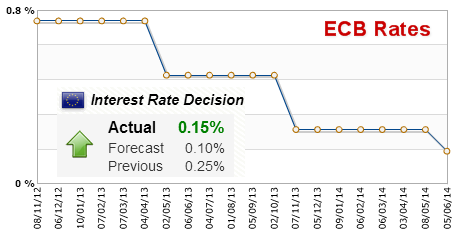
The six members of the European Central Bank (ECB) Executive Board and the 16 governors of the euro area central banks vote on where to set the rate. We watch interest rate changes closely as short term interest rates are the primary factor in currency valuation.
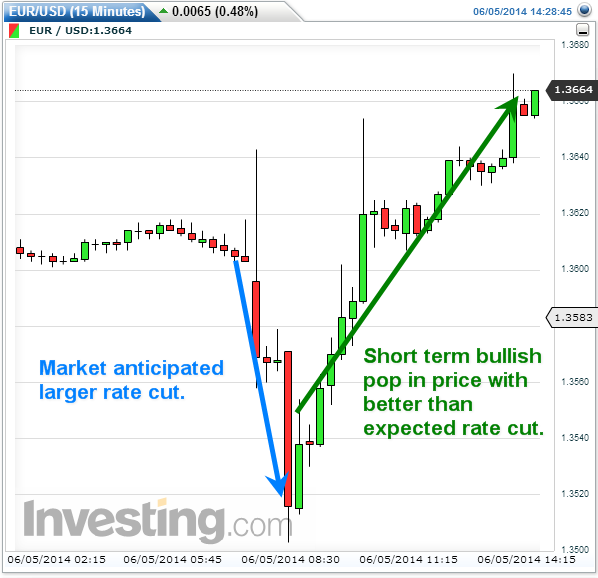
A higher than expected rate is positive for the EUR, while a lower than expected rate is negative for the EUR. Today (Thursday June 5th) we expected a rate cut. The cut was not as much as analysts expected which is bullish for the short term, but the rate is still declining and nearing zero, or even worse, negative territory.
A negative interest rate may sound crazy or impossible, but it's already happening in Denmark. Europe is already in a deflationary state and central banks are doing everything they can to bring about inflation by cutting rates and devaluing the euro. This will cause a ripple through multiple asset classes and will drastically alter the outcome of individuals worldwide. Just imagine if you had to pay a bank to hold your money and you do not earn any interest but rather pay interest.
People who have been saving their entire lives will get hit the hardest. Retired folks will stop earning money and start paying for all the money they hold held at banks. Individuals will go more into debt because money will be extremely cheap to borrow. Price of assets like equities, real estate, discretionary goods will rise because the cheap money everyone is borrowing will be used to buy more stuff. While all this happens everyone takes on more dept. It is a brutal spiral leading to increase debt levels, inflation and eventually bankruptcy.
If the euro dollar starts to decline at a quicker pace the U.S. dollar will likely rally. A strong dollar could affect the commodities market including gold, silver and the European stock markets. Todays rate cut led to a pop in the euro, but that is likely to be short lived. I hope this sheds some light on the markets and helps in your trading.
Chris Vermeulen
P.S. In the next few days members and myself will be looking to enter some trades based round this analysis. See Premium Trading Video & Newsletter
Sincerely,
Chris Vermeulen
Sign up for one of our Free Trading Webinars....Just Click Here!
A higher than expected rate is positive for the EUR, while a lower than expected rate is negative for the EUR. Today (Thursday June 5th) we expected a rate cut. The cut was not as much as analysts expected which is bullish for the short term, but the rate is still declining and nearing zero, or even worse, negative territory.
A negative interest rate may sound crazy or impossible, but it's already happening in Denmark. Europe is already in a deflationary state and central banks are doing everything they can to bring about inflation by cutting rates and devaluing the euro. This will cause a ripple through multiple asset classes and will drastically alter the outcome of individuals worldwide. Just imagine if you had to pay a bank to hold your money and you do not earn any interest but rather pay interest.
People who have been saving their entire lives will get hit the hardest. Retired folks will stop earning money and start paying for all the money they hold held at banks. Individuals will go more into debt because money will be extremely cheap to borrow. Price of assets like equities, real estate, discretionary goods will rise because the cheap money everyone is borrowing will be used to buy more stuff. While all this happens everyone takes on more dept. It is a brutal spiral leading to increase debt levels, inflation and eventually bankruptcy.
If the euro dollar starts to decline at a quicker pace the U.S. dollar will likely rally. A strong dollar could affect the commodities market including gold, silver and the European stock markets. Todays rate cut led to a pop in the euro, but that is likely to be short lived. I hope this sheds some light on the markets and helps in your trading.
Chris Vermeulen
P.S. In the next few days members and myself will be looking to enter some trades based round this analysis. See Premium Trading Video & Newsletter
Sincerely,
Chris Vermeulen
Sign up for one of our Free Trading Webinars....Just Click Here!
Sunday, April 20, 2014
10 Ways to Screw up Your Retirement
By Dennis Miller
There are many creative ways to screw up your retirement. Let me show you how it’s done.Supporting adult children. My wife Jo and I have friends with an unmarried, unemployed daughter who had a child. Our friends adopted their grandchild and are now in their late sixties raising a kid in grade school. The same daughter had a second child, and they adopted that one too. When she announced she was pregnant a third time, they finally said, “Enough! It’s time for a third party adoption.”
Last time I spoke with them, their unemployed daughter and her boyfriend were living in their basement, neither contributing financially nor lifting a finger around the house. What began as a temporary bandage had become a permanent crutch. Our friends love their grandchildren; however, they’ve become bitter.
Jo and I also know of retirees who make their adult children’s car payments. I’m not talking about college-age kids; some of these “children” are close to 50. What’s their justification? “If we don’t make the payments, they won’t be able to go to work.” What I can’t grasp is how these adult children have iPads and iPhones, go on vacations, and do other cool things, but can’t seem to make their car payments.
You are not the family bank. There is generally a brief window of opportunity between children leaving the nest and retirement. Use it to stash away enough money to retire comfortably!
Ignore your health. I served on the reunion committee for my 50th high school class reunion. We diligently tried to track down our classmates, but many had not lived long enough to RSVP to the party. The number of deaths from lung cancer and liver cancer were shocking. Many of those six feet under had been morbidly obese or simply never went to the doctor for checkups.
I know this sounds obvious, but your health choices really do affect how long and how well you live. Retiring only to become homebound because of health problems won’t be much fun.
Not keeping your retirement plan up to date. In the summer of 2013, the Employee Benefit Research Institute (EBRI) published a survey about low-interest-rate policies and their impact on both baby boomers and Generation Xers, who are following right behind. The bottom line (emphasis mine):
“Overall, 25-27 percent of baby boomers and Gen Xers who would have had adequate retirement income under return assumptions based on historical averages are simulated to end up running short of money in retirement if today’s historically low interest rates are assumed to be a permanent condition, assuming retirement income/wealth covers 100 percent of simulated retirement expense.”
Thinking you can continue working as long as you wish. While age discrimination is illegal, you may not be able to work forever. If illness doesn’t push you out the door, your employer might downsize (we all know who goes first) or buy you out with a lucrative lump sum.
Many companies want older employees off the payroll because their healthcare costs are high; plus, they are often at the top of the salary scale. More than one employer has made the workplace so uncomfortable that an older employee felt he had to quit. Other employers will systematically build a case to terminate a senior employee with their legal team waiting in the wings to help.
Whatever the reason, you may have to stop working even if you enjoy your job, so plan for it.
Not increasing your rate of saving. A surefire way to end up short is to pay off a large-ticket item like your home mortgage and then continue spending that money every month. Start paying yourself instead! Don’t prioritize saving after it’s too late to benefit from years of compounded interest.
Continually taking equity out of your home. Too many of my friends have been duped into taking out additional equity when refinancing with a lower-interest mortgage. If you can secure a lower rate, use it to pay off your home off faster. When you have, start making those payments to your retirement account.
Retire with a substantial mortgage. The general rule of thumb is your mortgage payment should be no more than 20-25% of your income. If you retire and still have a mortgage, it might be tough to stay within those guidelines.
Taking out a reverse mortgage at a young age. Debt-laden baby boomers are taking out reverse mortgages at an increasingly younger age. Just read the HUD reports. Many have very little equity to begin with and use a reverse mortgage to stop their monthly bank payments for pennies in return.
Locking yourself into a fixed income at a young age is a great way to kiss your lifestyle goodbye. Many of these young boomers will find themselves wondering, “Why is there is so much life left at the end of my money?”
Putting your life savings into an annuity. While annuities have their place in a retirement portfolio, going all in is dangerous, particularly at a young age. After all, your monthly payment depends in part on your age.
I know folks who put their entire life savings into variable annuities. They thought they were buying a “pension plan” and would never have to worry again. The crash of 2008 slashed their monthly checks, and they have yet to recover. Retirement without worry is not that simple.
Thinking your employer’s retirement plan is all you need. The era of pensions is gasping its dying breath. We have many friends who retired from the airlines with sizable pensions. When those airlines filed for bankruptcy, their pensions shriveled. No industry is immune to this danger, so we all need a backup plan.
Government pensions are following suit. Just ask anyone who has worked for the city of Detroit! While the unions are fighting the city to preserve their pensions, an initial draft of the plan indicates underfunded pensions (estimated at $3.5 billion) may receive $0.25 on the dollar.
Don’t fall for the trap! If you work for the government, you still need to save for retirement. Contribute to your 457 plan or whatever breed of retirement account is available to you. The federal government has over $100 trillion in unfunded promises, and many state governments are woefully underfunded. That doesn’t mean your retirement has to be.
Reverse mortgages and annuities are often the undoing of many income investors and retirees. They can be used properly, however, if your situation or the opportunity fits with your needs. With all of the misinformation out there about these two products, we decided to pen two special reports to help you decide whether these are right for you. They are The Reverse Mortgage Guide and The Annuity Guide. Check out one – or both – today and learn where, if at all, these fit your needs.
The article 10 Ways to Screw up Your Retirement was originally published at Millers Money
Sign up for one of our Free Trading Webinars....Just Click Here!
Labels:
annuities,
Dennis Miller,
equity,
government,
interest,
investors,
money,
mortgage,
retirement
Saturday, February 1, 2014
What are Business Development Companies?
By Andrey Dashkov
Business Development Companies (BDCs) are publicly traded private debt and equity funds. I know that description isn’t terribly sexy, but keep reading and you’ll find there’s a lot to be excited about.BDCs provide financing to firms too small to seek traditional bank financing or to do an IPO, but at the same time are too advanced to interest the earliest-stage venture capitalist. These companies are often near or at profitability and just need extra cash to reach the next milestone. Filling this void, BDCs provide funds to target companies in exchange for interest payments and/or an equity stake.
BDCs earn their living by lending at interest rates higher than those at which they borrow. Conceptually, they act like banks or bond funds, but with access to yields unlike any you’ll see from a traditional bond fund. The interest rate spread—meaning the difference between their capital costs and interest they charge their clients—is a major component of their business.
Oftentimes, a BDC will increase its dividend when market interest rates have not changed. Like a bank, the more loans it has in force, the more it profits. Increasing its dividend payout will generally have a very positive effect on its share price.
Unlike banks or many other traditional financial institutions, however, BDCs are structured to pay out more than 90% of their net profits to the shareholders. In return, BDCs don’t pay any income tax. In essence, their profits flow through to the owners. Many investors like to own BDCs in an IRA to create tax deferred or tax free income. The opportunity to use them for tax planning purposes, access to diversified early stage financing, and the impressive dividend yields they deliver make them a perfect fit for the Bulletproof Income strategy we employ at Miller's Money Forever.
The Clients
As a business model, BDCs emerged in response to a particular need: early-stage companies needed funding but couldn’t do it publicly due to their small size. At the same time, these companies didn’t match the investment criteria of so-called angel investors or venture capital providers. Enter the Business Development Company.
BDC teams, through expertise and connections, select the most promising companies in their fields and provide funds in return for a debt or equity stake, expecting gains from a potential acquisition scenario and a flow of interest payments in the meantime. The ability to selectively lend money to the right startup companies is paramount. It makes little difference how much interest they charge if the client defaults on the loan.
With limited financing options, BDCs’ clients may incur strict terms regarding their debt arrangements. The debt often comes with a high interest rate, has senior level status, and is often accompanied by deal sweeteners like warrants which add to the upside potential for those with a stake in the borrowing company.
In return for these stringent terms, the borrower can use the funds to:
• Increase its cash reserve for added security;
• Accelerate product development;
• Hire staff and purchase licenses necessary to advance R&D, etc.
• Invest in property, plant, and equipment to produce its product and bring it to market.
Turning to a BDC for funds allows a company to finance its development and minimize dilution of equity investors while reaching key value adding milestones in the process.
What’s in It for Investors?
In addition to the unique opportunity to access early-stage financing, we like BDCs for their dividend policy and high yield. The Investment Act of 1940 requires vehicles such as BDCs to pay out a minimum of 90% of their earnings. In practice, they tend to pay out more than that, plus their short term capital gains.
This often results in a high yield. Yields of 7-12% are common, which makes this vehicle unique in today’s low yield environment. The risk is minimized by diversification—like a good bond fund, they spread their assets over many sectors. This rational approach and the resulting income make the right BDC(s) a great addition to our Bulletproof Income strategy.
BDCs and the Bulletproof Income Strategy
In short, BDCs serve our strategy by:
- Providing inflation protection in the form of high yields and dividend growth;
- Limiting our exposure to interest rate risk, thereby adding a level of security (some BDCs borrow funds at variable rates, but not the ones we like);
- Maintaining low leverage, which BDCs are legally required to do;
- Distributing the vast majority of their income to shareholders, thereby creating an immediate link between the company’s operating success and the shareholders’ wellbeing… in other words, to keep their shareholders happy, BDCs have to perform well.
How Should You Pick a BDC?
Not every BDC out there qualifies as a sound investment. Here’s a list of qualities that make a BDC attractive.
- Dividend distributions come from earnings. This may sound like common sense, but it’s worth reiterating. A successful BDC should generate enough quarterly income to pay off its dividend obligations. If it doesn’t, it will have to go to the market for funds and either issue equity or borrow, or deplete cash reserves it would otherwise use to fund future investments. An equity issuance would result in share dilution; debt would increase leverage with no imminent potential to generate gains; and a lower cash reserve is no good either. We prefer stocks that balance their commitments to the shareholders with a long term growth strategy.
- The dividends are growing. This is another characteristic of a solid income pick, BDC or otherwise. Ideally, the dividend growth would outpace inflation, in addition to the yield itself being higher than the official CPI numbers. This growth can come from increasing the interest rate spread and also having more loans on the books.
- Yields should be realistic. We’d be cautious about a BDC that pays more than 12% of its income in dividends. Remember, gains come from the interest it receives from the borrowers. Higher interest indicates higher risk debt on a BDC’s balance sheet, which should be monitored regularly.
- Fixed-rate liabilities are preferred. We need our BDC to be able to cover its obligations if interest rates rise. Fixed rates are more predictable than floating rates; we like the more conservative approach.
- Their betas should be (way) below 1. We don’t want our investment to move together with the broad market or be too interest-rate sensitive. Keeping our betas as low as possible provides additional opportunities to reduce risk, which is a critical part of our strategy.
- They are diversified across many sectors. A BDC that has 100 tech companies in its portfolio is not as well diversified as a one with 50 firms scattered across a dozen sectors, including aerospace, defense, packaging, pharmaceuticals, and others. Review a company’s SEC filings to see how many baskets its eggs are in.
Wrap up......
Right now, BDCs look very interesting to income-seeking investors. They provide excellent yields, diversification opportunities, and access to early-stage companies that previously only institutions enjoyed. They also fit in with Miller Money Forever's Bulletproof Income strategy, the purpose of which is to provide seniors and savers with real returns, while offering maximum safety and diversification.
Catching a peek our Bulletproof portfolio is risk-free if you try today. Access it now by subscribing to Miller's Money Forever, with a 90-day money-back guarantee. If you don't like it, simply return the subscription within those first three months and we'll refund your payment, no questions asked. And the knowledge you gain in those months will be yours to keep forever.
Posted courtesy of our trading partners at Casey Research
Labels:
Andrey Dashkov,
Bank,
BDC,
bond,
Casey Research,
dividend,
funds,
interest,
investments,
risk,
sectors,
stocks,
strategy
Friday, August 16, 2013
Three urgent steps to take right now as interest rates begin to explode higher
FIRST, other than for trading purposes, exit all sovereign bond holdings. There is the possibility of one more drop in interest rates, but the long term reality is that bond prices are going to fall.
SECOND, exit the most vulnerable interest sensitive stocks. See our list below of 25 STOCKS TO DUMP RIGHT NOW.
THIRD, beef up your income portfolio with these three rock solid companies my research analysts have found that thrive on rising interest rates."
Just click here to read John Mauldins, Chairman of Mauldin Economics, entire article "Three urgent steps to take right now as interest rates begin to explode higher"
What makes THIS different? In this 7 minute video, John Carter shows his REAL account and trades
SECOND, exit the most vulnerable interest sensitive stocks. See our list below of 25 STOCKS TO DUMP RIGHT NOW.
THIRD, beef up your income portfolio with these three rock solid companies my research analysts have found that thrive on rising interest rates."
Just click here to read John Mauldins, Chairman of Mauldin Economics, entire article "Three urgent steps to take right now as interest rates begin to explode higher"
What makes THIS different? In this 7 minute video, John Carter shows his REAL account and trades
Labels:
bond,
interest,
John Mauldin,
Mauldin Economics,
rates,
stocks
Subscribe to:
Posts (Atom)