Showing posts with label metals. Show all posts

Thursday, February 25, 2021

Bonds And Stimulus Are Driving Big Sector Trends And Shifting Capital

Falling Bonds and rising yields are creating a condition in the global markets where capital is shifting away from Technology, Communication Services and Discretionary stocks have suddenly fallen out of favor, and Financials, Energy, Real Estate, and Metals/Miners are gaining strength. The rise in yields presents an opportunity for Banks and Lenders to profit from increased yield rates. In addition, historically low interest rates have pushed the Real Estate sector, including commodities towards new highs.

We also note Miners and Metals have shown strong support recently as the US Dollar and Bonds continue to collapse. The way the markets are shifting right now is suggesting that we may be close to a technology peak, similar to the DOT COM peak, where capital rushes away from recently high flying technology firms into other sectors (such as Banks, Financials, Real Estate, and Energy).

The deep dive in Bonds and the US Dollar aligns with the research we conducted near the end of 2020, which suggested a market peak may set up in late February. We also suggested the markets may continue to trade in a sideways (rounded top) type of structure until late March or early April 2021. Our tools and research help us to make these predictions nearly 4 to 5+ months before the markets attempt to make these moves....You Can Read This Research Here.


Wednesday, January 2, 2019

Silver Starts a Breakout Move Higher

Watch Silver, folks. This quiet shiny metal is starting a move that could be very foretelling of global market concerns and risks. Early on December 26, 2018, Silver broke through recent resistance, to the upside, with a relatively large 2.8%+ upside move. Why is this so important to traders? Because Silver is the “sleeper metal” that is typically the last to react to global economic concerns. Once Silver starts to move to the upside with a renewed bullish trend, we believe this move would indicate that bigger players are starting to accumulate Silver as a safe haven for future economic concerns/crisis events.

This Daily chart of Silver shows the December 26 upside breakout move. We can clearly see the breakout above $15.00 and the historical resistance just below $15.00. This move is extremely important in the context of the total risk play that has recently played out through the past two months. Take a look as how quiet the Silver market has been over the past few months. Take a look at how Silver reacted only moderately to the recent market selloff and Fed statements. There was no real “fear” exhibited in the metals markets or in Silver over the past 60+ days. Yet, today, there is some real fear that is playing out in the price of Silver.


This next Weekly Silver chart helps us to understand the total scope of this move and what we could expect to see as an immediate upside price target. Our Adaptive Fibonacci Price modeling system is suggesting that $16.00 is an immediate upside price target and is showing us the current trend is bullish and that price volatility is increasing. Overall, we could see a move well above $17.00 on an extended run in the metals.


Watch how this “sleeper metal” plays out over the next few weeks and months. This upside breakout is very important to investors for the simple reason that it indicates a renewed level of “fear” is entering the markets and we could be starting a very big upside move in the metals markets again. The last time Silver entered a massive bullish phase it shot up over 400%. If a similar move happens again in the near future, Silver could reach a price level near $60-65 per ounce.

Want to know how to position your investments to take advantage of these types of moves and learn how to capture greater opportunities in the markets? 2019 is setting up to be an incredible year for traders with the skills and insight to find and execute these types of trades. We have already been positioning our members for this move and we believe 2019 will provide incredible opportunities for all skilled traders. Take a minute to visit The Technical Traders to learn how we can help you in 2019 and join our other members in finding greater success.


Check Out Our Trading Strategy Mastery 3 Hour Video Course....Right Here


Stock & ETF Trading Signals

Monday, June 13, 2016

Precious Metals Take Center Stage....Let's Follow the Yellow Brick Road

By Jeff Thomas

For over a hundred years, it’s been theorised that author L. Frank Baum wrote his 1900 book, “The Wonderful Wizard of Oz”, as a fanciful way to explain the economic situation at the time and that the Yellow Brick Road was a reference to the path created by gold ownership. Whether or not the theory is correct, for many people today, “Follow the Yellow Brick Road” might serve as a mantra for alleviating economic woes.

What will happen is that one day, gold will suddenly be up $100 per ounce, then the next day, $200 per ounce. At first the pundits will be claiming that it’s an anomaly, but as it continues rising, a point will be reached when the average person says to himself, “This seems to be a trend. I’d better buy some gold.” 

Unfortunately, once the trend is underway, the price that day will have no bearing on whether gold is available. Your local coin shop may be sold out. If you go online, the mints may say that demand is exceeding supply. Large entities will be buying all they can get and the smaller buyers will be way down on the order list, unlikely to take delivery of even a single ounce.


These Are the Good Old Days

Gold has experienced a four year bear market and only recently has begun to rise again. But is it in reality a barbarous relic? Not by a long shot. For over 5,000 years, whenever people have experienced erratic economic periods, they’ve bought gold in order to stabilise their economic position. This has particularly been true whenever fiat currencies have been on the rise and were in danger of hyper-inflating, as in recent years. Most currencies are in decline against the U.S. dollar—a currency which, itself, is very much in danger of collapse in the not-too-distant future.

In the ’70s, I was buying gold in London, as it rose from $35. It reached a high of $850 in January, 1980, then crashed. When gold dropped below $400, I began buying Krugerrands. Sounds like a bargain, and yet, word on the street was that gold was headed further south. But I was buying long. I was not playing the market; I was building my economic insurance policy. I wasn’t too fussed over price fluctuations, as my gold holdings were meant to cover me if my other investments proved to be a mistake.

At present, gold is well above the high of 1989, but, if we adjust for inflation, we see that gold is actually a bargain at present. This excellent Casey Research chart from 2014 explains it better than mere words:


This tells us that $8,800 would not be an unreasonable level for gold today, if conditions were as dire as they were in 1980. However, conditions are far more dire—debt levels are far beyond any historical levels and markets are in a bubble, just waiting for the arrival of a pin.

A decade ago, when gold topped $700, I predicted $1,500 at some point and even my closest colleagues wondered what I’d been smoking. But it turned out that my prediction was, if anything, conservative. Over the last four years, some of the world’s most informed prognosticators—Eric Sprott, Peter Schiff, Jim Rickards, and Jim Sinclair—have all predicted gold to rise to between $5,000 and $7,000, and some have suggested numbers as high as $50,000. But this hasn’t happened. Are they wrong? No, it just hasn’t happened as of yet.

Conversely, Harry Dent has predicted a drop to $750. So, who’s right? Well, actually, they may all be right. After a crash in the markets, deflation is a certainty, as brokers and investors dump investments of every type in order to cover margin losses. This panic sell off will most assuredly include gold, even though the holders will not wish to sell their gold. This panic promises to create an immediate and possibly very dramatic downward spike in gold.

However, large numbers of long term investors already have their orders in for any price below $1,000. If the spike drops below that number, it will therefore be brief, as every ounce that hits the market at $999 is scooped up. In addition, the Federal Reserve will make good on its decades-long promise to roll the printing presses to counter any sudden deflation. That very act will light the fuse on the gold rocket and send it skyward.

Will the Sun Rise in the Morning or Set in the Evening?

The argument over whether gold will drop to $750 or rise to $5,000 is a pointless one. Any understanding of basic economics assures us that we shall see both sudden deflation and dramatic inflation. It’s as natural and inevitable as sunrise and sunset. (By the way, several of the above individuals have standing bets with each other as to the $750 number. The prize? An ounce of gold.)

But it matters little who will win the bets. What matters is the overview. Rickety economic times are now upon us and they will soon morph into crisis times. In such times, precious metals always return to centre stage, as paper currencies and electronic currencies return to their intrinsic worth of zero. Gold does not so much rise against fiat currencies, as fiat currencies collapse against gold.

Most assuredly, we shall see a dramatic rise in gold, but, just as in the ‘70s, the average person will fail to understand why and will simply chase the upward trend. When gold hits $2,000, but no one is willing to sell for under, say, $2,500, those who are chasing the trend will pay the $2,500 and that will become the new price across the board. Then it will leap higher—again and again, as monetary panic grips the investment world. The inflation-adjusted 1980 price of $8,800 should not be a surprise at all—in fact it would be low, as, in the coming years, conditions will be far more dire than in 1980. Gold may well blow through $10,000. Even the $50,000 figure is not impossible, as we shall be seeing a runaway bull market where those chasing the trend carry gold beyond any rational value.

But gold has an intrinsic value. 2,000 years ago, an ounce of gold could buy you a good suit of clothes. That’s still true today. A gold mania will fuel the gold price beyond anything logical, but a correction will be equally inevitable, dropping it to its intrinsic value. We shall see a gold rise for the record books. The wise investor should already have stocked up his supply of physical gold and gotten rid of gold ETFs. He should already have his seat belt fastened and ready for take off. We’re off to see the wizard.

Editor’s Note: Owning gold is the first step to protecting your wealth from stock market crashes, currency collapses or destructive government policies. But there are many other steps you can take to protect yourself during an economic collapse. We put together a free video to show you exactly how. 

Click here to watch this video now.


The article Follow the Yellow Brick Road was originally published at caseyresearch.com.


Get out latest FREE eBooK "Understanding Options"....Just Click Here

Stock & ETF Trading Signals

Monday, April 11, 2016

Why Are Traders Hiding Their Cash in Their Microwaves?

People in Sweden are pulling cash out of the bank and hiding it in their microwaves. It sounds crazy, but when you hear why they're doing it, you'll instantly see why this could be the beginning of a massive wave of "gold mania."

And why there's 1 thing you can do tomorrow morning that could give you a quick 40% gain -- without making any trades or buying any precious metals.

Have a look.....


See you in the markets,
The Stock Market Club


P.S. Banks in Sweden, France, England and Japan have already started. When banks in Canada and the U.S. jump on board, that's when things will really get ugly.....Full Story Here


Tuesday, August 11, 2015

The Next Silver Bull May Have Already Started

By Laurynas Vegys

Silver is down 7.1% this year. Will this weakness persist? To find out, let’s look at the key factors in the silver market this year.
  • Like gold, silver fell as the US dollar rose on the back of expectations that the Fed will hike rates.
  • World demand for physical silver fell 4% in 2014, largely due to a record 19.5% drop in investment demand.
  • Silver exchange traded funds (ETFs) did not see big liquidations in 2014. ETF holdings grew by 1.4 million ounces and recorded their highest year end level at 636 million ounces.
The first two factors helped push silver 19.9% lower last year. That’s more than gold or any other precious metal fell. Despite this, silver production rose 5% in 2014. That added to the pressure on prices.


Why did miners produce more silver when prices were falling? Because of:
  • By-product metal. Around 75% of the silver mined is a by-product at gold or base metal mines. These producers will keep mining silver, almost regardless of price.
  • Reduced cash costs. The primary silver producers have cut costs since they peaked in 2012. The main way miners do that is by boosting production to achieve economies of scale.
  • Bull market hangover. Precious metals were in a major bull market from 2001 to 2011. Producers built a lot of mines in response. Nobody wants to pull the plug on a new mine that’s losing money if they think prices will go higher.
That’s the backdrop. Now let’s look at this year’s fundamentals.


Supply


Silver mine output has risen for 12 consecutive years (silver mine supply is a little different, due to hedging, but also trending upward). This year could break this trend. Industry experts at GFMS forecast up to a 4% decline in silver output in 2015. Why? It’s not rocket science. There are now fewer major new mines under construction due to lower metals prices. That leaves scrap supply. But scrap comes from jewelry, and sellers are price sensitive. People like to sell granny’s silver tea set when prices are up. We expect subdued scrap supply until silver heads much higher.

Demand


Investment demand - that’s us - is a big chunk of total silver demand: 18.4% as of the latest figures.
There was a big drop in investment demand last year: 19.5%. This tells us that most short-term investors and sellers have left the market. We don’t know any “silver bugs” who were selling. That means that today’s bullion is in stronger hands. And that means that any new buying will have a strong impact on prices.
But will there be buyers?

The Silver Institute expects more silver demand from investors this year. They say that the first half of 2015 sales of silver bars were the fifth highest on record.

Photovoltaics (PV) is another source of silver demand that many analysts expect to rise in 2015 and beyond. Global PV demand is set to increase by 30% in 2015, according to IHS analysts. China alone has plans to install 17 gigawatts of solar capacity by the end of the year.

The solar industry consumes a small amount of silver compared to jewelry and other electronics. Yet, if PV demand delivers in 2015, it will become the third-largest source of fabrication demand for silver.

Wildcard: Tesla plans to put batteries big enough to power a house in every home. What happens if that takes root is anyone’s guess… but it will be big. Really big. And the impact on demand for silver would be just as huge.


The Deficit


Silver supply went into deficit during much of the big run up from 2001 to 2011. That may happen again. Silver Institute expects the silver supply deficit to grow to 57.7 million ounces in 2015. (Note that even if physical mine supply is up, net supply can be down if a lot of the mine supply was forward sold as hedges.) If the institute is right, it’ll be bullish for silver prices.


The Dollar and the Fed


We believe the dollar is grossly overvalued, and we are not alone. HSBC thinks the greenback’s rise since 2014 could be in its final stage. For the three months between April and June, the US dollar fell against every developed-market currency (save for the yen and the New Zealand dollar).

Many investors seem convinced that the Fed will raise interest as soon as September. We view this as unlikely at this stage. Yes, tightening US monetary policy would propel the dollar to new highs. But an even stronger dollar would mean slicing billions off the US GDP; not exactly a desirable situation from the standpoint of the Fed given the sluggish growth of the economy.  We think the Fed could delay raising rates until 2016. It might even stop talking about rate hikes indefinitely. Each delay, the dollar will get whacked, and that’s good for precious metals.

On the other hand, if the Fed does nudge rates higher this year, it would likely dampen the stock market. That would increase demand for silver and gold. This could push silver prices much higher, given the small size of the market.


The Gold-Silver Ratio


The gold-silver ratio (GSR) tells you how many ounces of silver you need to buy one ounce of gold. The record shows that the GSR often surges during a recession. (See the shaded areas on the chart below.)


Silver is about 17 times more abundant than gold in the earth’s crust. Silver and gold prices were close to this ratio for most of history. These facts make many investors think that the GSR should be 17-to-1 and that eventually it will be.

They may be right, but we’ve never found the GSR to be a strong predictor of gold or silver prices. To us, the GSR “suggests a lot but proves nothing.”


Conclusion


The fundamentals are positive for silver in 2015: less mine supply, and the healthy demand we already see is bullish. The greater demand that’s possible could create a real supply crunch. As a result, we expect silver to hold on throughout 2015 and perhaps even increase faster than gold, if the whole precious metals sector turns positive this year.

As for guessing the future, we have no crystal ball. We can say that Louis’ case for 2015 as a win-win year for silver is backed by the numbers.

P.S. If silver moves off its current level of $15 and into the $20 or $30 areas, silver investors could make large gains. But owners of a unique silver-related security could make gains that are five... 10... even 100 times greater. And right now is a once-in-a-decade chance to buy them very, very cheap.

Our friends at Casey Research are the world’s leading experts in this sector. And they’re EXTREMELY bullish on this rare opportunity. Read on here for details.


The article The Next Silver Bull May Have Already Started was originally published at caseyresearch.com.


Get our latest FREE eBook "Understanding Options"....Just Click Here!

Sunday, June 14, 2015

Time to Move Capital into Next Bull Market – Part I

Our trading partner Chris Vermeulen just shared with us his take on what most traders are missing when it comes to market rotation. It's a great reminder of what so many of us did so wrong not to long ago. Let's play this different this time.

If you remember the dot com bubble as clearly as I do and are a technical analyst then you will recall the month which the NASDAQ broke down and confirmed a new bear market has started. The date was November of 2000.

You may be wondering why I bring this up. What do tech stocks have to do with commodities?

Good question because they have nothing in common. But the key here is that when a bull market ends in one asset class that money is shifted into another. That money moved into commodities and resource stocks and in a big way. Precious metals and miners exploded, surging an average of 1000% return (10 times ROI) over the next six years, topping out in 2008. In fact, these resource stocks bottom the exact month which the NASDAQ confirmed it was in a bear market on Nov 2000.

Compare Dot-Com Bubble & Burst to Precious Metals Stocks 

Over the next couple of weeks, I will be sharing some of my top stock picks in the metals sector (gold, silver, nickel, and copper). If you missed the 2001 and 2008 metals bull market then you best pay attention and be sure you don’t miss what is about to happen.

Read Chris' entire post and chart work here > Time to Move Capital into Next Bull Market – Part I


Get our latest FREE eBook "Understanding Options"....Just Click Here!

Wednesday, February 4, 2015

2015 Outlook: What You Really Need to Know

By Jeff Clark, Senior Precious Metals Analyst

In the January issue of BIG GOLD, I interviewed 17 analysts, economists, and authors on what they expect for gold in 2015. Some of those included what we affectionately call our Casey Brain Trust—Doug Casey, Olivier Garret, Bud Conrad, David Galland, Marin Katusa, Louis James, and Terry Coxon. The issue was so popular that we decided to reprint this portion.

I think you’ll find some very insightful and useful reading here (click on a link to read his bio)…..

Doug Casey, Chairman

Jeff: The Fed and other central banks have kept the economy and markets propped up longer than you thought they could. Has the Fed succeeded in staving off crisis?

Doug: I’m genuinely surprised things have held together over the last year. The trillions of currency units created since 2007 have mostly inflated financial assets, creating bubbles everywhere. There’s an excellent chance that the bubble will burst this year. I don’t know whether it will result in a catastrophic deflation, extreme inflation, or both in sequence. I’m only sure it will result in chaos and extreme unpleasantness.

Jeff: Are we still going to get rich from gold stocks? Or should we face reality and start exiting?

Doug: The fact so many people are discouraged with gold and mining stocks is just another indicator that we’re at the bottom. Gold and silver are now, once more, superb speculations. And I think we’ll see some 10-to-1 shots in gold stocks—if not this year, then 2016. I can afford to wait with those kinds of returns in prospect.

Olivier Garret, CEO

Jeff: The crash in the general markets we warned about didn’t materialize. Have those risks dissipated, or should we still expect to see a major correction?

Olivier: Last October the risk of a very severe market correction was indeed very serious; hence our call to subscribers to batten down the hatches, tighten their portfolios, and have cash and gold on hand. We warned of further downturn across all commodities, including oil. We also highlighted the dollar would be strong and that an excellent short term speculation was to be long 10 to 30 year Treasuries, as they would be considered a safe haven.

Let’s look at where we are today. Clearly, the S&P did not extend its correction after its initial dip in mid-October. In light of the possibility of a perfect storm coming, the Fed announced that it may not end QE in early 2015 as anticipated if the economy failed to continue to pick up. Then the Bank of Japan announced its version of QE infinity, followed by the largest Japanese pension fund’s decision to invest in equities worldwide.

The bulls were reassured and came back with a vengeance; the crash was averted. That said, fundamentals are still very weak, and market growth is concentrated within the largest-cap stocks. Mid- and small-caps are hurting, and many economic indicators are still concerning.

Jeff: What about lower energy prices—aren’t these good for the economy?

Olivier: In theory, yes. In practice, there is another crisis brewing. Most of the development of new shale resources in the US has been financed by debt based on oil prices of $80 and above. This easy debt was immediately securitized, just like home mortgages were in 2003-2006, and we have a monstrous bubble about to pop with oil around $55. The potential risk of another derivative crisis is as high or higher than in 2007.

Jeff: Does that mean the inevitable is imminent?

Maybe, maybe not. We know central bankers will do whatever it takes to provide liquidity to the markets. That said, I do not believe central bankers are wizards endowed with supernatural powers that enable them to stem all crises. Bernanke told us in 2007 and 2008 that there was no real estate crisis and that he had everything under control—will Janet Yellen be better?

My view is that our subscribers should be prepared for the worst and hope for the best. Sacrifice a bit of performance for safety, and use money you can afford to lose to speculate on opportunities that could bring outsized upside. I believe subscribers should continue to hold cash (in dollars), gold (the ultimate hedge against crisis), and stocks in best-of-breed companies that are unlikely to collapse during a financial meltdown.

For speculations, I still believe that we should be invested in the best gold producers, in well-managed explorers with good management and first-class resources, in long-term Treasuries, and top-quality tech companies.

Jeff: As a former turnaround professional, what would signal to you that the gold market is about to turn around?

Olivier: Two things: market capitulation, and valuations for the best companies not seen in decades. The cure for low prices is low prices.

Cyclical markets do turn around, and I would rather buy low and hold on until the market turns around than buy in the later stage of a bull market. At this point, the gold market presents amazing value for the patient investor. In my opinion, that is all that matters. The gold market may take longer than I want to turn around, but I know I am near an all time low.

Bud Conrad, Chief Economist

Jeff: What role do big banks and government currently play in gold’s behavior? Is this role here to stay?

Bud: I’ve looked at the huge demand for gold from China, Russia, India, and private investors and been surprised the price has eroded over the last three years. My explanation is that the “paper gold futures market” sets the price of gold, with very little physical gold being traded. There are two parts of futures market trading: one is the minute by minute trading of only paper contracts that dominate 99% of the trading, in which every long position is matched by a short position. That is why the futures market is called “paper gold.”

Almost all trades are unwound and rolled over to another contract. Only a few thousand contracts are held into the second process, called the “delivery process.” Just a handful of big banks dominate that delivery process, so they are in a position to affect the market. There is surprisingly little physical gold used in the delivery process compared to the 200,000 ongoing paper trading of the contracts not yet in delivery every day, where no physical gold is used.

Big players can place huge orders to move the “paper price” for a short term, but eventually 99% of these paper positions are unwound before delivery, so their effect in the longer term is canceled. The delivery process is the only time where physical gold is actually sold (delivered) or purchased (stopped). The gold price can be influenced in one direction in this process by bringing gold to the market from their own account (or the reverse).

Big banks gain a big benefit from the Fed driving their borrowing rate to zero with the QE policy. Banks lend that money at higher rates and have become very profitable. If gold were soaring, then the Fed would be less inclined to keep rates low, as it would be concerned that the dollar is purchasing less and inflation is returning. So banks are happy to have the gold price contained so the Fed is more likely to keep rates low.


The above chart shows that in the delivery process for the December 2014 contract, only three banks—JP Morgan, Bank of Nova Scotia, and HSBC—handled most of the transactions. Big banks can act as either traders for other customers or as trading for the banks themselves in their in-house account. In the December contract, 90% of the gold was purchased by HSBC and JP Morgan for themselves, and Bank of Nova Scotia provided over half of the gold from its in house account. With so few players, the delivery market is prone to being dominated and price being set.

Jeff: So if the big players influence the market, why should we own gold?

Bud: I see the regulators issuing big fines to banks who have been caught manipulating foreign exchange, LIBOR, and even the London Gold Fix (which is being changed) as evidence that the methods used to influence the futures market will be curtailed by the regulators. So gold will become the recognized alternative to paper money issued in excessive amounts to fix whatever problems the governments want.

I also see the collapse of the petrodollar as leaving all currencies in limbo, which will lead to big swings in the currency wars, where ultimately gold will be the winner. Governments themselves are recognizing the value of gold, as I’m sure Russia does after the ruble collapsed in half since last summer.

David Galland, Partner

Jeff: What personal benefits have you achieved from living in Argentina?

David: Most important, my stress levels have fallen significantly. Even though I wouldn’t consider myself a high stress type, I used to be on meds for moderately high blood pressure and for acid reflux… both of which I take as signs of stress. After a few months back in Cafayate, I am med-free.

Second, living in the Argentine outback provides perspective on what actually matters in life. Life in Cafayate is very laid back, with time for siestas, leisurely meals, and any number of enjoyable activities with agreeable company. There is none of the ceaseless dosing of bad news that permeates Western cultures. After a week of unplugging, you realize that most of what passes as important or urgent back in the US is really just a charade.

Finally, my personal sense of freedom soars, as life in rural Argentina is very much live and let live.
In sharp contrast, returning to the USA for even a short visit reveals the national moniker “land of the free” as blatant hypocrisy. There are laws against pretty much everything, and worse, a no-strikes willingness to enforce them. That a person can get mugged by a group of police over selling loose cigarettes tells you pretty much everything you need to know.

Jeff: Gold and gold stocks have been hammered. What would you say to those precious metals investors sitting on losses?

David: I doubt anything anyone can say will prove a panacea for the pain some have suffered, but I do have some thoughts. Like many of our readers, I have taken big losses as well, but because I have long believed in moderation in most things, especially the juniors, I have taken those losses only on smallish positions.

Specifically, about 20% of our family portfolio is in resource investments, with about half in the stocks and the rest held as an insurance position in the physical metals, diversified internationally. So a 70% loss on 10% of our portfolio, while painful, is not the end of the world.

I guess my primary message would be to continue to view the sector for what it is: physical metals for insurance, and moderate positions in the stocks—big and small—as speculative investments.

I remain convinced the massive government manipulations that extend into all the major markets must eventually begin to fail, at which time investors will come back into the resource sector in droves. When the worm begins to turn, I anticipate the physical metals will recover first—and $1,200 gold is starting to look like a fairly solid foundation. The BIG GOLD companies, which I’m starting to personally get interested in, will rally soon thereafter.

When the producers decisively break through resistance levels on the upside, it will be time to refocus on the best juniors.

But regardless, per my first comment, while these stocks can offer life-changing returns, being highly selective and moderate in the size of your positions is the right approach. Then you can sit tight and wait for the market to prove you right.

Marin Katusa, Chief Energy Investment Strategist

Jeff: I loved your book The Colder War. And I liked your concluding recommendation to buy gold. Are events playing out as you expected? And does the fall in the oil price change the game at all?

Marin: First off, thank you. A lot of personal time was spent completing the book. And yes, most of the events are playing out as expected in the book. I expect this trend to continue over the next decade, as the Colder War will take many years to play out.

As I stated to all our energy subscribers and to attendees at the last Casey Conference in San Antonio, we expected a significant drop in oil prices, but it has happened a lot faster than I expected. I think we will continue to see volatility in oil; we’ll probably get a rally to the mid-$60s for WTI, but I think it will hit $45 before January 1, 2016.

This definitely makes Putin’s strategy harder to implement—but we are in the Colder War, not the Colder Battle, and wars are made of many battles. Putin’s strategy is still being implemented, and it will play out over many years.

Jeff: You’re calling for the end of the petrodollar system. This is very bullish for gold, but won’t that process take many years? Or should investors buy gold now?

Marin: The process is well underway, and yes, as I point out in the book, the demise of the petrodollar will take many years—but it will happen.

Each investor must evaluate his position and situation, but I don’t believe anyone knows when the bottom in gold will happen, and I see gold as insurance. You never know exactly when you need health insurance, but speaking from personal experience, it’s good to have, and good to have as much as you can afford, because when you need it, trust me, you won’t regret it.

Resources are in the “valley of darkness” right now—but this is part of the cycle. The key is portfolio survival. If you can get to the other side, the riches will be much greater than you can fathom. I’m speaking from personal experience. I’ve been through this before, and while it was stressful, what happened on the other side blew away my own expectations. We are in a cyclical business, and this bottom trend has been nasty—longer and lower than most have expected—but I am excited, because this is what I have been waiting for and what will take my net worth to a new level.

I see no difference in the outcome for yourself, Louis James, and all of those who follow you and survive to the other side. I believe there will be significant upside in gold stocks, especially certain junior gold explorers and developers. Subscribers are in good hands with you and Louis in that regard, and I always read my BIG GOLD and International Speculator when I get the email, regardless of where I am—the most recent being in an airport in Mexico. Keep up the great work, Jeff; even though it’s a difficult market, you’re doing the right things. It will pay off—maybe not on our desired schedules, but it will pay off.

Louis James, Chief Metals & Mining Investment Strategist

Jeff: The junior resource sector tends to progress in cycles. Is the current down cycle about over, or should investors expect the recovery to drag out for several more years?

L: That’s essentially a market timing question—literally the million-dollar question we all wish we could answer definitively. That’s not an option, and I’m sure your readers know better than to listen to anyone who claims to be able to time the market with any precision or reliability.

That said, I don’t want to dodge the question; for what it’s worth, Doug Casey and I both feel that gold has likely bottomed. Yes, it’s true that I felt that December 2013 was the bottom—but it’s also true that most of our stocks are up since then. So, gold may have put in a double bottom, but our stocks outperformed the metal and the market.

Either way, if we’re right, the next big move should be upward, and that’s as good for BIG GOLD readers as it is for International Speculator readers.

I should also add that precious metals are not just “resources”—gold is money, not a regular commodity like pork bellies or corn. It’s the world’s most tested and trusted means of preserving wealth. So even though resource commodities tend to move as a group in cycles, gold and silver can be expected to act differently during times of crisis.

And 2015 looks fraught with crises to me… I am cautiously quite bullish for this year.

Jeff: Where will gold speculators get the biggest bang for their buck in 2015?

L: If you mean when, statistically the first and fourth quarters of the year tend to be the strongest for gold, making now a good time to buy.

As to what to buy, it depends on whether you want to maximize potential gains or minimize risk. The most conservative move is to stick with bullion, which is not a speculation at all, but a sort of forex deal in search of safety. For more leverage with the least amount of added risk, there’s the best of the larger, more stable producers that you recommend in BIG GOLD. For greater wealth-creation potential, as opposed to wealth preservation, there are the junior stocks I follow in the International Speculator.

As to where in the world to invest, I’d say it’s easier to get in on the ground floor investing in an exploration or development company working in less well-known countries—you always pay more of a premium for North American projects where the rule of law is well established. That’s obviously riskier too, but that doesn’t mean you have to go to a kleptocratic regime with a history of nationalization. There are stable places off most investors’ radars, like Ireland and Scandinavia. Africa plays may be oversold in the wake of the Ebola outbreak, but that story isn’t done yet, so even I am waiting before going long there again.

Terry Coxon, Senior Economist

Jeff: In spite of profligate money printing over the past six years, there’s been minimal inflation. Should we give up on this notion that money printing causes inflation?

Terry: No, you shouldn’t. As Milton Friedman put it, the lags between changes in the money supply and changes in prices are “long and variable.” I’m surprised we haven’t yet seen the inflationary effects of a better than 60% increase in the M1 money supply. But the Federal Reserve has essentially guaranteed that those effects are coming, since they are committed to keep printing until price inflation shows up. And when it does appear, the delayed effects of all the money creation that has occurred to date will start to take hold. There won’t be “just a little” inflation.

Jeff: What do you watch to tell you the next gold bull market is about to get underway?

Terry: Beats me. I won’t know it is happening until it’s already started. But because high inflation rates are already baked in the cake, so is another strong period for gold. That’s a reason to own gold now, and the reason is compelling if you believe, as I do, that there’s little downside. At this point, given the metal’s weak performance since 2011, virtually everyone who lacks a clear understanding of the reason for owning it has already sold. So it’s safe to buy.

 10 other analysts were also interviewed, plus Jeff recommended a new stock pick. Tomorrow’s BIG GOLD issue has another new stock recommendation—an exciting company that has the biggest high-grade deposit in the world. Now is the time to buy, before gold enters the next bull market!

Check it Out Here

The article 2015 Outlook: What You Really Need to Know was originally published at caseyresearch.com.


Get our latest FREE eBook "Understanding Options"....Just Click Here!



Saturday, October 25, 2014

Blood in the Streets to Create the Opportunity of the Decade

By Laurynas Vegys, Research Analyst

Gold stocks staged spring and summer rallies this year, but haven’t able to sustain the momentum. Many have sold off sharply in recent weeks, along with gold. That makes this a good time to examine the book value of gold equities; are they objectively cheap now, or not?

By way of reminder, a price to book value ratio (P/BV) shows the stock price in relation to the company’s book value, which is the theoretical value of a company’s assets minus liabilities. A stock is considered cheap when it’s trading at a historically low P/BV, and undervalued when it’s trading below book value.

From the perspective of an investor, low price to book multiples imply opportunity and a margin of safety from potential declines in price.

We analyzed the book values of all publicly traded primary gold producers with a market cap of $1 billion or more. The final list comprised 32 companies. We then charted book values from January 2, 2007 through last Thursday, October 15. Here’s what we found.


At the current 1.20 times book value, gold stocks aren’t as cheap as they were when we ran the numbers in June, 2013, successfully pinpointing the all-time low of 0.91 (the turning point before the period in gray). Of course, that P/BV is hard to beat: it was one of the lowest values ever. And while the stocks not quite as cheap now, the valuation multiple still lingers close to its historical bottom. Remember, we’re talking about senior mining companies here—producers with real assets and cash flow selling for close to their book values.

In short, yes, gold stocks are objectively selling cheaply.

The juniors, of course, have been hit harder. It’s hard to put a meaningful book value on many of these “burning matches” with little more than hopes and geologists’ dreams, but valuations on many are scraping the bottom, making them even better bargains, albeit substantially riskier ones.

What does this mean for us investors?

It’s no surprise to see that every contraction in the ratio was followed by a major rally. In other words, the cure for low prices is low prices:
  • The August, 2007 bottom (2.2) and the momentary downtrend that preceded it were quickly erased by a swift price rally leading to a January, 2008 peak (3.8).
  • The bull also made a comeback in 2009-2010, fighting its way up out of what seemed at the time to be the deepest hole (1.04) in October, 2008.
Stocks have been on a long slide since the ratio last peaked at 3.24 in October, 2010, with the downturn in 2013 pushing multiples to previously unseen lows.

No one—us included—has a crystal ball, and so it’s impossible to tell if the bottom is behind us. We can, however, gauge with certainty when an asset is cheap—and cash-generating companies selling for little more than book value are extraordinary values for big-picture investors.

Now let’s see how these valuations look against the S&P 500.


Stocks listed in the S&P500 are currently more than twice as expensive as the gold producers. That’s not surprising given how volatile metals prices can be and how unloved mining is—but is it rational? Note that despite the downtrend in the last month, the multiple for the S&P500 remains close to a multiyear high.

In other words, yes, the S&P 500 is expensive.

This contrast points to an obvious opportunity in our sector.

So is now the time to buy gold stocks? Answer: our stocks are good values now, and, if there is a larger correction ahead, they may well become fantastic values, briefly. Either way, value is value, on sale.

As the most successful resource speculators have repeatedly said: you have to be a contrarian in this sector to be successful, buying low and selling high, and that takes courage based on solid convictions. Yes, it’s possible that valuations could fall further. However:

The difference between prices and clear-cut value argue for going long and staying that way until multiples return to lofty levels again—which they’ve done every time, as the historical record shows.

With a long term time frame in mind, whatever happens in the short term is less of a concern. Building substantial positions at good prices in great companies in advance of what must transpire sooner or later is what successful speculation is all about. This is how Doug Casey, Rick Rule, and others have made their fortunes, and it’s why they’re buying in the market now, seeing market capitulation as one of the prime opportunities of the decade.

That’s worth remembering, especially during a downturn that has even die hard gold bugs giving up.
Bottom line: “Blood in the streets” isn't pretty, but it’s a good thing for those with the liquidity and courage to act.

What to buy? That’s what we cover in BIG GOLD. Thanks to our 3 month full money back guarantee, you have nothing to lose and the potential for gains that only a true contrarian can expect.


Get out latest FREE eBooK "Understanding Options"....Just Click Here


Wednesday, September 3, 2014

How is Doug Casey Preparing for a Crisis Worse than 2008?

By Doug Casey, Chairman


He and His Fellow Millionaires Are Getting Back to Basics


Trillions of dollars of debt, a bond bubble on the verge of bursting and economic distortions that make it difficult for investors to know what is going on behind the curtain have created what author Doug Casey calls a crisis economy. But he is not one to be beaten down. He is planning to make the most of this coming financial disaster by buying equities with real value—silver, gold, uranium, even coal. And, in this interview with The Mining Report, he shares his formula for determining which of the 1,500 "so called mining stocks" on the TSX actually have value.

The Mining Report: This year's Casey Research Summit is titled "Thriving in a Crisis Economy." What is the most pressing crisis for investors today?

Doug Casey: We are exiting the eye of the giant financial hurricane that we entered in 2007, and we're going into its trailing edge. It's going to be much more severe, different and longer lasting than what we saw in 2008 and 2009. Investors should be preparing for some really stormy weather by the end of this year, certainly in 2015.

TMR: The 2008 stock market embodied a great deal of volatility. Now, the indexes seem to be rising steadily. Why do you think we are headed for something worse again?

DC: The U.S. created trillions of dollars to fight the financial crisis of 2008 and 2009. Most of those dollars are still sitting in the banking system and aren't in the economy. Some have found their way into the stock markets and the bond markets, creating a stock bubble and a bond superbubble. The higher stocks and bonds go, the harder they're going to fall.

TMR: When Streetwise President Karen Roche interviewed you last year, you predicted a devastating crash. Are we getting closer to that crash? What are the signs that a bond bubble is about to burst?

Missing the 2014 Casey Research Summit (Thriving in a Crisis Economy) could be hazardous to your portfolio.
Sept. 19-21 in San Antonio, Texas.
DC: One indicator is that so-called junk bonds are yielding on average less than 5% today. That's a big difference from the bottom of the bond market in the early 1980s, when even government paper was yielding 15%.

TMR: Isn't that a function of low interest rates?

DC: Yes, it is. Central banks all around the world have attempted to revive their economies by lowering interest rates to all time lows. It's discouraging people from saving and encouraging people to borrow and consume more. The distortions that is causing in the economy are huge, and they're all going to have to be liquidated at some point, probably in the next six months to a year. The timing of these things is really quite impossible to predict. But it feels like 2007 except much worse, and it's likely to be inflationary in nature this time. The certainty is financial chaos, but the exact character of the chaos is, by its very nature, unpredictable.

TMR: Casey Research precious metals expert Jeff Clark recently wrote in Metals and Mining that he's investing in silver to protect himself from an advance of what he calls "government financial heroin addicts having to go cold turkey and shifting to precious metals." Do you agree or are you more of a buy-gold-for-financial-protection kind of guy?

DC: I certainly agree with him. Gold and silver are two totally different elements. Silver has more industrial uses. It is also quite cheap in real terms; the problem is storing a considerable quantity—the stuff is bulky. It's a poor man's gold. We mine about 800 million ounces (800 Moz)/year of silver as opposed to about 80 Moz/year of gold. Unlike gold, most of silver is consumed rather than stored. That is positive.

On the other hand, the fact that silver is mainly an industrial metal, rather than a monetary metal, is a big negative in this environment. Still, as a speculation, silver has more upside just because it's a much smaller market. If a billion dollars panics into silver and a billion dollars panics into gold, silver is going to move much more rapidly and much higher.

TMR: Are you are saying that because silver is more volatile generally, that is good news when the trend is to the upside?

DC: That's exactly correct. All the volatility from this point is going to be on the upside. It's not the giveaway it was back in 2001. In real terms, silver is trading at about the same levels that it was in the mid-1960s. So it's an excellent value again.

TMR: In another recent interview, you called shorting Japanese bonds a sure thing for speculators and said most of the mining companies on the Toronto Stock Exchange (TSX) weren't worth the paper their stocks were written on, but that some have been priced so low, they could increase 100 times. What are some examples of some sure things in the mining sector?

DC: Of the roughly 1,500 so-called mining stocks traded in Vancouver, most of them don't have any economic mineral deposits. Many that do don't have any money in the bank with which to extract them. The companies that I think are worth buying now are well-funded, underpriced—some selling for just the cash they have in the bank—and sitting on economic deposits with proven management teams. There aren't many of them; I would guess perhaps 50 worth buying. In the next year, many of them are likely to move radically.

TMR: Are there some specific geographic areas that you like to focus on?

DC: The problem is that the whole world has become harder to do business in. Governments around the world are bankrupt so they are looking for a bigger carried interest, bigger royalties and more taxes. At the same time, they have more regulations and more requirements. So the costs of mining have risen hugely. Political risks have risen hugely. There really is no ideal location to mine in the world today. It's not like 100 years ago when almost every place was quick, easy and profitable. Now, every project is a decade long maneuver. Mining has never been an easy business, but now it's a horrible business, worse than it's ever been. It's all a question of risk/reward and what you pay for the stocks. That said, right now, they're very cheap.

TMR: Let's talk about the U.S. Are we in better or worse shape as a country politically and economically than we were last year? At the Casey Research Summit last year, I interviewed you the morning after former Congressman Ron Paul's keynote, and you said that you hoped that the IRS would be shut down instead of the national parks. There's no such shutdown going on today, so does that mean the country is more functional than it was a year ago?

DC: It's in worse shape now. The direction the country is going in is more decisively negative. Perhaps what's happening in Ferguson, Missouri, with the militarized police is a shade of things to come. So, no, things are not better. They've actually deteriorated. We're that much closer to a really millennial crisis.

TMR: Your conferences are always thought provoking. I always enjoy meeting the other attendees—it's always great to talk to people from all over the world who are interested in these topics. But you also bring in interesting speakers. In addition to your Casey Research team, the speakers at the conference this year include radio personality Alex Jones and author and self-described conservative paleo-libertarian Justin Raimondo. What do you hope attendees will take away from the conference?

DC: This is a chance for me and the attendees to sit down and have a drink with people like Justin Raimondo and author Paul Rosenberg. I'm looking forward to it because it is always an education.
Another highlight is that instead of staging hundreds of booths of desperate companies that ought to be put out of their misery, we limit the presenting mining companies in the map room to the best in the business with the most upside potential. That makes this a rare opportunity to talk to these selected companies about their projects.

TMR: We recently interviewed Marin Katusa, who was also excited about the companies that are going to be at the conference. He was bullish on European oil and gas and U.S. uranium. What's your favorite way to play energy right now?

DC: Uranium is about as cheap now in real terms as it was back in 2000, when a huge boom started in uranium and billions of speculative dollars were made. So, once again, cyclically, the clock on the wall says buy uranium with both hands. I think you can make the same argument for coal at this point.

TMR: You recently released a series of videos called the "Upturn Millionaires." It featured you, Rick Rule, Frank Giustra and others talking about how you're playing the turning tides of a precious metals market. What are some common moves you are all making right now?

DC: All of us are moving into precious metals stocks and precious metals themselves because in the years to come, gold and silver are money in its most basic form and the only financial assets that aren't simultaneously somebody else's liability.

TMR: Thanks for your time and insights.

You can see Doug LIVE September 19-21 in San Antonio, TX during the Casey Research Summit, Thriving in a Crisis Economy. He'll be joined on stage by Jim Rickards, Grant Williams, Charles Biderman, Stephen Moore, Mark Yusko, Justin Raimondo, and many, many more of the world's brightest minds and smartest investors. To RSVP and get all the details, click here.


Make sure to get John Carters new FREE eBook "Understanding Options"....Just Click Here!

Monday, July 7, 2014

Gold Option Trade – Will Gold Continue to Consolidate?

Until recently, the world has forgotten about gold and gold futures prices it would seem. A few years ago, all we heard about was gold and silver futures making new highs on the back of the Federal Reserve’s constant money printing schemes.

However, after a dramatic sell off the world of precious metals it became very quiet.


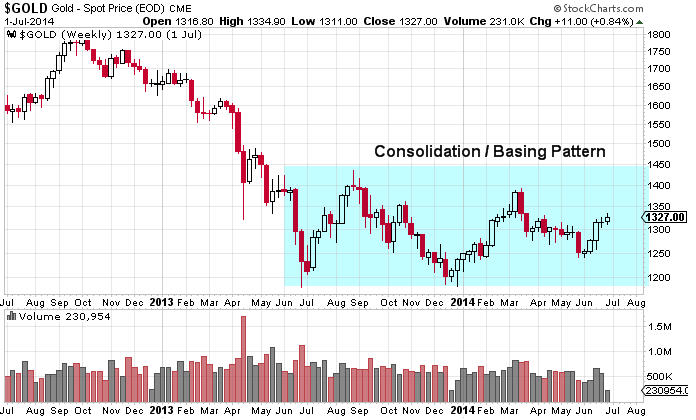
Gold prices have been in a giant basing or consolidation pattern for more than one year. As can clearly be seen below, gold futures prices have traded in a range between roughly 1,175 and 1,430 since June of 2013.


Chart1


The past few weeks we have heard more about gold prices as we have seen a five week rally since late May. I would also draw your attention to the fact that gold futures also made a slightly higher low which is typically a bullish signal.


At this point in time, it appears quite likely that a possible test of the upper end of the channel is possible in the next few weeks / months. If price can push above 1,430 on the spot gold futures price a breakout could transpire that could see $150 or more added to the spot gold price.


Clearly there are a variety of ways that a trader could consider higher prices in gold futures. However, a basic option strategy can pay handsome rewards that will profit from a continued consolidation. The trade strategy is profitable as long as price stays within a range for a specified period of time. Ultimately this type of trade strategy involves the use of options and capitalizes on the passage of time.


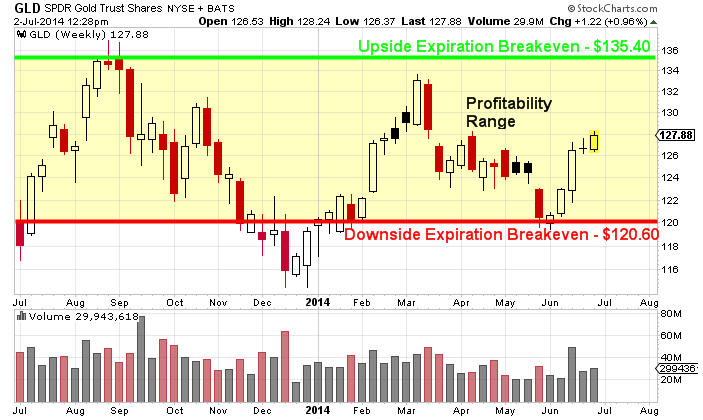
The strategy is called an Iron Condor Strategy, however in order to make this trade worth while we would consider widening out the strikes to increase our profitability while simultaneously increasing our overall risk per spread. Consider the chart of GLD below which has highlighted the price range that would be profitable to the August monthly option expiration on August 15th.


Chart2


As long as price stays in the range shown above, the GLD August Iron Condor Spread would be profitable. Clearly this strategy involves patience and the expectation that gold prices will continue to consolidate. This trade has the profit potential of $37 per spread, or a total potential return based on maximum possible risk of 13.62%. The probability based on today's implied volatility in GLD options for this spread to be profitable at expiration (August 15) is roughly 80%.


Our new option service specializes in identifying these types of consolidation setups and helps investors capitalize on consolidating chart patterns, volatility collapse, and profiting from the passage of time. And if you Advanced options trades are not your thing, we also provide Simple options where we buy either a call or put option based on the SP500 and VIX. The nice thing about buying calls and puts is that you can trade with an account as little as $2,500.


If You Want Daily Options Trades, Join the Technical Traders Options Alerts

See you in the markets!

Chris Vermeulen

Sign up for our next free trading webinar "Low VIX and What It Means to Your Trading"


Wednesday, June 25, 2014

The Only PGM Stock You Should Buy

By Jeff Clark, Senior Precious Metals Analyst

It’s quite the dilemma.

One of the major reasons my colleagues and I are so bullish on platinum group metals (PGM)—palladium, in particular—is because of the intractable problems with supply. But most of the producers are backed into corners, with few options for improving their outlook. There’s simply no way for these metals to avoid a long-term production deficit due to the deep seated problems with the companies that produce them.

So, how to invest?

Since we’re talking about profiting from a metals bull market, we could just buy bullion—and we have indeed recommended doing so to our readers. But to really maximize your leverage to the upside (and avoid more risky futures and options), a stock in a company that produces the metal is normally the way to go. Unfortunately, as above, the pickings are slim.

For us to invest in a PGM producer, the company would have to be:
  • Outside of South Africa and Russia. The problems with miners in both countries are numerous and difficult.
  • Making money. Many producers are not profitable at current prices because production costs are so high. And they won’t come down just because the strikes ended—they’ll go up, due to higher wages.
  • Have a strong growth profile. We want a company that can capitalize on burgeoning demand, which would add further leverage to our investment.
  • Have strong management (of course!). The last thing we want is a team with no experience navigating a volatile market such as this.
Does such a stock exist?

It’s a tall order, but the answer is yes. The company we recommend in this area meets all the criteria above—and is the safest speculation in this space. We consider it so safe, in fact, that we just “graduated” it from the International Speculator to BIG GOLD.

How’s This for Leverage?


This profitable mid-tier producer is perfectly positioned: it’s not so small that we’re purely speculating on some uncertain game changing event, and yet it’s small enough to generate much larger share price gains than would be possible for one of the major mining companies. On the other hand, it’s big enough to catch the attention of mainstream investors.

Here are seven reasons why we’re excited about this company and the leverage we think we’ll get by owning shares…...

#1: Large, High-Grade Assets

The company has two distinct but closely related mine sites. These alone will support the company’s growth for many years. However, only nine miles of an estimated 28 miles of known mineralization has been developed between them—essentially one third of one giant mineralized structure. Management thinks it has an additional 102 million tonnes of undeveloped resources waiting to be dug up.

And get this: the average grade of their proven and probable reserves is 0.45 ounces per tonne, the world’s highest grade PGM deposit. Of these, 78% is palladium, a very attractive figure since we’re even more bullish on it than platinum. At the right metals prices, this company could double or triple production and still maintain a very long mine life.

#2: Growing Production and Low Costs

The company grew 2013 production by 10,000 ounces, but has yet to use all its milling capacity. It currently uses about 3,600 tonnes per day (tpd) of its 6,000 tpd total capacity. The company is working to increase ore production this year, which is good timing for us.

With a much cleaner balance sheet and a forecast of $800-$850 per ounce for all-in sustaining costs (AISC) in 2014, the company looks poised to make money in the current price environment—and a lot of money in the supply squeeze we anticipate.

#3: Recycling Business

In addition to mining, this company recycles depleted catalyst materials to recover palladium, platinum, and rhodium at its smelter and base metal refinery. It’s been doing this since 1997, and business is booming. Pre-tax earnings last year rose a whopping 233% over 2012. And management says it will expand this end of their business over the next few years.

#4: Strong Financial Performance

This company reported over a billion dollars of revenue last year, up nearly 30% from 2012. It finished the year with a very strong working capital position of almost a half billion dollars.

#5: Unique North American Operations

The company is one of only a few PGM producers in North America. Nearly all other PGM mines operate in South Africa (Impala, Amplats, Lonmin, etc.) or Russia (Norilsk). Therefore, this company is more stable than most that mine in other jurisdictions.

#6: Upgraded Management

A prior management team made a poor investment in Argentina a few years back, which led to major changes in the board of directors and top management last year. The new president and CEO is a 21-year industry veteran and has experience in both M&A and mine optimization. He’s already corrected past mistakes, and we’re happy with the direction he’s taken the company. The technical people on the ground seem competent and are getting admirable results.

And finally…...

#7: We’ve Been There!

Our Chief Metals Investment Strategist Louis James, who conducted a due diligence trip to the company’s operations last year, says:

I liked the story when I visited and considered it to be the company to buy in a safe mining jurisdiction. But I didn’t want to bet on the team in place at the time. Flash forward and now it’s under new management, which is very focused on cutting costs and expanding the core business. The company’s results for 2013 were quite impressive, and I expect them to get better going forward. I’m convinced this company is uniquely positioned to benefit from potential supply shortages. Coupled with a likely rise in demand from the global auto industry in the years ahead, this stock is a very attractive play.

Here’s a picture from his visit.

Pay dirt: this is what the company’s palladium-platinum mineralization looks like before blasting. You can see the closely spaced holes that will be blasted a fraction of a second before the surrounding ones—in successive waves—so the ore is blasted inward. This high-grade resource in a safe and stable jurisdiction is the heart of our speculation.


The Only Stock to Buy, in a Market Backed into a Corner


Johnson Matthey, the world’s leading authority on PGMs, estimates the platinum market will register a deficit of at least 1.2 million ounces this year. This would be the largest shortfall since it first compiled data in 1975.

While it will take an enormous amount of time and expense to recover from the strikes in South Africa, that’s only the first layer of problems for the industry:
  • According to consultancy GFMS, 300,000 ounces of platinum and 165,000 ounces of palladium could be lost after the strikes end, as it will take time and money to ramp up to full capacity—if that’s even possible since some mines have been damaged. The Implats CEO said it will take his company at least three months to return to full production, and they’ve already put the development of three new replacement shafts in the Rustenburg area on hold. Anglo American announced just last week that it plans to sell its platinum operations.
  • Holdings of physically backed palladium ETFs continue to hit record highs. In less than two months, a half million ounces were added to ETFs. Fund holdings will likely continue to climb and push the palladium market further into deficit.
  • The Russian government has been reportedly buying palladium from local producers, since it appears its stockpiles are near exhaustion. Exports ticked higher last month, but that was likely in anticipation of potential sanctions.
  • Some recyclers announced they are holding back on sales, as they believe prices will move higher.
  • Platinum demand in India is expected to grow 35% this year.
  • Reports have surfaced that tout replacements to platinum and/or palladium. However, these are mostly research projects and are at least two to three years away from commercial viability (some will never make it).
  • Auto sales in the US, China, and Europe, the three biggest regions by consumption, were up 12% through May over 2013.
  • Existing stockpiles of these metals have dwindled. Based on prior estimates from Citigroup, only nine weeks of palladium and 22 weeks of platinum supplies remain—and half of those are in Russia. Standard Bank projects that stockpiled material from South African producers will run out in a month or less.
The key point is that platinum and palladium supply is in a structural deficit. Prices will pull back now that the strikes have ended—and that is your opportunity. The bull market in these metals is really just getting underway.

And we have the primo pick in the space. The shares of this stock would have to climb 50% just to match its 2011 highs—and that’s without the platinum/palladium supply crunch we’re speculating on. As you’ve surmised by now, I can’t give away the name of this stock in fairness to paid subscribers. But you can get it by giving BIG GOLD a risk free try. You’ll receive our full analysis and specific buy guidance, along with an exclusive discount on a popular gold coin in the June issue. And, if you want the absolute safest way to invest in PGMs, check out the options recommended in the May issue.

If you’re not 100% satisfied with the newsletter, simply cancel during the 3-month trial period for a full refund—no questions asked. Whatever you do, though, don’t miss out on the best stock pick in the PGM bull market. Click Here to learn more about BIG GOLD or Click Here to go straight to the order form.

The article The Only PGM Stock You Should Buy was originally published at Casey Research


Check out our "Beginner's Guide to Trading Options"....Just Click Here!


Wednesday, May 21, 2014

The Birth of a New Bull Market

By Jeff Clark, Senior Precious Metals Analyst


If I asked you why you think I’m bullish on platinum and palladium, you’d probably point to the strikes in South Africa, the world’s largest producer of platinum. Or maybe the geopolitical conflicts with Russia, the largest supplier of palladium. Maybe you’d even mention that some technical analysts say the palladium price has “broken out” of its trading range.

These are all valid points—but they’re reasons why a trader might be bullish. When the strikes end, or Russia ends its aggression, or short-term price momentum eases, they’ll sell.
And that will be a mistake.

Because underneath the headlines lies an irreparable situation with the PGM (Platinum Group Metals) market, one that will last at least several years and probably more like a decade. This market is teetering on the edge of a supply crunch, one more perilous than many investors realize. As the issues outlined below play out, prices will be forced higher—which signals that we should diversify into the “other” precious metals now.
The basic problem is that platinum and palladium supply is in a structural deficit. It won’t be resolved when the strikes end or Russia simmers down. Here are six reasons why…...

#1. Producers Won’t Meet the Cost of Production

The central issue of the striking workers in South Africa is wages. In spite of company executives offering to double wages over the next five years, workers remain on the picket line.

Regardless of the final pay package, wages will clearly be higher. And worker pay is one of the biggest costs of production. And the two largest South African producers (Anglo American and Impala), which supply 69% of the world’s platinum, are already operating at a loss.


Once the strike settles, costs will rise further. Throw in ongoing problems with electric power supply, high regulations, and past labor agreements, and there is virtually no chance costs will come down. This dilemma means that platinum prices would need to move higher for production to be maintained anywhere near “normal” levels. Morgan Stanley predicts it will take at least four years for that to occur. And if the price of the metal doesn’t rise? Companies will have no choice but to curtail production, making the supply crunch worse.

#2. Inventories Are Near the Bottom of the Barrel 


One reason platinum price moves have been muted during the work stoppage is because there have been adequate stockpiles. But those are getting low. Impala, the world’s second-largest platinum producer, said the company is now supplying customers from its inventories. In March, Switzerland’s platinum imports from strike-hit South Africa plummeted to their lowest level in five and a half years, according to the Swiss customs bureau.

Since producers can’t currently meet demand, some customers are now obtaining metal from other sources, including buying it in the open market. As inventories decline, supply from producing companies will need to make up the shortfall—and they’ll have little ability to do that.

#3. The Strikes Will Make Recovery Difficult and Prolonged

Companies are already strategizing how to deal with the fallout from the worst work stoppage since the end of apartheid in 1994…
  • Amplats said it might sell its struggling Rustenburg operations. Even if it finds a buyer, the new operator will inherit the same problems.
  • Impala said that even if the strike ends soon, its operations will remain closed until at least the second half of the year.
  • Some companies have announced they may shut down individual shafts. This causes a future problem because some of these mines are a couple of miles deep and would require a lot of money to bring back online—which they may balk at doing with costs already so high.
  • It’s not being advertised, but a worker settlement will almost certainly result in layoffs since some form of restructuring will be required. This could trigger renewed strikes and set in motion a vicious cycle that further degrades production and makes labor issues insurmountable.

#4. Russian Palladium Is Already in a Supply Crunch

When it comes to palladium, Russia matters more than South Africa, since it provides 42% of global supply. Remember: palladium demand is expected to rise more than platinum, due to new auto emissions control regulations in Asia.

But Russia’s mines are also in trouble…
  • Ore grades at Russia’s major mines, including the Norilsk mines, are reported to be in decline.
  • New mines will take as long as 10 years to come online. It could take a decade for Russian production to rebound—if Russia even has the resources to do it. This stands in stark contrast to global demand for palladium, which has grown 35.8% since 2004.
  • Russia’s aboveground stockpile of palladium appears to have dwindled to near extinction. The precise amount of the country’s reserves is a state secret, but analysts estimate stockpiles were 27-30 million ounces in 1990.
Take a look at reserve sales today:


Many analysts believe that since palladium reserve sales have shrunk, Russia has sold almost all its inventory. As unofficial confirmation, the government announced last week that it is now purchasing palladium from local producers. This paints a sobering picture for the world’s largest supplier of palladium—and is very bullish for the metal’s price.

#5. Demand for Auto Catalysts Cannot Be Met

The greatest use of PGMs is in auto catalysts, which help reduce pollution. Platinum has long been the primary metal used for this purpose and has no widely used substitute—except palladium.

But that market is already upside down.


Palladium is cheaper than platinum, but replacing platinum with palladium requires some retooling and, on a large scale, would worsen the supply deficit. As for platinum (which does work better than palladium in higher-temperature diesel engines), auto parts manufacturers are expected to use more of it than is mined this year, for the third straight year. Some investors may shy away from PGMs because they believe demand will decline if the economy enters a recession. That could happen, but tighter emissions controls and increasing car sales in Asia could negate the effects of declining sales in weakening Western economies.

For example, China is now the world’s top auto-producing country. According to IHS Global, auto sales in China are projected to grow 5% annually over the next three years. PricewaterhouseCoopers forecasts that sales of automobiles and light trucks in China will double by 2019. That will take a lot of catalytic converters. This trend largely applies to other Asian countries as well. It’s important to think globally when considering demand.

The key, however, is that supply is likely to fall much further than demand.

#6. Investment Demand Has Erupted

Investment demand for platinum rose 9.1% last year. The increase comes largely from the new South African ETF, NewPlat. At the end of April, all platinum ETFs held nearly 89,000 ounces—a huge amount when you consider it was zero as recently as 2007.

Palladium investment fell 84% last year—but demand is up sharply year-to-date due to the launch of two South African palladium ETFs, pushing global palladium holdings to record levels. And like platinum, there was no investment demand for palladium seven years ago.

Growing investment demand adds to the deficit of these metals.

The Birth of a 10 Year Bull Market


Add it all up and the message is clear: by any reasonable measure, the supply problems for the PGM market cannot be fixed in the foreseeable future. We have a rare opportunity to invest in metals that are at the beginning of a potential 10-year bull run. Platinum and palladium prices may drop when the strikes end, but if so, that will be a buying opportunity. This market is so tenuous, however, that an announcement of employees returning to work may be too little, too late. We thus wouldn’t wait to start building a position in PGMs.

GFMS, a reputable independent precious metals consultancy, predicts the palladium price will hit $930 by year-end and that platinum will go as high as $1,700. But that will just be the beginning; the forces outlined above could easily push prices to double over the next few years.

At that point, stranded supplies might start coming back online—but not until after major, sustained price increases make it possible.

The RIGHT Way to Invest

In my newsletter, BIG GOLD, we cover the best ways to invest in the metals themselves (funds and bullion), but for the added leverage of investing in a profitable platinum/palladium producer, I have to hand the baton over to Louis James, editor of Casey International Speculator.

You see, most PGM stocks are not worth holding, so you have to be very diligent in making the right picks. Remember, the dire problems of the PGM miners are one reason we’re so bullish on these metals. However, Louis has found one company in a very strong position to benefit from rising prices—and its assets are not located in either South Africa or Russia.

It’s the only platinum mining stock we recommend, and you can get its name, our full analysis, and our specific buy guidance with a risk free trial subscription to Casey International Speculator today.
If you give it a try today, you’ll get three investments for the price of one: Your Casey International Speculator subscription comes with a free subscription to BIG GOLD, where you’ll find two additional ideas on how to invest in the PGMs.

If you’re not 100% satisfied with our newsletters, simply cancel during the 3 month trial period for a full refund—but whatever you do, make sure you don’t miss out on the next 10 year bull market.  

Click here to get started right now.


The article The Birth of a New Bull Market was originally published at Casey Research


Sign up for one of our Free Trading Webinars....Just Click Here!