Showing posts with label copper. Show all posts

Monday, August 24, 2015

Playing the Chinese Trump Card

By John Mauldin

“I know the Chinese. I’ve made a lot of money with the Chinese. I understand the Chinese mind.” – Donald Trump, 2011

Back in the olden days (pre-2000 or so), information junkies like me relied on printed newspapers, paper magazines, TV newscasts, and snail mail newsletters. All these channels still exist, but they can’t begin to compete with the constant stream of data rushing into our tablets and smartphones. And on some days the stream rushes faster.

Last week, for instance, it seemed I couldn’t go five minutes without another story on either (a) China or (b) Donald Trump. For a day or so, I really wondered if someone had planted malware in my browser to make me think all other topics were inconsequential. It was all Trump and China, all day and all night. China has pushed the Fed into second place (for a few days at least) – perhaps we should be grateful that at least something has. Of course, there is the little problem that a bear market might be in the offing. Commodity prices seem to be in the toilet. Global currency markets are throwing up. Isn’t the world supposed to be on vacation in August?

Let’s see if we can find a connecting thought or three among all these topics. Plus, I want to show you how the current market meltdown is being brought to you courtesy of your friendly US Federal Reserve Bank. As our starting point, though, let’s cast an eye at The Donald and Chinese currency manipulation.

“Nobody Does Anything”

As we all know by now, on Aug. 11 the People’s Bank of China changed the way it manages the renminbi daily trading band against the US dollar. The result was a two day drop for the RMB and a lot of consternation on trading floors around the world.

Taking questions at an event in Michigan that day, Donald Trump had this to say:
I think you have to do something to rein in China. They devalued their currency today. They’re making it absolutely impossible for the United States to compete, and nobody does anything. China has no respect for President Obama whatsoever, whatsoever.

Well, you have to take strong action. How can we compete? They continuously cut their currency. They devalue their currency. And I have been saying this for years. They have been doing this for years. This isn’t just starting. This was the largest devaluation they have had in two decades. They make it impossible for our businesses, our companies to compete.
                       
They think we’re run by a bunch of idiots. And what’s going on with China is unbelievable, the largest devaluation in two decades. It’s honestly – great question – it’s a disgrace.” Before you dismiss this as nonsense, remember that it comes from a Wharton School graduate.

Still not impressed? You’re right; it is indeed nonsense. Trump and all those who prattle on about Chinese currency manipulation have the economic comprehension of a parakeet. Is Trump really so clueless?

In one sense, it doesn’t matter. Trump isn’t talking to most of us. He draws an audience of frustrated, mostly middle-class Americans who are still hurting from the Great Recession. They want to blame someone. China is an easy target. So are illegal immigrants and Mexico and other faceless culprits. Furthermore, his audience has legitimate concerns. They are fully aware that both political parties ignore them.

A recent Gallup poll shows that 75% of our country believes there is significant corruption in government. They’re tired of it. They want to try something different. It is telling that a recent Michigan poll of Republican party activists found that 55% would go with either untested non politicians or Ted Cruz, who is about as much of an outsider as you can find inside the Washington DC Beltway.

I find almost nothing attractive about Donald Trump, but significant numbers in both parties have clearly demonstrated that they are looking for real change. Shades of Greece and Syriza’s coming to power, or France and the startling surge by Marine Le Pen’s Front National. The US is beginning to experience what our European friends have been living through the past few years.

Back to Trump and currency manipulation. I could do a sentence-by-sentence analysis of his populist harangue on China, but let’s take the really egregious statement: How can we compete? They continuously cut their currency. They devalue their currency. And I have been saying this for years. They have been doing this for years. This isn’t just starting. This was the largest devaluation they have had in two decades. They make it impossible for our businesses, our companies to compete.

No, they haven’t. This whole myth that China has purposely kept their currency undervalued needs to be completely excised from the economic discussion. First off, the two largest currency manipulating central banks currently at work in the world are (in order) the Bank of Japan and the European Central Bank. And two to four years ago the hands down leading manipulator would have been the Federal Reserve of the United States. The leaders/aggressors in the currency wars come and go.

Today, the euro is off over 30% from its highs, as is the Japanese yen. Numerous other currencies are likewise well into double digit slides. China has moved maybe 3 to 4%. Oh, wow.

Secondly, Donald (and to be fair I should address this to Senators Schumer and Graham, et al., too) the Chinese have not been continuously cutting their currency for years. In fact, if they have manipulated their currency, it was first to make it even stronger when the dollar was falling and then to hold those gains in the face of the steadily rising dollar. Meanwhile the rest of the world (Japan, Europe, Great Britain, Brazil, India, among others) was letting their currencies drift down.

The simple fact is that the Chinese currency rose by 20% over the last five years up until a week ago, for reasons we will examine a little later. It is utterly wrong headed to call a 20% rise over almost 10 years “continuous devaluation.” Yes, prior to that time they did allow their currency to devalue rather precipitously, but if you look back and think about it, they were faced with something of a crisis at the time. Most currencies do fall during periods of economic stress.

Don’t get me wrong. The United States and China have a several page list of issues that need to be worked out between them. If you read my recent book on China, you learned about more than a few of those problems. But given that the Federal Reserve has been the most egregious currency manipulator in the world over the last five years, hearing the pot calling the kettle black probably sticks in the craw of most non US citizens. I understand it makes for a great populist harangue. It’s always easiest to blame our problems on someone else. But it doesn’t get us anywhere we want to go.

Back to the main story. Let’s look at this fascinating chart from my friend Chris Whalen over at the Kroll Bond Rating Agency:


Chris writes:

With the end of QE in sight in 2014, the dollar began to climb against most major currencies with the exception of the yuan, which remained effectively pegged against the dollar because of intervention by the PBOC. The yuan has, in fact, appreciated steadily against the dollar since 2006 and continued to move higher within the managed foreign exchange regime maintained by the Chinese government. 

Until last week, the PBOC had been using its foreign exchange reserves to cope with the increased demand for dollars from domestic investors. The decision to end the defense of the currency has economic as well as financial ramifications. For example, investors are starting to wonder just how much foreign currency debt China has accumulated to fund infrastructure investment as well as foreign ventures, and whether this total is reflected in official debt statistics.

Oil and copper are priced in dollars. From the point of view of China, and much of the rest of the world, oil is up several times in the last 15 years, and copper is up 2 to 3 times, even after the recent selloffs. From an inflation-adjusted standpoint, the rest of the world just sees things as getting back to normal. A strong dollar can do that.

Chinese Déjà Vu

Trump’s China complaints are nothing new. I wrote an entire issue on this topic five years ago (and Jonathan Tepper and I dealt with it at length in both Endgame and Code Red.) At that time, economist Paul Krugman and a group of senators led by New York Democrat Chuck Schumer wanted to impose a 25% tariff on Chinese imports. This is from my March 20, 2010, issue: I probably shouldn't take on a Nobel Laureate who got his prize for his work on trade, but this truly scares me. People pay attention to this nonsense, including the five senators, led by Schumer of New York, who want to start the process of targeting China.

First, the Chinese have got to be wondering what they have to do to make these guys happy. In 2005 they were demanding a 30% revaluation of the Chinese yuan. And over the next three years the yuan actually rose by 22% at a gradual and sustained pace. Then the credit crisis hit, and China again pegged their currency [even as the dollar got weaker!]. From their standpoint, what else were they to do? Force their country into a recession to appease our politicians?

They responded by a massive forcing of loans to their businesses and governments and huge infrastructure projects. Kind of like our stimulus, except they got a lot more infrastructure to show for their money. It remains to be seen how wise that policy was, and how large the bad (non performing) loans will be that came from that push – just as there are those (your humble analyst included) who do not think the way we went about the stimulus plan in the US was the wisest allocation of capital.

But the reality is that the Chinese will do what is in their best interest. I wrote in 2005 that the yuan would rise slowly over time. The political posturing of Schumer, et al., was counterproductive then, and it still is now.

My prediction? The Chinese will begin to allow the yuan to rise again sometime this year, just as they did three years ago, because it will be to their advantage. A stronger yuan will act as a buffer to inflation, which they may face due to the massive stimulus they created. They are going to need some help in that area. But it will be 5–7% a year, so as not to create a shock to their export economy. Not 25% at one time. And at some point they will allow the yuan to float against the dollar. They know they will have to in order to get the currency status they want.

Back then, it was Schumer and Krugman who wanted to “rein in” China. Now we have Trump saying more or less the same things. Look at what happened in the intervening five years, in this chart from Krugman’s home-base New York Times.


And sure enough, right on schedule and as I predicted in 2010, the RMB began to slowly rise and rose through early 2014. This was about the same time that “China stopped acting Chinese,” as I wrote earlier this month. At about that time, China Beige Book detected a noticeable shift in Chinese business behavior, when companies stopped using the government’s stimulus to add new capacity.

Our hypothesis, you may recall, is that the Chinese monetary stimulus began going into stocks instead of capital improvement projects. That inflow led to the stock bubble that has popped over the last few weeks. Which resulted in an apparent panic in the halls of Chinese government.

Code Red at the PBOC

Sorting through the approximately 47,000 China reports people sent me in the last 10 days, I see two broad categories of analysis. To continue reading this article from Thoughts from the Frontline – a free weekly publication by John Mauldin, renowned financial expert, best-selling author, and Chairman of Mauldin Economics – please click here.


Get out latest FREE eBooK "Understanding Options"....Just Click Here


Tuesday, August 18, 2015

A Great Insight into Why Commodity Weakness Will Persist

By John Mauldin 

In today’s Outside the Box, good friend Gary Shilling gives us deeper insight into the global economic trends that have led to China’s headline making, market shaking devaluation of the renminbi. He reminds us that today’s currency moves and lagging growth are the (perhaps inevitable) outcome of China massive expansion of output for many products that started more than a decade ago. China was at the epicenter of a commodity bubble that got underway in 2002, soon after China joined the World Trade Organization.

As manufacturing shifted from North America and Europe to China –with China now consuming more than 40% of annual global output of copper, tin, lead, zinc and other nonferrous metal while stockpiling increased quantities of iron ore, petroleum and other commodities – many thought a permanent commodity boom was here.

Think again, Australia; not so fast, Brazil. Copper prices, for instance, have been cut nearly in half as world growth, and Chinese internal demand, have weakened. Coal is another commodity that is taking a huge hit: China’s imports of coking coal used in steel production are down almost 50% from a year ago, and of course coal is being hammered here in the US, too.

And the litany continues. Grain prices, sugar prices, and – the biggee – oil prices have all cratered in a world where the spectre of deflation has persistently loomed in the lingering shadow of the Great Recession. (They just released grain estimates for the US, and apparently we’re going to be inundated with corn and soybeans. The yield figures are almost staggeringly higher than the highest previous estimates. Very bearish for grain prices.)

Also, most major commodities are priced in dollars; and now, as the US dollar soars and the Fed prepares to turn off the spigot, says Gary, “raw materials are more expensive and therefore less desirable to overseas users as well as foreign investors.” As investors flee commodities in favor of the US dollar and treasuries, there is bound to be a profound shakeout among commodity producers and their markets.

See the conclusion of the article for a special offer to OTB readers for Gary Shilling’s INSIGHT. Gary’s letter really does provide exceptional value to his readers and clients. It’s packed with well-reasoned, outside-the-consensus analysis. He has consistently been one of the best investors and analysts out there.

There are times when you look at your travel schedule and realize that you just didn’t plan quite as well as you could have. On Monday morning I was in the Maine outback with my youngest son, Trey, and scheduled to return to Dallas and then leave the next morning to Vancouver and Whistler to spend a few days with Louis Gave. But I realized as Trey and I got on the plane that I no longer needed to hold his hand to escort him back from Maine. He’s a grown man now. I could’ve flown almost directly to Vancouver and cut out a lot of middlemen. By the time that became apparent, it was too late and too expensive to adjust.

Camp Kotok, as it has come to be called, was quite special this year. The fishing sucked, but the camaraderie was exceptional. I got to spend two hours one evening with former Philadelphia Fed president Charlie Plosser, as he went into full-on professor mode on one topic after another. I am in the midst of thinking about how my next book needs to be written and researched, and Charlie was interested in the topic, which is how the world will change in the next 20 years, what it means, and how to invest in it. Like a grad student proposing a thesis, I was forced by Charlie to apply outline and structure to what had been only rough thinking.

There may have been a dozen conversations like that one over the three days, some on the boat – momentarily interrupted by fish on the line – and some over dinner and well into the night. It is times like that when I realize my life is truly blessed. I get to talk with so many truly fascinating and brilliant people. And today I find myself with Louis Gave, one of the finest economic and investment thinkers in the world (as well as a first class gentleman and friend), whose research is sought after by institutions and traders everywhere. In addition to talking about family and other important stuff, we do drift into macroeconomic talk. Neither of us were surprised by the Chinese currency move and expect that this is the first of many
.
I did a few interviews while I was in Maine. Here is a short one from the Street.com. They wanted to talk about what I see happening in Europe. And below is a picture from the deck of Leen’s Lodge at sunset. Today I find myself in the splendor of the mountains of British Columbia. It’s been a good week and I hope you have a great one as well.


Oops, I’ve just been talked into going zip-trekking this afternoon with Louis and friends. Apparently they hang you on a rope and swing you over forests and canyons. Sounds interesting. Looks like we’ll do their latest and greatest, the Sasquatch. 2 km over a valley. Good gods.

Your keenly aware of what a blessing his life is analyst,
John Mauldin, Editor

Stay Ahead of the Latest Tech News and Investing Trends...

Each day, you get the three tech news stories with the biggest potential impact.

Commodity Weakness Persists

(Excerpted from the August 2015 edition of A. Gary Shilling’s INSIGHT)
The sluggish economic growth here and abroad has spawned three significant developments – falling commodity prices, looming deflation and near-universal currency devaluations against the dollar. With slowing to negative economic growth throughout the world, it’s no surprise that commodity prices have been falling since early 2011 (Chart 1). While demand growth for most commodities is muted, supply jumps as a result of a huge expansion of output for many products a decade ago. China was the focus of the commodity bubble that started in early 2002, soon after China joined the World Trade Organization at the end of 2001.


China, The Manufacturer


As manufacturing shifted from North America and Europe to China – with China now consuming more than 40% of annual global output of copper, tin, lead, zinc and other nonferrous metal while stockpiling increased quantities of iron ore, petroleum and other commodities – many thought a permanent commodity boom was here.

So much so that many commodity producers hyped their investments a decade ago to expand capacity that, in the case of minerals, often take five to 10 years to reach fruition. In classic commodity boom-bust fashion, these capacity expansions came on stream just as demand atrophied due to slowing growth in export-dependent China, driven by slow growth in developed country importers. Still, some miners maintain production because shutdowns and restarts are expensive, and debts incurred to expand still need to be serviced. Also, some mineral producers are increasing output since they believe their low costs will squeeze competitors out. Good luck, guys!

Copper, Our Favorite


Copper is our favorite industrial commodity because it's used in almost every manufactured product and because there are no cartels on the supply or demand side to offset basic economic forces. Also, copper is predominantly produced in developing economies that need the foreign exchange generated by copper exports to service their foreign debts. So the lower the price of copper, the more they must produce and export to get the same number of dollars to service their foreign debts. And the more they export, the more the downward pressure on copper prices, which forces them to produce and export even more in a self reinforcing downward spiral in copper prices. Copper prices have dropped 48% since their February 2011 peak, and recently hit a six year low as heavy inventories confront subdued demand (Chart 2).


Even in 2013, after two solid years of commodity price declines, major producers were in denial. That year, Glencore purchased Xtrata and Glencore CEO Ivan Glasenberg called it “a big play” on coal. “To really screw this up, the coal price has got to really tank,” he said at the time. Since then, it’s down 41%. But back in February 2012 when the merger was announced, coal was selling at around $100 per ton and Chinese coal demand was still robust.

Nevertheless, Chinese coal consumption fell in 2014 for the first time in 14 years and U.S. demand is down as power plants shift from coal to natural gas. Meanwhile, coal output is jumping in countries such as Australia, Colombia and Russia. China’s imports of coking coal used in steel production are down almost 50% from a year ago. Many coal miners lock in sales at fixed prices, but at current prices, over half of global coal is being mined at a loss. U.S. coal producers are also being hammered by environmentalists and natural gas producers who advocate renewable energy and natural gas vs. coal.

Losing Confidence?


Recently, major miners appear to be losing their confidence, or at least they seem to be facing reality. Anglo-American recently announced $4 billion in writedowns, largely on its Minas-Rio $8.8 billion iron ore project in Brazil, but also due to weakness in metallurgical coal prices. BHP took heavy writedowns on badly timed investments in U.S. shale gas assets. Rio Tinto’s $38 billion acquisition of aluminum producer Alcan right at the market top in 2007 has become the poster boy for problems with big writeoffs due to weak aluminum prices and cost overruns.

Glencore intends to spin off its 24% stake in Lonmin, the world’s third largest platinum producer. Iron ore-focused Vale is considering a separate entity in its base metals division to “unlock value.” Meanwhile, BHP is setting up a separate company, South 32, to house losing businesses including coal mines and aluminum refiners. That will halve its assets and number of continents in which it operates, leaving it oriented to iron ore, copper and oil.

Goldman Sachs coal mines suffered from falling prices and labor problems in Colombia. It is selling all its coal mines at a loss and has also unloaded power plants as well as aluminum warehouses. The firm’s commodity business revenues dropped from $3.4 billion in 2009 to $1.5 billion in 2013. JP Morgan Chase last year sold its physical commodity assets, including warehouses. Morgan Stanley has sold its oil shipping and pipeline businesses and wants to unload its oil trading and storage operations.

Jefferies, the investment bank piece of Leucadia National Corp., is selling its Bache commodities and financial derivatives business that it bought from Prudential Financial in 2011 for $430 million. But the buyer, Societe Generale, is only taking Bache’s top 300 clients by revenue while leaving thousands of small accounts, and paying only a nominal sum. Bache had operating losses for its four years under Jefferies ownership.

Grains and other agricultural products recently have gone through similar but shorter cycles than basic industrial commodities. Bad weather three years ago pushed up grain prices, which spawned supply increases as farmers increased plantings. Then followed, as the night the day, good weather, excess supply and price collapses. Pork and beef production and prices have similar but longer cycles due to the longer breeding cycles of animals.

Sugar prices have also nosedived in recent years (Chart 3). Cane sugar can be grown in a wide number of tropical and subtropical locations and supply can be expanded quickly. Like other Latin American countries, Brazil – the world's largest sugar producer – enjoyed the inflow of money generated from the Fed’s quantitative easing. But that ended last year and in combination with falling commodity prices, those countries’ currencies are plummeting (Chart 4). So Brazilian producers are pushing exports to make up for lower dollar revenues as prices fall, even though they receive more reals, the Brazilian currency that has fallen 33% vs. the buck in the last year since sugar is globally priced in dollars.


Oil Prices


Crude oil prices started to decline last summer, but most observers weren’t aware that petroleum and other commodity prices were falling until oil collapsed late in the year. With slow global economic growth and increasing conservation measures, energy demand growth has been weak. At the same time, output is climbing, especially due to U.S. hydraulic fracking and horizontal drilling. So the price of West Texas Intermediate crude was already down 31% from its peak, to $74 per barrel by late November.

Cartels are set up to keep prices above equilibrium. That encourages cheating as cartel members exceed their quotas and outsiders hype output. So the role of the cartel leader – in this case, the Saudis – is to accommodate the cheaters by cutting its own output to keep prices from falling. But the Saudis have seen their past cutbacks result in market share losses as other OPEC and non-OPEC producers increased their output. In the last decade, OPEC oil production has been essentially flat, with all the global growth going to non-OPEC producers, especially American frackers (Chart 5). As a result, OPEC now accounts for about a third of global production, down from 50% in 1979.


So the Saudis, backed by other Persian Gulf oil producers with sizable financial resources – Kuwait, Qatar and the United Arab Emirates – embarked on a game of chicken with the cheaters. On Nov. 27 of last year, while Americans were enjoying their Thanksgiving turkeys, OPEC announced that it would not cut output, and they have actually increased it since then. Oil prices went off the cliff and have dropped sharply before the rebound that appears to be temporary. On June 5, OPEC essentially reconfirmed its decision to let its members pump all the oil they like.

The Saudis figured they can stand low prices for longer than their financially-weaker competitors who will have to cut production first. That list includes non-friends of the Saudis such as Iran and Iraq, which they believe is controlled by Iran, as well as Russia, which opposes the Saudis in Syria. Low prices will also aid their friends, including Egypt and Pakistan, who can cut expensive domestic energy subsidies.

The Saudis and their Persian Gulf allies as well as Iraq also don’t plan to cut output if the West's agreement with Iran over its nuclear program lifts the embargo on Iranian oil. As much as another million barrels per day could then enter the market on top of the current excess supply of two million barrels a day.

The Chicken-Out Price


What is the price at which major producers chicken out and slash output? It isn’t the price needed to balance oil-producer budgets, which run from $47 per barrel in Kuwait to $215 per barrel in Libya (Chart 6). Furthermore, the chicken out price isn’t the “full cycle” or average cost of production, which for 80% of new U.S. shale oil production is around $69 per barrel.


Fracker EOG Resources believes that at $40 per barrel, it can still make a 10% profit in North Dakota as well as South and West Texas. Conoco Phillips estimates full cycle fracking costs at $40 per barrel. Long run costs in the Middle East are about $10 per barrel or less (Chart 7).


In a price war, the chicken out point is the marginal cost of production – the additional costs after the wells are drilled and the pipelines laid – it’s the price at which the cash flow for an additional barrel falls to zero. Wood Mackenzie’s survey of 2,222 oil fields globally found that at $40 per barrel, only 1.6% had negative cash flow. Saudi oil minister Ali al-Naimi said even $20 per barrel is “irrelevant.”

We understand the marginal cost for efficient U.S. shale oil producers is about $10 to $20 per barrel in the Permian Basin in Texas and about the same on average for oil produced in the Persian Gulf. Furthermore, financially troubled countries like Russia that desperately need the revenue from oil exports to service foreign debts and fund imports may well produce and export oil at prices below marginal costs – the same as we explained earlier for copper producers. And, as with copper, the lower the price, the more physical oil they need to produce and export to earn the same number of dollars.

Falling Costs


Elsewhere, oil output will no doubt rise in the next several years, adding to downward pressure on prices. U.S. crude oil output is estimated to rise over the next year from the current 9.6 million level. Sure, the drilling rig count fell until recently, but it’s the inefficient rigs – not the new horizontal rigs that are the backbone of fracking – that are being sidelined. Furthermore, the efficiency of drilling continues to leap. Texas Eagle Ford Shale now yields 719 barrels a day per well compared to 215 barrels daily in 2011. Also, Iraq’s recent deal with the Kurds means that 550,000 more barrels per day are entering the market. OPEC sees non-OPEC output rising by 3.4 million barrels a day by 2020.

Even if we’re wrong in predicting further big drops in oil prices, the upside potential is small. With all the leaping efficiency in fracking, the full-cycle cost of new wells continues to drop. Costs have already dropped 30% and are expected to fall another 20% in the next five years. Some new wells are being drilled but hydraulic fracturing is curtailed due to current prices. In effect, oil is being stored underground that can be recovered quickly later on if prices rise Closely regulated banks worry about sour energy loans, but private equity firms and other shadow banks are pouring money into energy development in hopes of higher prices later. Private equity outfits are likely to invest a record $21 billion in oil and gas start ups this year.

Earlier this year, many investors figured that the drop in oil prices to about $45 per barrel for West Texas Intermediate was the end of the selloff so they piled into new equity offerings (Chart 8), especially as oil prices rebounded to around $60. But with the subsequent price decline, the $15.87 billion investors paid for 47 follow-on offerings by U.S. and Canadian exploration and production companies this year were worth $1.41 billion less as of mid-July.


Dollar Effects


Commodity prices are dropping not only because of excess global supply but also because most major commodities are priced in dollars. So as the greenback leaps, raw materials are more expensive and therefore less desirable to overseas users as well as foreign investors. Investors worldwide rushed into commodities a decade ago as prices rose and many thought the Fed’s outpouring of QE and other money insured soaring inflation and leaping commodity prices as the classic hedge against it.

Many pension funds and other institutional investors came to view them as an investment class with prices destined to rise forever. In contrast, we continually said that commodities aren’t an investment class but a speculation, even though we continue to use them in the aggressive portfolios we manage.

We’ve written repeatedly that anyone who thinks that owning commodities is a great investment in the long run should study Chart 9, which traces the CRB broad commodity index in real terms since 1774. Notice that since the mid-1800s, it’s been steadily declining with temporary spikes caused by the Civil War, World Wars I and II and the 1970s oil crises that were soon retraced. The decline in the late 1800s is noteworthy in the face of huge commodity-consuming development then: In the U.S., the Industrial Revolution and railroad building were in full flower while forced industrialization was paramount in Japan.


At present, however, investors are fleeing commodities in favor of the dollar, Treasury bonds and other more profitable investments. Gold is among the shunned investments, and hedge funds are on balance negative on the yellow metal for the first time, according to records going back to 2006. Meanwhile, individual investors have yanked $3 billion out of precious metals funds.

Commodity Price Outlook

Commodity prices are under pressure from a number of forces that seem likely to persist for some time.

1. Sluggish global demand due to continuing slow economic growth.
2. Huge supplies of minerals and other commodities due to robust investment a decade ago.
3. Chicken games being played by major producers in the hope that pushing prices down with increasing supply will force weaker producers to scale back. This is true of the Saudis in oil and hard rock miners in iron ore.
4. Developing country commodity exporters’ needs for foreign exchange to service foreign debt. So the lower the prices, the more physical commodities they export to achieve the same dollars in revenue. This further depresses prices, leading to increased exports, etc. Copper is a prime example.
5. Increased production to offset the effects on revenues from lower prices, which further depresses prices, etc. This is the case with Brazilian sugar producers.
6. The robust dollar, which pushes up prices in foreign currency terms for the many commodities priced in dollar terms. That reduces demand, further depressing prices.

It’s obviously next to impossible to quantify the effects of all these negative effects on commodity prices. The aggregate CRB index is already down 57% from its July 2008 pinnacle and 45% since the more recent decline commenced in April 2011. To reach the February 1998 low of the last two decades, it would need to drop 43% from the late July level, but there’s nothing sacred about that 1998 number.

In any event, ongoing declines in global commodity prices will probably renew the deflation evidence and fears that were prevalent throughout the world early this year. And they might prove sufficient to deter the Fed from its plans to raise interest rates before the end of the year.

Like Outside the Box? Sign up here today and get each new issue delivered free to your inbox.
It's your opportunity to get the news John Mauldin thinks matters most to your finances.

The article Outside the Box: Commodity Weakness Persists was originally published at mauldineconomics.com.


Get our latest FREE eBook "Understanding Options"....Just Click Here!

Sunday, August 2, 2015

Distressed Investing

By Jared Dillian 

When most people think of distressed investing, they think of buying CCC-rated bonds at 20 or 30 cents on the dollar, then maybe sitting in bankruptcy court to divvy up the capital structure, making healthy risk-adjusted returns in the end. You just need to hire a few lawyers.

Distressed investors are a different breed of cat. It’s one of those countercyclical businesses, like repo men, who do well when everyone else is getting hammered.

I remember distressed guys killing it in 2002. Most people remember the dot-com bust, but there was a nasty credit crunch that went along with it. Nasty. High yield/distressed investments had some amazing years in 2003 and 2004. Convertible bonds in particular.

Funny thing about distressed investors is that they like to stay within their comfort zone. In my experience, they’re not keen on commodities. Like coal mining, which this week saw one bankruptcy filing and another one in the works. Distressed guys hate commodities because they are just timing the earnings cycle – which is the same as market timing.  Distressed guys want less volatile earnings so their projections aren’t totally dependent on commodity prices rising.

Coal is distressed, all right. But you don’t see the distressed guys getting involved. Even they are too scared!


Here’s a somewhat controversial statement: I think most commodities are distressed. Coal is definitely distressed. So is iron ore. Copper, too. And yes, even gold. Corn and beans have had a nice little run, but metals and energy in particular have been a complete horrorshow.

So I think it’s time to start looking at commodities as a distressed asset class. The assumption is that fair value of these commodities/producers is well above current market prices, and current market prices are wrong because of, well, a lot of things. In particular, a self-reinforcing process where selling begets more selling.

If you’re a distressed investor and you’re buying something at a deep discount, if you have a long enough time horizon, you’ll be vindicated eventually. Sometimes, it takes a long time. Sometimes, not very long at all. It’s pretty great when it works.

I have never had much aptitude for it. But I am trying it now.

Gold: A Special Case


Gold is a little different.

How do you value gold? It has no cash flows. An industrial commodity like copper is pretty easy to value. With gold, you’re trying to gauge investment demand (at the retail or sovereign level), which is hard, against mining production, which is a little easier.

But what an ounce of gold is worth is entirely subjective. More subjective than copper or cocoa or coffee. For example, if everyone started using bitcoin, there would be little to no demand for gold. (For the record, I think cryptocurrencies indeed have had an impact on gold demand.)

Basically, people want gold when they think their government no longer cares about the purchasing power of their currency. In our case, that was when the Fed was conducting quantitative easing, known colloquially as printing money.

But that’s not really what people were nervous about. Think about it. The Fed was printing money for monetary policy reasons. They were trying to effect monetary policy with interest rates at the zero bound. That’s different from printing money to buy government bonds because nobody else wants to. That’s called debt monetization.

When budget deficits get sufficiently large, people worry about things like failed bond auctions, that the Fed will have to step in and be the buyer of last resort. This is the nightmare scenario described in Greenspan’s Gold and Economic Freedom essay.

We had $1.8 trillion deficits not that long ago. The bond auctions were a little scary. I thought debt monetization was a possibility.

The deficit is lower today, mostly because of higher taxes, more aggressive revenue collection, and economic growth. As you can see, the price of gold has corresponded almost perfectly with the budget deficit.


With a small deficit today, nobody cares about gold.

Is the deficit going higher or lower in the future? Higher. Ding-ding-ding, we have a winner. One of the reasons I’m happy owning gold as a part of my portfolio.

Paper vs. Things


Asset allocation gets a lot easier when you figure out that the financial markets are a tug-of-war between paper and things. Sometimes, like now, financial assets (stocks and bonds) outperform. Stocks are overpriced, and bonds are way overpriced. Other times, like 10 years ago, commodities outperformed.

It has to do with the degree of confidence people have in… other people. A bond is a promise to repay. A stock is a promise to pay dividends, or that there will be something left over at the end. A dollar is a promise that it’s worth something, namely, a divisible part of the sum total of the productive abilities of all the people in the country.

These are pieces of paper. Paper promises. When confidence in promises is high, nobody needs gold, coal, or copper. When confidence in promises is low, time to build that underground bunker in the backyard. Confidence in promises is currently at all-time highs. Without making a positive statement either way, I’d say that only in the year 2000 were commodities more undervalued than they are right now.

Sidebar: it is tempting to treat commodities as an asset class, but you should try not to. They are idiosyncratic, and for most commodities, the cost of carry is high enough that it’s impractical to hold them for long periods of time.

Commodity related equities are a different story.

Disclaimer


I’m kind of biased on this, and I always think commodities are undervalued because I’m a deeply suspicious person and I don’t believe promises. I’ve owned gold and silver for years (plus GLD and SLV, and GDX and SIL), and if prices get low enough, I will add to those positions.

Keep in mind that I worked for the government under the Clinton administration. Clinton’s mantra to government employees was, “Do more with less.” The man did a lot to restrain the growth of government—and he was a Democrat!


People resented him for it. They wanted their fancy toys and their boondoggles. Public servants have been much happier under Bush and Obama. Not coincidentally, gold bottomed in 2000, at the end of Clinton’s presidency, and has basically been going up since.

So here is the secret sauce: You want to know when commodities are going up?
Watch the deficit. If someone dreams up free college for everyone, buy commodities with veins popping out of your neck.
Jared Dillian
Jared Dillian

If you enjoyed Jared's article, you can sign up for The 10th Man, a free weekly letter, at mauldineconomics.com. Follow Jared on Twitter @dailydirtnap


The article The 10th Man: Distressed Investing was originally published at mauldineconomics.com.


Get our latest FREE eBook "Understanding Options"....Just Click Here!


Monday, July 20, 2015

Is it Time to Take Gold and Copper Seriously?

With gold bulls sitting on the sidelines for some time now, and copper bulls basically being an extinct species it's a bit of a surprise to see a trader poke their head out and say....it just might be time. And when that trader is our friend Carley Garner we pay attention. But we aren't the only ones. Mad Moneys Jim Cramer brought Carley into the studio this week. Check out Carleys Mad Money appearance and her call on gold and copper. You better be paying attention.


Carley Garner is a technician and co-founder of DeCarley Trading and author of "A Trader's First Book on Commodities." Click here to get it on Amazon.com


Get our latest FREE eBook "Understanding Options"....Just Click Here!

Sunday, June 14, 2015

Time to Move Capital into Next Bull Market – Part I

Our trading partner Chris Vermeulen just shared with us his take on what most traders are missing when it comes to market rotation. It's a great reminder of what so many of us did so wrong not to long ago. Let's play this different this time.

If you remember the dot com bubble as clearly as I do and are a technical analyst then you will recall the month which the NASDAQ broke down and confirmed a new bear market has started. The date was November of 2000.

You may be wondering why I bring this up. What do tech stocks have to do with commodities?

Good question because they have nothing in common. But the key here is that when a bull market ends in one asset class that money is shifted into another. That money moved into commodities and resource stocks and in a big way. Precious metals and miners exploded, surging an average of 1000% return (10 times ROI) over the next six years, topping out in 2008. In fact, these resource stocks bottom the exact month which the NASDAQ confirmed it was in a bear market on Nov 2000.

Compare Dot-Com Bubble & Burst to Precious Metals Stocks 

Over the next couple of weeks, I will be sharing some of my top stock picks in the metals sector (gold, silver, nickel, and copper). If you missed the 2001 and 2008 metals bull market then you best pay attention and be sure you don’t miss what is about to happen.

Read Chris' entire post and chart work here > Time to Move Capital into Next Bull Market – Part I


Get our latest FREE eBook "Understanding Options"....Just Click Here!

Tuesday, February 26, 2013

Gold, Copper, and Crude Oil Forecasted the Recent Selloff in the S&P 500

Nobody better in the industry at understanding herd mentality then the staff at The Technical Traders. And of course they have been telling us it would be like this.....you just have to know which herd to watch and when.....

For the past several weeks, everywhere I looked all I could find was bullish articles. After the fiscal cliff was patched at the last second, prices surged into the 2013 and have since climbed higher all the way into late February.

I warned members of my service that this runaway move to the upside which was characterized by a slow grinding move higher on excessively low volume and low volatility would eventually end violently. I do not have a crystal ball, this is just based on my experience as a trader over the years.

Unfortunately when markets run higher for a long period of time and just keep grinding shorts what typically follows is a violent selloff. I warned members that when the selloff showed up, it was likely that weeks of positive returns would be destroyed in a matter of days.

The price action in the S&P 500 Index since February 20th has erased most of the gains that were created in the entire month of February already and lower prices are possible, if not likely. However, there are opportunities to learn from this recent price action.

There were several warning signs over the past few weeks that were indicating that a risk-off type of environment was around the corner. As a trader, I am constantly monitoring the price action in a variety of futures contracts in equities, currencies, metals, energy, and agriculture to name a few.

Besides looking for trading opportunities, it is important to monitor the price action in commodities even if you only trade equities. In many cases, commodity volatility will occur immediately prior to equity volatility. Ultimately the recent rally was no different.

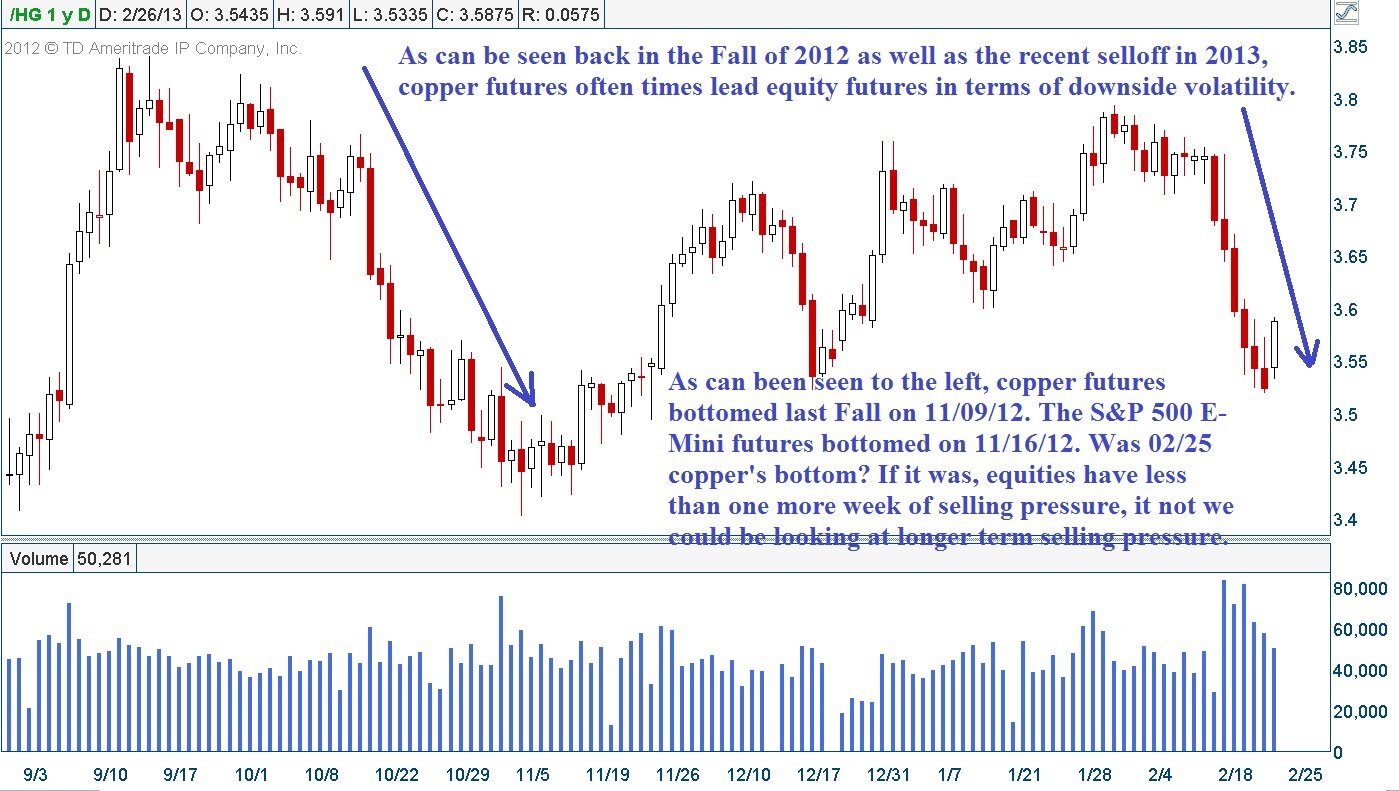
As an example, metals were showing major weakness overall with both gold and silver selling off violently. However, what caught my eye even further was the dramatic selloff in copper futures which is shown below.

Copper Futures Daily Chart

Chart1

As can be seen above, copper futures had rallied along with equities since the lows back in November. However, prices peaked in copper at the beginning of February and a move lower from 3.7845 on 02/04 down to recent lows around 3.5195 on 02/25 resulted in roughly a 7% decline in copper prices over a 3 week period.

As stated above, commodity volatility often precedes equity volatility. As can be seen above, copper futures appear to be reversing during the action today and many times commodities will bottom ahead of equities.

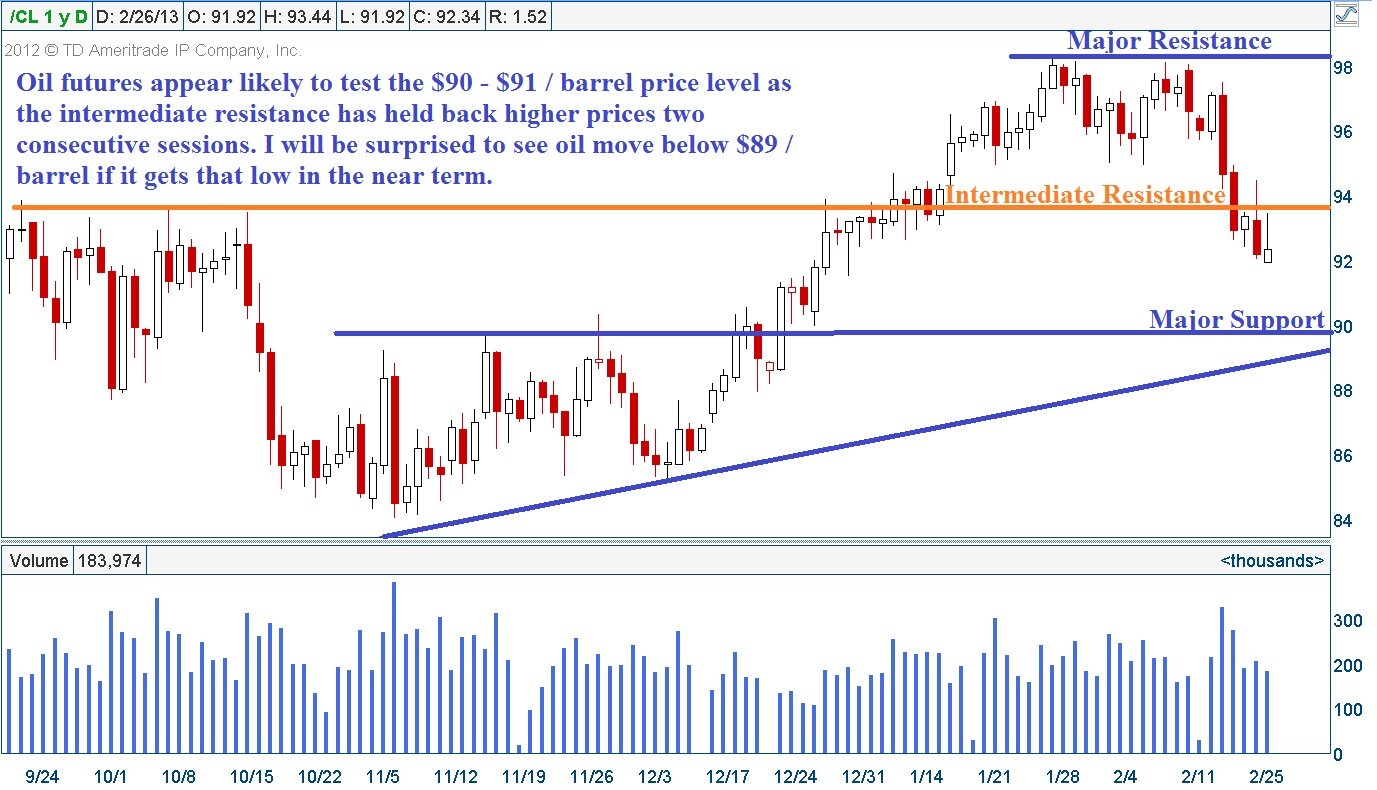
I want to be clear in stating that equities will not necessarily mirror the action in commodities or copper specifically, but some major volatility was seen in several commodity contracts besides just metals. Oil futures were also coming under selling pressure as well.

Crude Oil Futures Daily Chart

Chart2

As can be seen above, oil futures topped right at the end of January and then sold off briefly only to selloff sharply lower a few weeks later. Oil futures gave back roughly 6% – 7% as well which is quite similar to copper’s recent correction. I have simply highlighted some key support / resistance levels on the oil futures chart for future reference and for possible price targets.

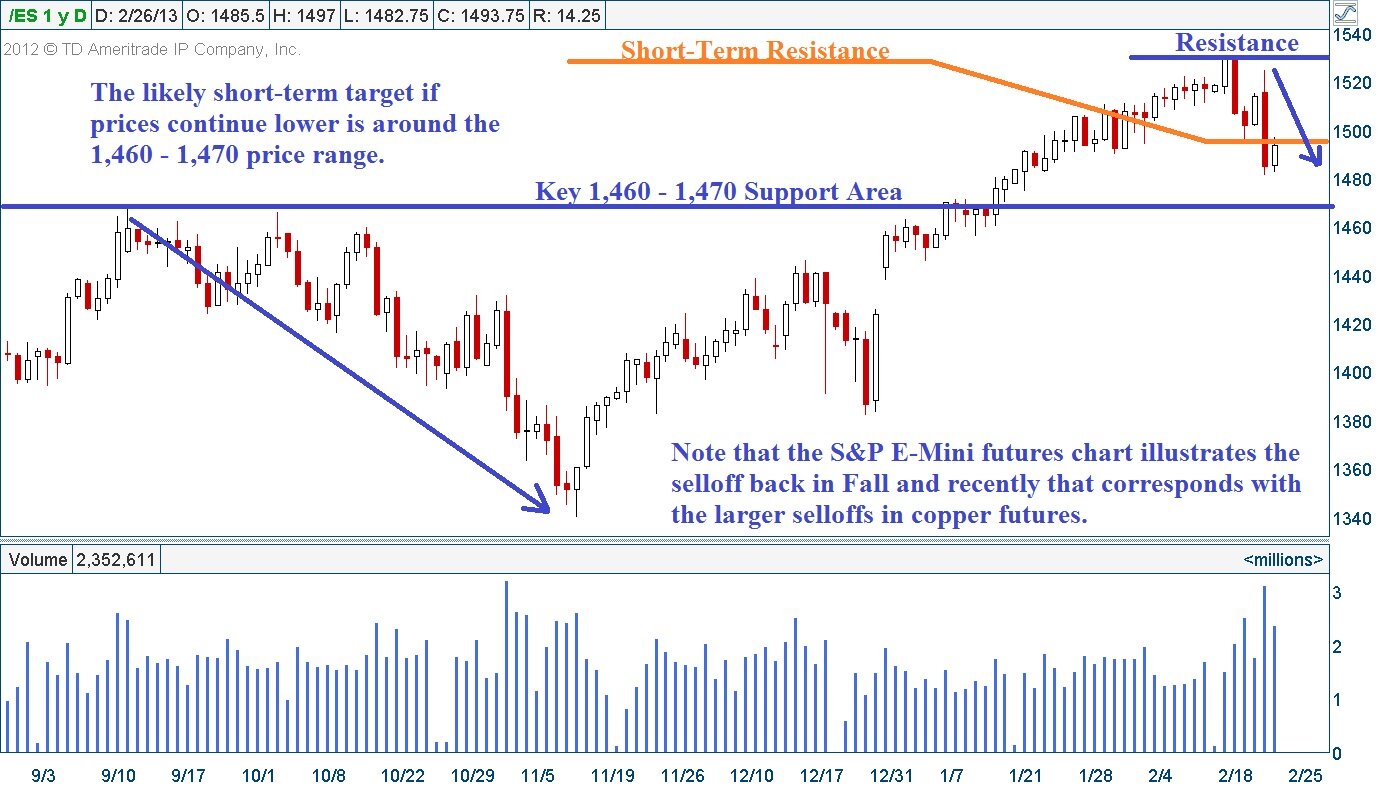
In equity terms, since February 20th the S&P 500 futures have sold off from a high of around 1,529 to Monday’s low of 1481.75. Thus far we are seeing a move lower of about 3.10% since 02/20 in the S&P 500 E-Mini futures contract. While I am not calling for perfect correlation with commodities, I do believe that a 5% correction here not only makes sense, but actually would be healthy for equities.

S&P 500 E-Mini Futures Daily Chart

Chart3

If we assume the S&P 500 E-Mini contracts were to lose 5% from their recent highs, the price that would correspond with that type of move would be around 1,453.

As shown above, while 1,453 does represent a consolidation zone in the S&P 500 which occurred in the beginning of January of 2013, there is a major support level that corresponds with the 1,460 – 1,470 price range.

I am expecting to see the S&P 500 test the 1,460 – 1,470 price range in the futures contract, however the outcome at that support level will be important for future price action. If that level holds, I think we likely reverse and move higher and we could even take out recent highs potentially. In contrast, if we see a major breakdown below 1,460 I believe things could get interesting quickly for the bears.

I am watching the price action today closely as I am interested in what kind of retracement we will get based on yesterday’s large bullish engulfing candlestick on the daily chart of the S&P 500 futures.

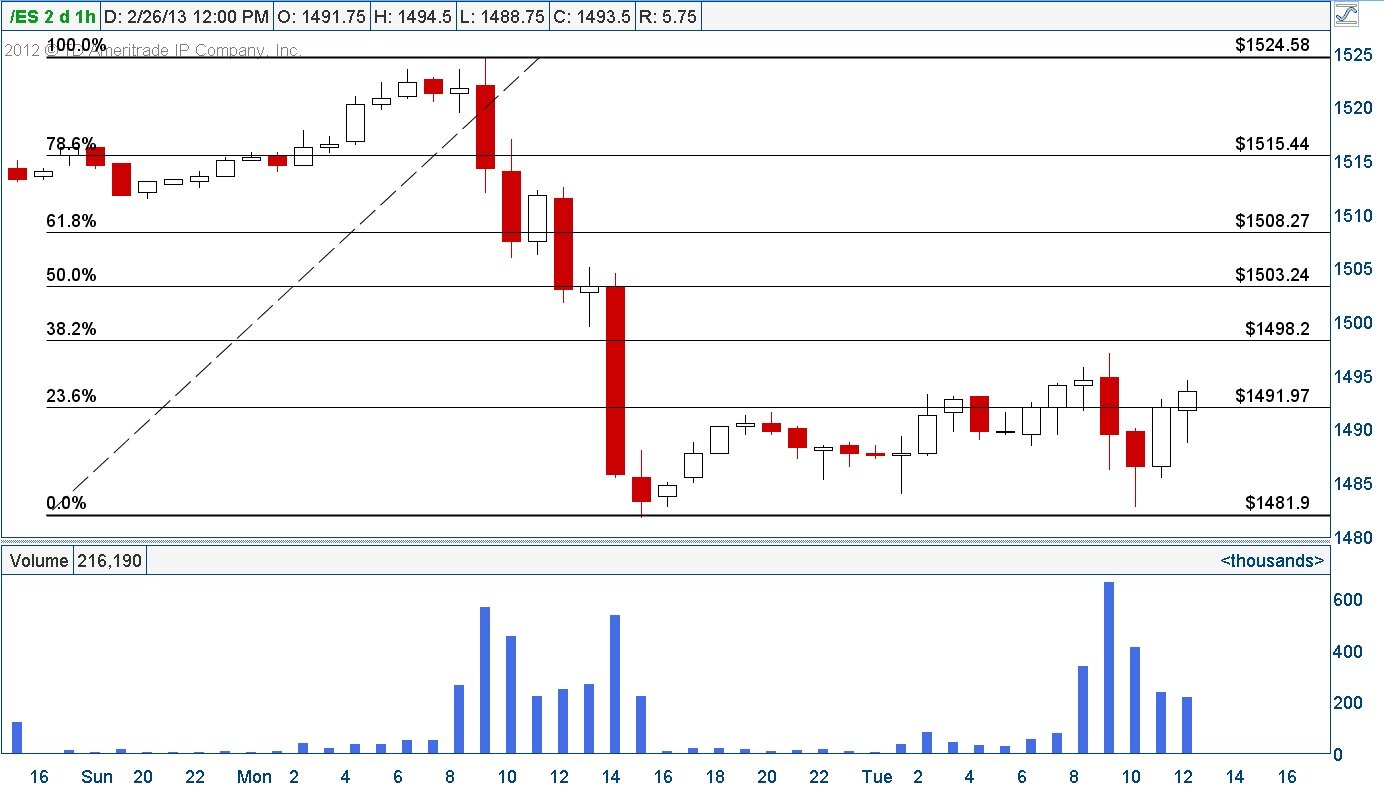
Ultimately if the retracement remains below the .500 Fibonacci Retracement area into the bell we could see some stronger selling pressure setting in later this week. The Fibonacci retracement of the 02/25 candlestick can be seen below.

S&P 500 E-Mini Futures Hourly Chart

Chart4

So far today we have not been able to crack the 0.382 Fibonacci retracement area. This is generally considered a relatively weak retracement and can precede a strong reversal which in this case would be to the downside in coming days.

It is always possible to see strength on Wednesday and a move up to the .500 retracement level. As long as price stays under the .500 Fibonacci retracement level, I think the bears will remain in control in the short-term. However, should we see the highs from 02/25 taken out in the near term the bulls will be in complete control again.

Right now I think it is early to be getting long unless a trader is looking to scale in on the way down. I think the more logical price level to watch carefully is down around 1,460 – 1,470 on the S&P 500. If that level is tested, the resulting price action will be critical in shaping the intermediate and long-term price action in the broad equity indexes.

If you have to trade, keep position sizes small and define your risk. Risk is elevated at this time.

If you would like to get our detailed trading videos each week and know what is just around the corner test out here:

Risk FREE 30 Day Trial only $1 for the first 30 days!

Chris Vermeulen & JW Jones
The "Traders Video Playbook"


Get our Free Trading Videos, Lessons and eBook today!

Thursday, August 2, 2012

Silver Suffers The Most From Bernanke And What Is Next

Test drive our video analysis and trade idea service for only $1.00

While the exchange traded funds for gold and copper fell today due to investors expressing disappoint at the modest response of the Federal Reserve to declining economic growth, it was silver that was off the most.

SPDR Gold Shares (GLD) fell in trading today by 0.89%. IPath Dow Jones Copper (JJC) dropped 1.89%.  Plunging the deepest was iShares Silver Trust (SLV), off by 2.14%.

Traders were hoping for more aggressive action by Federal Reserve Chairman Ben Bernanke. But that will not come until after the November elections in the United States. Remember that Quantitative Easing 2 did not begin until November 2010, though it was announced at the Jackson Hole economic policy summit in August of 2010.

Silver is in what would seem to be the “sweet spot” between gold and copper.  Almost all of gold is used for investment or decorative purposes.  Almost all of The Red Metal goes for industrial needs.   For silver, it comes almost down right in the middle between commercial and a commodity for investments or jewelry.  The charts below show the trading relationship for each of the exchange traded funds when paired against each other.

JJC Copper ETF Trading


Even though silver has a much higher industrial usage, the SLV moves along with the GLD.   As a result, it soared during Quantitative Easing 2.  Obviously, the charts reveal that most of the trading is from speculators as the JJC should move in an inverse relationship with the GLD.  That is due to gold being used almost entirely for non-industrial end uses while copper is used almost industrial for industrial uses.

Up slightly for the week as traders thought more dramatic economic stimulus efforts would result from the Federal Open Market Committee meeting  other than an extension until the end of the year for Operation Twist, the SLV is down for the last month, quarter, six months and 52 weeks of market action.  Year to date, the SLV is off by 1.48%.

For the last year, however, the SLV is down 33.35%.  Volume was up today, with the SLV below its 20 day, 50 day and 200 day moving averages.  In the most obvious trend, it is trading much lower under its 200 day day moving average at 11.67% down than underneath the 20 day moving average, beneath it by only 0.17%.  The only move worth noting in the technical indicators for silver were the long engulfing green bodies last week after Treasury Secretary Geithner’s  gloomy testimony on The Hill and more bad economic news from the US peaked buying as traders thought Quantitative Easing 3 was coming.

SLV ETF Trading


If traders long on silver are looking for help from Bernanke, it will not be coming until after the November election, though it could be announced when he speaks later this month at Jackson Hole.

Chris Vermeulen


Just click here to sign up for Chris' Newsletter and free market videos

Get our Free Trading Videos, Lessons and eBook today!

Saturday, July 21, 2012

Put Your Seatbelts On, It’s About To Get Bumpy!

It was just about a year ago today when the S&P was sitting at fresh highs and everyone was enjoying a rather upbeat summer. It was a nice summer, the markets were calm, and there was a surreal sense of optimism. Then, in the matter of a few days, things got real ugly, real quickly.

Well, it doesn’t seem like too much has changed since then. We’ve had mixed earnings reports, ever evolving worries in Europe, and the always looming fiscal mess in the U.S. Once again, are we in the calm before the storm?

It looks like things in Europe may start to heat up again. Riots turned violent again in Spain as protestors took to the street over austerity measures. With seemingly no resolution, a sinking tourism industry in the PIGS, and a typically hot summer August on its way, all signs point to further turmoil.

Technically, we’re currently seeing a number of bearish indicators setting up in the S&P and other markets. First, on the weekly chart of the SP500 Futures we can see what appears to be a bear flag formation developing. Note the recent rise in price since the beginning of June on decreasing volume.


Weekly SP500 Futures Chart Patterns


Daily Chart Elliott Wave Count For SP500

A second look at the S&P daily illustrates a down trend and 5 wave count bounce in the market, both are currently pointing to lower prices.

>> Completion of two intermediate cycles within longer term 5 wave pattern

>> Downwards wave one from April until beginning of June followed by wave 2 correction from June until present.

The wave two correction typically proceeds the longest wave, wave three, which is pointing towards a large move down (Note that in the first shorter term cycle the downwards wave three was the longest by far. We expect the same to be repeated in the longer term cycle.)


SP500 BIG PICTURE Wave Count

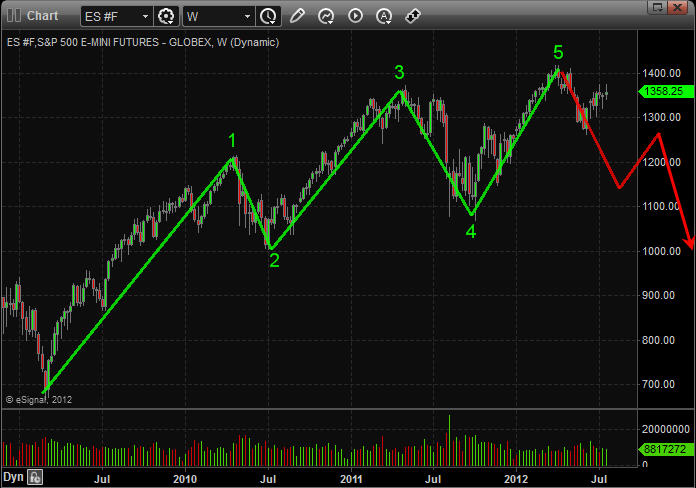
A look at the longer term view once again using the weekly chart, again supports our argument for a major correction. We have just completed a 5 wave pattern since the 2009 lows, and it is looking more like a big pull back is due. Remember most major trends end after the fifth wave.


Copper Weekly Chart Patterns

If we take a look at the copper ETF, “JJC”, we are provided with further justification. Copper is often referred to as “Dr.Copper” due to its industrial application and is known to be a leading indicator for equity markets. Copper has significantly underperformed equity markets and is likely leading the next move down. A look at the weekly chart which points to a rather dismal outlook. There is a major head and shoulder patterns developing.


Major Market Pattern Analysis Conclusion:

Last summer turned into a bloodbath with nothing but red candlesticks taking stocks and commodities sharply lower. If you haven’t already, it’s time to lock in some profits. Short, intermediate, and long term cycles are pointing down, and the increasingly bearish technical developments cannot be ignored. We’ll be looking at entering multiple shorts potentially in the very near future once/if setups present themselves.

 Buckle up and stay tune for more....


Stay in the loop by joining my free weekly newsletter
& videos to stay ahead of the crowd. 

Click here to visit The Gold & Oil Guy.com


Get our Free Trading Videos, Lessons and eBook today!

Wednesday, April 4, 2012

Did a “bearish divergence” yesterday signal a top for the equity markets?

Crude Oil pulls back....is this a buying opportunity? We analyze where this energy market is headed.

Gold crashes....no surprise for our readers. We show you where we think this precious metal is headed in today’s video.


Try MarketClub for 30 Days for just $8.95 - Click Here!

Monday, January 24, 2011

The State of the Markets

From guest blogger/analyst David Banister.....

I have been forecasting a Mid January top in the SP 500 (Us Markets) for multiple weeks now well in advance. My work had looked for 1285 as a minimal upside rally from the 1173 4th wave lows. The range was 1285-1315, we have been to 1296 but that pretty much should have capped off the rally. Here are some further thoughts:

Copper, Gold, Silver- All topping and rolling over for now. A few weeks ago I began to go bearish on Gold (And with it of course Silver), and the Elliott Wave patterns became very muddy and unclear. This was a warning signal. Also, the inability of Gold to pierce through the 1425-30 highs for a 3rd attempt indicated a triple top failure which I eluded to in an Email bulletin a few weeks back. The Gold, Copper, Silver topping and rollover movements are warning signals to be more cautious. Gold should work down to 1270-1280 eventually, and Silver to 25-26.50 ranges likely.

Small Cap Index- The TZA ETF I suggested on TMTF recently had a huge 2 day reversal rally on Thursday and Friday of this trading week. TZA Closed just over 16 and I see it moving to 19-20. We are long also in my ATP advisory service for insurance and gains potential. The Russell 2000 is rolling over first, which makes sense because the sentiment and strong economic rebound from the summer lows has peaked out. Small Caps are likely to correct the hardest in this wave pattern down, and so we shorted them instead of shorting the large caps or SP 500. To wit, this week the small caps dropped 3.5% and the SP 500 only 0.8%.

IBD 100 - The Investors Business Daily top 100 fell 5.4% this week collectively. A quick scan of the charts on those 100 reveals a lot of topping and weakness patterns to me. These would be considered leader small cap and mid cap growth stocks, and suggests further evidence of continuing correction in the markets.

Elliott Wave theory is scoffed at by many investors because they have been led to believe that Robert Prechter is apparently the only person on earth who has a license to use them. I’ll reserve my comments on his abilities, but you can gather that I tend to often disagree with his views and leave it at that. EWT works extremely well in the right hands, and that is why I launched TMTF last year, to share my views and my methods. This has allowed me to confirm summer bottoms at 1040 this year based on the movement from 1120 to 1040 (Which we also forecast). This allowed me to call a top on November 5th at 1225 after going just over my 1220 predictions made weeks in advance. This allowed me to call a bottom 4th wave at 1173-75 and a resulting rally to 1285 in advance. Not to mention April 2010 and January 2010 tops within days. Still think EWT is bunk? Try ignoring those who are biased and trade their biases. I dont trade Gold, Silver, or the SP 500 futures or indexes… that allows me to remain 100% objective and not force wave counts into my personal opinions.

EWT is not perfect, but nor is any forecasting methodology or technical analysis strategy. They all have their flaws. However, I try to blend in a few elements to back up my EW forecasts, so as to eliminate too many mistakes. Sentiment readings for one, and Fibonacci sequences for another.

Bottom line: I continue to be cautious on the markets and believe the SP 500 will drop to 1170-1180 on the LOW END, with 1210-1229 possible as the shallower end of a correction. The Russell 2000 will take the hardest hit, and probably has another 8-9% downside left before a bottom pivot. We remain long TZA to short that index at 3x multiple over at my ATP service. I have not shorted the SP 500 or large Caps on purpose, because I think the best place to short is small caps. I continue to recommend high cash positions for now (Im about 40%) so that you have money to buy into an oversold wave 2 bottom in the markets when it occurs. Gold will continue to correct with a bounce at 1310-1320 areas likely. I see it getting to 1270-1280 though as most likely.

Large Caps are likely to outperform small caps in 2011, as the bulk of the economic trough and rebound have now occurred and been priced in. Gold may struggle for several months but has a shot at hitting $1500-$1515 by years end, but one month at a time. That said, selective stock picking will always have the ability to trounce the index averages, and that is what I do over at Active Trading Partners.com.

Stay tuned!

If you would like to benefit from learning more about my methods, which have been historically accurate, please check us out at Active Trading Partner.com where you can sign up for free occasional reports.

David Bansiter


Share